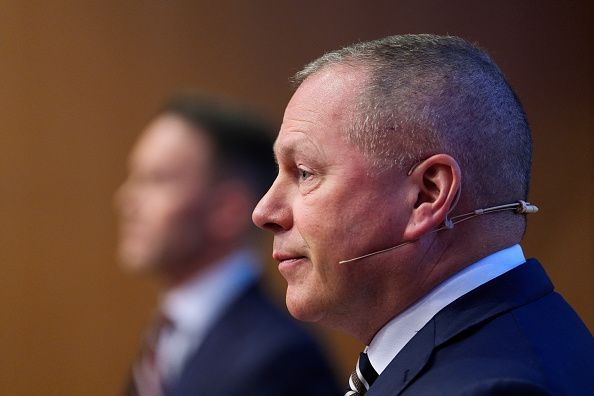
Nicolai Tangen’s Norway Fund Faces Its Tech Concentration
Nicolai Tangen is defending Norway’s investment approach as technology stocks take a growing share of its national savings. In a September submission to the Ministry of Finance, the Norges Bank Investment Management CEO and central bank governor Ida Wolden Bache advised against caps on individual companies or sectors. Their warning about how quickly the vast fund could sell during a crisis helps explain what is at stake.
This past summer, as much of the world rearranged its waking hours around the World Cup, Norway offered an unexpected reason to keep watching. Powered by its towering blond striker, Manchester City’s Erling Haaland, the team reached its first-ever quarterfinal. Those familiar with Haaland’s appetite for goals might have seen it coming; the spectacle supplied by his country’s supporters, however, was harder to anticipate.
In stadiums and city squares around the world, Norwegian fans crouched in rows, reached forward and pulled back in unison, chanting “Ro! Ro! Ro!”—“Row! Row! Row!”
Thousands of people, one imaginary Viking longship, everyone pulling together.
It was a brazen demonstration of the collective resolve that has helped define the Norwegian spirit. But perhaps the most consequential expression of this shared purpose has unfolded far from the football stands, in the patient accumulation of the country’s vast wealth.
Since its sovereign wealth fund—officially named the Government Pension Fund Global (GPFG)—received its first capital injection in 1996, Norway has methodically invested the proceeds of its North Sea offshore oil and gas resources. Managed by Norges Bank Investment Management, or NBIM, the investment-management arm of the country’s central bank, the Norwegian sovereign wealth fund embodies a commitment to future generations that has outlasted governments and weathered multiple global financial crises.
Deposits and investment returns have built GPFG into the world’s largest sovereign wealth fund: a more-than-$2 trillion behemoth larger than the individual sovereign funds of Saudi Arabia, Abu Dhabi, Kuwait or Qatar.
For a country of just 5.6 million people, that is an extraordinary inheritance, but it also ties Norway’s future to forces far beyond its shores.
Too big to diversify
Somewhere along its voyage, Norway acquired a sizable piece of Silicon Valley—leaving its national savings increasingly exposed to technology’s soaring expectations and sudden reversals.
For most institutional investors, trimming winners and taking profits is prudent housekeeping. For Norway, it raises a more unsettling question: What happens when the investor trying to reduce its risk is large enough to become a risk to everyone else? A retreat from American technology stocks could send tremors through markets increasingly dependent on the same handful of companies. Could Norway’s effort to protect its national nest egg help set off the sell-off it hoped to escape?
Wall Street knows what it means to be too big to fail. Is Norway’s sovereign wealth fund too big to diversify?
“The principal constraint would be the mandate: the benchmark and risk limits set by the Ministry of Finance and the Norges Bank Executive Board define how far we can deviate from the market,” NBIM Deputy CEO Trond Grande tells Observer. “We wouldn’t say the fund is too big to diversify.”
Technology investments represented roughly 32 percent of GPFG’s equity portfolio at midyear, up from about 20 percent five years earlier. That puts technology at approximately 23 percent of the entire fund, compared with roughly 14 percent in 2021—albeit these figures cover the sector globally.
Success has helped spur the concentration. Its technology investments returned over 25 percent in the first half, nearly twice its stock portfolio’s overall return.
“We see [the concentration in tech] as a feature of the market, not a position we’ve taken,” Grande observed.
For Otaviano Canuto, a former World Bank vice president and IMF executive director, counting holdings only tells part of the story.
“It is diversified across the market, not away from it, so a tech-and-AI drawdown would hit it hard,” he tells Observer.
Yet Canuto describes Norway as “more of a price-taker than price-maker.” Its gradual trading and relatively small flows compared with turnover in liquid stocks temper its market impact.
Patient reallocation, however, differs from an emergency exit.
In a September submission to the Ministry of Finance, signed by Norway’s central bank governor, Ida Wolden Bache, and NBIM CEO Nicolai Tangen, Norges Bank warned that the fund’s size severely limits rapid selling during a crisis. A hypothetical A.I.-disappointment scenario modeled in 2025 estimated a 35 percent decline in its value—a stress test, not a forecast. Nevertheless, the bank advised against company or sector caps, citing potential lost returns and their limitations in capturing A.I. exposure.
Norway’s true advantage is its capacity to wait. With no short-term liabilities and a horizon spanning generations, it can withstand turbulence that might force others to sell.
The fund’s third-quarter results, released Oct. 22, brought a quieter disappointment: a 0.5 percent loss. Fixed-income investments fell 3.5 percent, while equities gained 0.5 percent. Even a portfolio built for generations can spend three months going backward.
A stronger Norwegian krone also reduced the value of the fund’s foreign assets when expressed in kroner, while new government deposits partly offset the decline. That currency effect is separate from the investment return. The fund’s value at the end of September was 22,014 billion kroner, or approximately 22 trillion kroner.
But even if NBIM decided to pull back its tech exposure, it would then immediately confront another dilemma: Where do you find alternatives large enough to matter to a $2 trillion portfolio?
“At our size, few investments can make a real difference,” Grande acknowledged. A deal can be enormous by ordinary standards and barely register in Oslo.
Case in point: GPFG’s recent 1.2 billion euro commitment to a renewable-energy fund managed by Copenhagen Infrastructure Partners, a specialist in developing large energy projects. That’s a billion-dollar-plus allocation that amounts to less than one-tenth of one percent of Norway’s portfolio.
Such investments, Grande said, are “unlikely to change the fund’s overall risk profile materially.”
Soft power
Whether Norway chooses to acknowledge it or not, three decades of patient investing have also built something no balance sheet fully captures: an extraordinary reservoir of soft power.
“The fund has given Norwegian soft power a financial dimension,” said Kristian Hvilen, a Norwegian who heads the Norway office of Rud Pedersen, a leading European public affairs firm.
“The challenge is not a lack of confidence,” he said. “It is that we are less comfortable describing the combined effect of these strengths as national power.”
Norway brings judgments about corporate behavior to the shareholder register. Its ethical exclusions have kept money out of tobacco producers, certain weapons manufacturers and companies implicated in human rights violations. Being deemed unfit for Norway’s savings can carry a reputational sting alongside the sale of shares.
But influence runs both ways.
“The portfolio may be globally diversified, while returns are still strongly shaped by US technology, regulation, trade policy and geopolitical tensions,” Hvilen tells Observer.
He argues that the fund’s strength rests on remaining a savings vehicle rather than an instrument of national power. Financial purpose, however, does not erase political significance.
For countries such as Guyana, Suriname and Uganda seeking to turn petroleum wealth into a lasting financial inheritance, Norway offers an alluring model. Yet Canuto sees a potential trap: If more sovereign funds invest according to the same market benchmarks, more money will flow into the same dominant companies. The geopolitical irony is hard to miss. Countries building a foundation for financial independence could deepen their dependence on American technology.
Grande emphasizes the discipline behind Norway’s success: a clear mandate, a long investment horizon and institutions that separate politics from daily investment decisions. “We can’t speak for other countries, and each has different needs.”
“Ro! Ro! Ro!” was the chant that echoed through football stands and city squares last summer—a full-throated expression of a national resolve that has been equally formidable, if less conspicuous, in global finance. Three decades of pulling together have given Norwegians a financial presence that much larger nations might envy.
But should Norway choose to row against the current, the world’s markets may discover just how much