
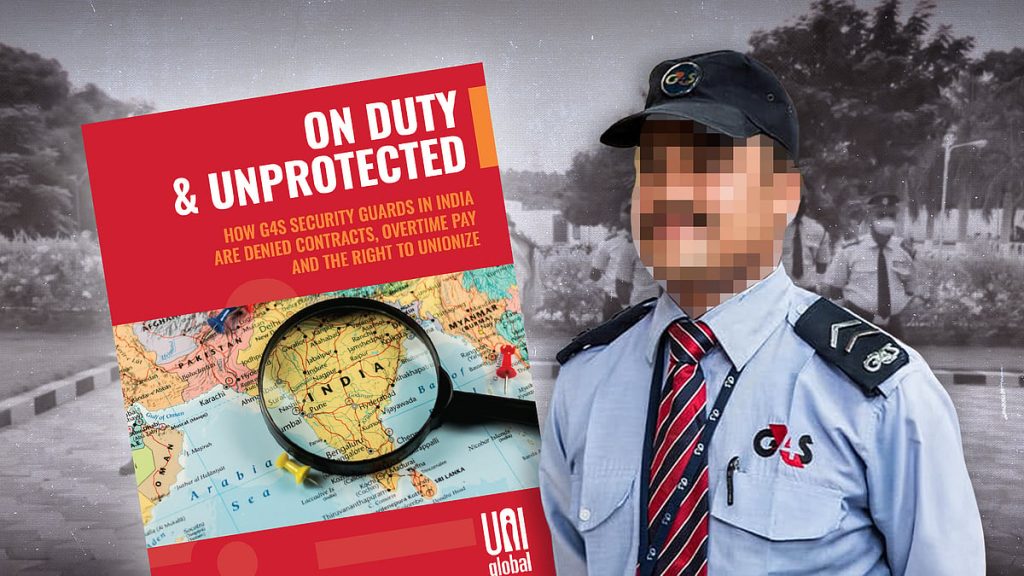
G4S security guards in India face long hours, no contracts, fear of unionising: Survey
UNI Global Union has released a report on the working conditions at G4S, an Allied Universal company, in India. Based on interviews with security guards, the report documents allegations of unpaid overtime, the absence of written contracts and efforts to discourage unionisation among guards deployed at malls, factories, offices and construction sites.
The draws on 104 interviews conducted between April and August 2026 with G4S guards across nine cities in four states — Maharashtra, Bihar, Uttar Pradesh and Gujarat. UNI Global Union is an international federation representing more than 20 million workers across 150 countries in the skills and services sectors, including private security.
According to the report, six issues recurred across every city and worksite type covered by the study.
The six main issues in the report
Excessive overtime without pay: Guards report averaging 12-hour shifts against the eight hours verbally promised at hiring, with no overtime pay for the extra hours. “On paper, the shift is listed as eight hours, but the reality is different. We have to arrive and take charge of our duties before the shift officially begins. We cannot leave immediately after the shift ends either; we must stay until the next guard has fully taken over or the office work is completed. Work at the office often runs late, requiring us to put in an extra half-hour or more. This has become a near-daily occurrence, yet we receive no additional overtime pay for it. Ideally, payment should be based on the actual time worked, but in practice, that is not the case,” said a guard in Varanasi.
No access to written contracts: Guards are routinely denied copies of their contracts and say they do not know what terms they agreed to. “When the job was started, some papers were signed, but no detailed contract was given which clearly stated what the rights of the employee would be, what would be the responsibilities of the company and what would be the procedure to be followed in case of dispute. Most of the things are mentioned orally only,” said a security guard at a worksite in Lucknow
Long hours standing with inadequate rest breaks: Guards stand for up to 12 hours with no seating, and describe having to wait for a colleague to cover basic needs such as drinking water or using the toilet. “In my experience, there were no such special arrangements [for facilities for women]. I was the only female guard on the entire site; all other employees were men. In such an environment, one had to exercise extra caution at all times. There was no separate rest area for women, nor any facility where one could sit for a while if needed. Often, I had to put off even personal needs until my shift ended,” said a guard in Lucknow.
Unprotected exposure to adverse weather and unsafe air: Guards work outdoors through extreme heat, cold and pollution without adequate protective equipment or facilities. It also describes unlawful wage deductions – wages are deducted for leave, including sick leave and bereavement leave, deterring workers from taking time off even in emergencies.
Pervasive fear at work; suppression of unionisation: Workers describe explicit management instructions against unionising, retaliation and surveillance of workers.
“Shortly after I started the job, I witnessed – and heard detailed accounts of – an incident that instilled fear in me. A security guard colleague of ours, Ankit Chadda (name changed), was on duty. He saw a child carrying a steel rod away from the construction site. He simply called out to stop the child. The child started running, fell down, and sustained a minor injury to his hand. Later, the child went home and told his family that the guard had hit him. Soon after, a large group of villagers arrived at the construction site. No one tried to understand the full story, and they severely beat Ankit. He suffered a serious head injury and lost a lot of blood. By the time the police and company officials arrived, it was already too late. Several guards present at the scene reported that the police were not properly listening to the guard’s side of the story in the face of the mob. The villagers stood united, while the security guard was left isolated. The company arranged for his treatment at the ESI hospital, but he was not paid his salary for the days he was unable to report for duty due to the treatment. Later, instead of being retained at the same site, he was transferred to a different one. In my opinion, if an employee is attacked while on duty, the company should stand by them, provide legal assistance, pay full wages for medical leave, and boost their morale. When this doesn’t happen, it instils fear,” said a security guard.
The report said the field team observed that some locations employ migrants on purpose. This is because migrant workers have less dense social networks on a local scale, tying them more firmly to employment. Conditions at smaller locations are worse.
The report also documents additional and serious concerns raised by a smaller number of workers, including harassment of women guards, caste-based discrimination in duty assignments, and a case of mob violence against a guard that the company did not adequately address.
‘A business choice’
“What we hear from guards in India is what happens when a global company treats its commitments as optional,” said Christy Hoffman, General Secretary of UNI Global Union. “This is not just a local management failure – it is a business choice by a global corporation. G4S signed a Global Framework Agreement with UNI promising to respect its workers’ rights arising under local law as well as the right to organise. Freedom of association is not a courtesy G4S extends when convenient; it is a fundamental right. We call on G4S to honour its agreements, respect its workers’ right to organise without fear of retaliation, and bring its practices in India into line with global standards.”
One female guard interviewed for the report, whose name was changed to protect her identity, said she lost her job after taking leave following her father’s death.
The report also mentions additional concerns, including harassment of women guards, caste-based discrimination in duty assignments, and a case in which a guard was seriously injured by a mob at a construction site and said the company failed to adequately support him afterwards.
The report follows a separate UNI Global Union report, , published on August 31, 2026, which found poverty wages, unpaid overtime and, in some cases, sexual harassment among G4S guards in South Africa, the Democratic Republic of Congo and Uganda. Guards in those countries described shifts of up to 36 hours without additional pay, coerced sexual favours in exchange for better postings in Uganda, and dismissal or discipline for attempting to organise, according to that report.
Freedom of association and the elimination of discrimination are among the fundamental principles set out in the International Labour Organization’s (ILO) 1998 Declaration on Fundamental Principles and Rights at Work; a safe and healthy working environment was added as a fifth fundamental principle in 2022. The union said several accounts in the report, including fear of reprisal, intimidation of workers who raise concerns and unexplained wage withholdings, also correspond to indicators the ILO uses to identify situations of forced labour, warranting further scrutiny.
We have emailed G4S India a set of questions about the allegations raised in UNI Global Union’s report. We will update this story with their response when we receive it.
Our new project visits the landscape described in Vande Mataram as it stands today, to ask what has become of the country the national song sings about. Support it here.