For injured bats and other wildlife, these volunteers are a lifeline
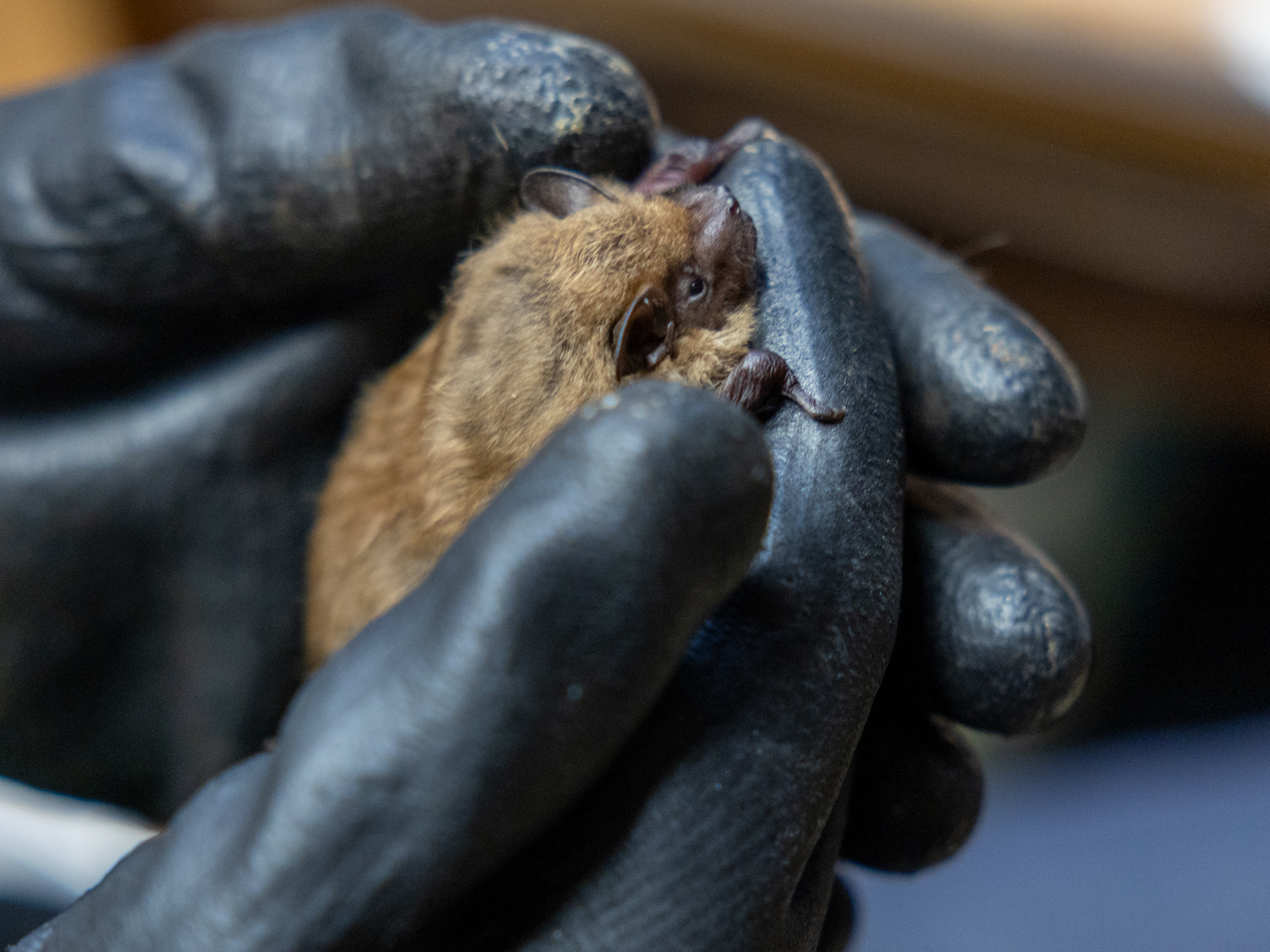
Maureen Heidtmann’s fourth call of the day was for a big brown bat stuck in a glue trap. She hoped to save its life, even if she had to amputate its wing.
She was able to coach her other callers through a variety of stuck-bat situations over the phone, but for this creature the size of a fig, she would need to use mineral oil and a tongue depressor to wiggle it free of the glue trap it arrived in.
Nelson — she names the bats that can’t be released — now snacks vigorously on mealworms, but it still carries signs of trauma after nearly starving in the trap.
Callers from across the state can deliver injured bats like Nelson to Heidtmann’s house for treatment, where she cares for up to 40 of them at a time.
Heidtmann isn’t the only person with such a specialist’s toolkit in Connecticut. She is one of a small army of 57 volunteers licensed by the state Department of Energy and Environmental Protection to rehabilitate wildlife.
When a Connecticut resident reports an injured or distressed animal, DEEP refers them to rehabilitators who can nurse the animals back to health until they can be returned to the wild. Rehabbers also advise the public on how to stay safe around wild animals and run educational programming about the state’s species, many of which are endangered.
And they do so without compensation, often spending their own money as well as countless hours in a labor of love.
Heidtmann has been rehabilitating bats for 25 years, a passion that first took flight when one snuck into her family’s Brooklyn, N.Y., apartment, when she was 5 years old.
“My mother went nuts,” Heidtmann said. “She was convinced this bat was going to get tangled in her hair, suck the blood of her children, just be an evil presence. So she slapped the newspaper on her head, picked up a broom and started to whale away.”
Common belief at the time was that bats were blind, and echolocation was poorly understood, but Heidtmann watched as the bat expertly avoided her mother’s swinging broom.
“I crept out from under the table, opened the window, the bat flew out, and I fell in love,” Heidtmann said.
The path to becoming a bat-saver
For four decades after that first flight, Heidtmann kept the spark alive by scouring her local library for books about bats. She studied biology in college and became a librarian and a single mom.
One day when she was working at the library some 25 years ago, a little boy found a young bat outside in a pool of water. He brought it inside, not knowing what to do, Heidtmann said.
When she saw the bat, “it was not even a week old. It didn’t even have fur.” She felt compelled to help.
“I dried it off, got it home, warmed it up and fed it, just using my common sense,” Heidtmann said. “I did not have the specific formulas then that I now have when I’m raising baby bats, so I just bought a can of milk replacer for kittens.” It worked.
For other rehabbers, the pipeline into the work is often similar. People come across injured wildlife, are referred by DEEP to a wildlife rehabber and realize the depth of the need.
Aspiring rehabbers must pass a state exam and complete 40 hours of training over at least three years under an authorized rehabber to get their DEEP license. Those working with endangered animals must earn additional federal permits.
“I actually found an injured turtle and didn’t know rehabbers existed,” said Angelina Carnevale, who has been rehabbing Connecticut’s native turtles in North Branford for the last eight years.
“It wasn’t until years later, when I had some kind of disposable income, that I was like, oh, maybe I can do this. Because as soon as I looked into it the first time, it was very straight up front that they don’t pay you anything, and they don’t reimburse you for anything,” Carnevale said.
Even after donations from appreciative community members, Carnevale expects to spend $4,000 of her own money this year. Heidtmann’s personal share of the bill averages $2,000 each year she operates, she said.
This year, a lawmaker sought to change that.
A labor of love and the law
Sen. Paul Cicarella, R-North Haven, was on a walk with his family last year when they came across an injured turtle.
DEEP’s wildlife program referred him to Carnevale, and he was impressed by the promptness of her response while still working her day job as a children’s librarian. Carnevale’s voicemail directs people to other resources if she doesn’t return their call within 10 minutes.
“When no one else could help me, and the state refers me to a nonprofit and they’re not given anything, it seems like something that’s worth investing into,” said Cicarella.
So last session, Cicarella proposed SB 456, a bill that would provide $500,000 in grants to DEEP-licensed wildlife rehabilitation nonprofits. Carnevale and other rehabbers testified in favor of the bill.
The bill passed the environment committee unanimously but was not taken up by the full Senate.
“I think it’s a great idea, and clearly my colleagues on both sides of the aisle thought it was as well,” Cicarella said.
“If you follow the building, you’ll realize that bills have to be put forward multiple times before they pass. It’s part of the process. It’s unfortunate.”
Cicarella said government leadership told him his legislation would be included in the final budget and implementer bill. He was surprised when he saw that it wasn’t there.
“Hopefully, we can get it done again,” Cicarella said.
Carnevale says she hopes to see some of the language tweaked to make the carveout open to all DEEP-licensed rehabbers.
“Most rehabbers are not 501(c)(3) nonprofits. It took me five years before I was able to get around to doing all of the paperwork to become one.”
“And when you are rehabbing animals, that’s where all your time goes,” she said.
Educating against the odds
Rehabbers, especially of bats, are fighting a battle for education against misinformation.
“Bats have been given a bad rap,” Heidtmann said. But if thoughts of vampires get the public interested in learning more about the science of bats, so be it, she said.
Connecticut is home to nine species of bats, and through their diet, they control the populations of pests including moths, ash borer beetles and spotted lanternflies, said Devaughn Fraser, a mammal biologist at DEEP.
Bats are “the only really predominantly night flying insectivore that’s controlling night flying insects,” Fraser said.
And all of Connecticut’s native bat species are in great conservational need. Five are endangered, with white nose syndrome decimating populations.
Bats, like other mammals, can carry rabies, a disease that is nearly always fatal in humans once symptoms start. And that’s what many people’s fears hinge on, Heidtmann said.
But those who study bats say that the disease’s prevalence is overstated. In her 25 years of rehabbing hundreds of bats, Heidtmann has only seen three rabies cases. And studies of bat fatalities at wind farms show less than 1% of wild bats to have the disease, Fraser said.
If a bat is found indoors, the first step to get it out is opening a window, according to DEEP’s website. People can also use a cardboard box to safely remove a bat.
While wearing thick leather gloves, move toward the bat slowly and place a container over it, then slide stiff paper under to form a lid and then release the bat outside, advises Heidtmann’s website.
People who are bitten or scratched by a bat should seek medical advice; effective post-exposure rabies vaccines are available. If a bat is found in the room of a child, someone sleeping, or a person otherwise cognitively impaired and unable to communicate about a bat encounter, rabies prevention care should be followed, and if possible, people should take the bat in for testing.
About 4% of bats brought in for testing this year in Connecticut were positive for rabies, the same percentage as the last two years.
Healthy bats do not seek out interaction with humans, Fraser said. And if they are stuck inside, they most likely got lost and are trying to find a way out.
Heidtmann’s busiest time of year is in June and July, when newborn bats may have become separated from their mothers. The next couple of months in Heidtmann’s care are about bringing them up to weight, encouraging flight and socializing them with other bats.
In their first few weeks, Heidtmann feeds them species-specific formula every two to three hours throughout the night before gradually weaning them onto mealworms. She has had to improvise to find feeding applicators tiny enough.
“I use whatever will work. Sometimes they will take to eye makeup applicators … they’re like little sponges.”
If all goes well, she releases them into an outdoor flight cage on her property and, eventually, into the wild. The ones unable to hunt for themselves because of their injuries are kept inside for educational programs.
But it takes newborn bats time to learn the skills of flight and navigation, and sealing up holes in a property at the wrong time of year can be a death sentence for pups nesting there with no way out.
That’s why John Griffin, Senior Director for Urban Wildlife Programs at the Humane World for Animals, sees codifying humane exclusion standards as an important step in protecting bats and many of Connecticut’s wildlife species.
“A stronger framework [for bats] could include prohibitions on exclusions (with certain exemptions) during pup season (June 1 through August 15), a ban on entombment, a requirement to use one-way devices, and meaningful enforcement for anyone performing exclusions for hire,” Griffin said.
Animals are “adapting to our communities and flourishing because we’re providing habitat,” Griffin said.
“Sometimes people think, ‘Oh, if I occupy my house, why would an animal want to live here?’ Well, they’re looking at your house with a different perspective. They’re thinking about, does it meet my denning or roosting needs, and is there an opening?”