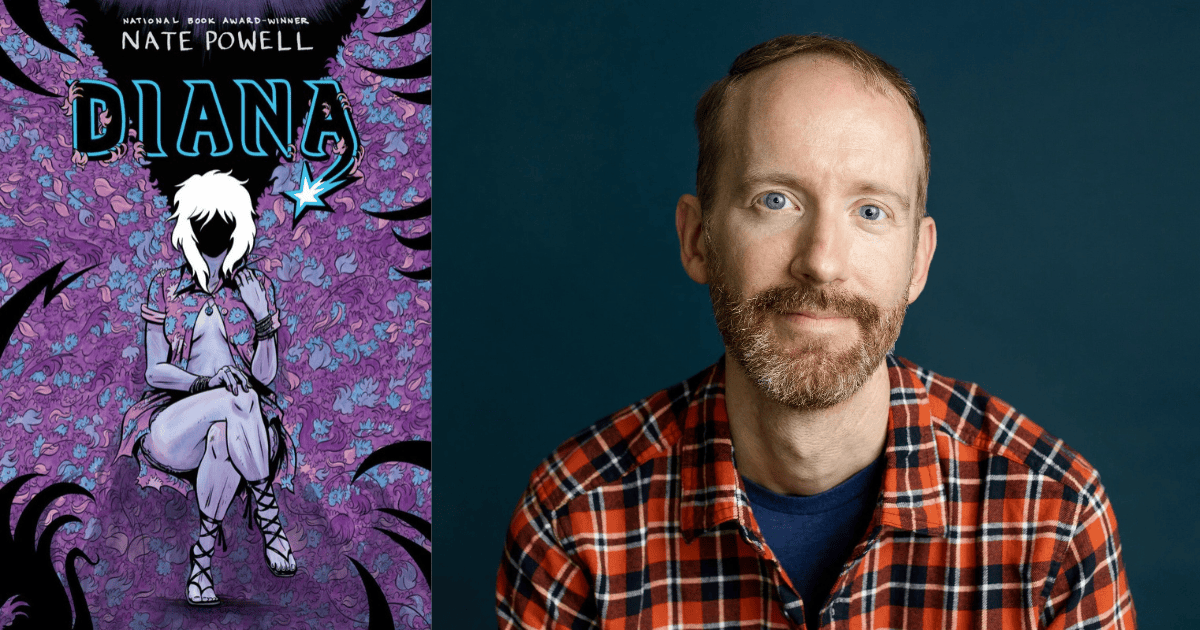
‘I feel untethered’: A review of ‘Diana,’ Arkansas native Nate Powell’s latest graphic novel
What does it mean to be rooted, especially when the roots reach into soil that is toxic and unforgiving? That’s one of the fundamental questions explored by “Diana,” the latest graphic novel from Arkansas native Nate Powell, set mostly in the din of the 1990s Arkansas punk scene.
Diana, our eponymous heroine, has two challenges that will be familiar to many of Powell’s readers. First, she must recover from a stifling religious upbringing. Second, she must forge ahead (or backward?) when one of her dearest friends dies unexpectedly. In the relatively scant copy of a graphic novel, Diana twice reflects on ties: on feeling untethered without one friend, on wanting to cling desperately to another. It’s a telling repetition. And indeed “Diana” consistently ruminates on the ties that bind — too often poisonous, too often precarious.
Powell establishes Diana’s first challenge right away: the smotheringly zealous Christianity of her childhood. The novel’s first images, a kind of prologue set in Murfreesboro in 1977, portray Diana’s grandmother as positively ghoulish. Powell draws gaunt cheeks, an angry pursed mouth and piercing eyes for the grandmother as she commands a young Diana to recite the words to “Jesus Loves Me” during bath time.
The image terrifies, especially how the lines contrast with the otherwise soft and flowing style that Powell uses throughout the rest of the book. Readers will get the gist right away, maybe with too much personal familiarity — not just the unbending orthodoxy, but the alienation that almost surely follows as a consequence. And as the novel moves back and forth between multiple timelines, the grandmother periodically resurfaces — once even threatening violence against Diana for her subversion.
Flash-forward to the early 1990s: Diana is finding her people in the Arkansas punk scene. Powell knows that world well, having owned the label Harlan Records and having played with bands such as Soophie Nun Squad, which gets a nod on a flyer late in the text. Diana hosts bands traveling through, and she establishes her own band, Diamond Mine.
One passage epitomizes the punk ethic. After his encore, a bassist throws his Rickenbacker into the Arkansas River. Diana’s friend and roommate Jodi dives in and retrieves it. The punk scene, open-ended and a bit anarchic, provides Diana the possibilities of true community where her family clearly does not.
It all begins to unwind, however, when Diana suffers an unexpected loss. “What if there’s only forward?” she wonders, dreaming about an alternate reality in which she kept her friend safe. Her loss is sudden and unexplained, leaving Diana and Powell’s readers without closure. With that tie now jerked away from her, Diana invests more and more in her music. Once Diamond Mine begins to gel, Diana comes to find that maybe a song is an incantation, that maybe with the right notes in the right rhythms, that maybe a song can forge a connection, even across time.
Powell makes excellent use of color. Many pages are characterized by subdued purple hues, allowing Powell to charge up a panel for effect when he wants contrast. For instance, here Diana and Jodi are fumbling toward reconciliation after a jealous feud over a man:
The fiery orange of the open panel in the middle of the frame contrasts the purple motifs to offset interior thoughts that are hard to speak aloud. And it emphasizes the desperation with which these characters are trying to find a meaningful connection. Later, when Diana’s incantation leads her into a kind of floating purgatory, Powell turns to a flat black-and-white scheme to indicate a boundless void.
“Diana” also features scenes familiar to Arkansas readers. Diana negotiates the formation of her new band over a plate of catfish and hushpuppies, and the Rickenbacker episode takes place at a pavilion closely resembling Little Rock’s Riverfront Park Belvedere. Diana and her mates trundle through the riverfront throng during the watch party for the 1992 presidential election. A moment of unexpected Arkansas pride wells up in the punks as they see an Arkansan accept the presidency, with one capitulating to a fundamental shared Arkieness, surprising her friends with an out-of-character woo pig sooie scream.
The riverfront episode also offers a provocative digression that underscores “Diana”’s themes. I found it resonant with our current political situations, too. With the lyrics to Fleetwood Mac’s “Don’t Stop” wafting through the background, one of Diana’s crew brings up Francis Fukuyama’s “end of history” thesis:
“There’s a new book called ‘The End of History’ about this moment we’re in — the end of the Cold War, with western democracy as the ‘final form of government’ … Like, it talks about how we’ve run out of plotlines for political conflicts, and finally we can aspire to more as a society.”
Powell’s characters subject this thesis to rigorous and deserved criticism. But more satisfyingly, Diana’s incantations offer another rejoinder: that maybe time is flatter than something that can end, that maybe past and present and future can provide meaningful tethers.
What would these young Arkie punks think of the Fukuyama thesis today? Since the 1990s, the U.S. has mainstreamed the very identities that marginalized them — only to marginalize them all over again. For all the triumphalism of the Fukuyama thesis, we have, evidently, not “run out of plotlines” after all. One wonders if Fukuyama might have been casting his own kind of spell, a kind of wish-fulfillment that even Powell’s characters might share as strange bedfellows.
Powell is, of course, the first graphic novelist to win a National Book Award, which he earned in 2016 for his work on the historical and politically-charged “March” trilogy, co-written by Congressman John Lewis and Andrew Aydin. But despite “Diana” — alongside “Come Again” (2018) and “Fall Through” (2024), the other two parts of a triptych — being a more personal endeavor, Powell remains at the top of his game, telling moving stories about community and belonging.
“Diana” released on Oct. 6 and is available through Abrams ComicArts and the usual book retailers.
Source link