A girl’s bond with wild horses is tested
Pontic-Caspian Steppe, c. 4,000 BCE
On a bluff top near the clan’s settlement…
Stretched out on her stomach, sharp rocks biting into her hips and forearms, the smell of damp soil and crushed weeds mingling in her nostrils, Naya lifted her head just high enough to see down into the ravine from her hidden perch. Even from this distance, she felt a constant buzz of anxiety coming from the herd of horses trapped below.
With no breeze stirring, the heat of the mid-morning sun was becoming uncomfortable but she remained as she was. If she sat up to ease her position or remove a layer of clothing, she might be spotted from below. She wished she could get closer but as it was, she was testing the limits of the strict orders her father had given her yesterday to stay away from the corrals.
UNDERWRITTEN BY
Each week, The Colorado Sun and Colorado Humanities & Center For The Book feature an excerpt from a Colorado book and an interview with the author. Explore the SunLit archives at coloradosun.com/sunlit.
Restless, the horses circled, and circled again, their hooves churning the rain-soaked earth into a quagmire as they searched for a way to escape. Occasionally, one or two at a time would stop to grab mouthfuls of grass hay from one of several scattered piles, before resuming their incessant pacing. A large clay basin near the corral gate held clean water, untouched. Every now and then, one of the mares, always the same one, lifted her head and gave a loud whinny, full of nervous tension, calling to the stallion to whom she and the others had looked for protection. The mare’s desperate cries were futile; the stallion could no longer answer. The sound rent Naya’s heart. These horses were her friends.
She could envision all too clearly what must have happened the previous day, not long before her return to the clan’s settlement after being away all winter. Too late, BeHregs, the stallion, had understood the danger toward which he and his family were being stampeded. Before he could turn them back, he’d been cut down by the men’s spears. Panicked, the rest of the herd had galloped on, chased by more men and their dogs, leaving BeHregs’s body trampled in their wake. Now the mares and the youngsters were trapped inside the corral into which they’d been driven. At first, Naya imagined, they must have raced frantically around the perimeter of the enclosure until eventually, exhausted, they’d had to stop. Even after a night in the pen, she could see they remained unsettled. Anyone approaching the fence set them off running again.
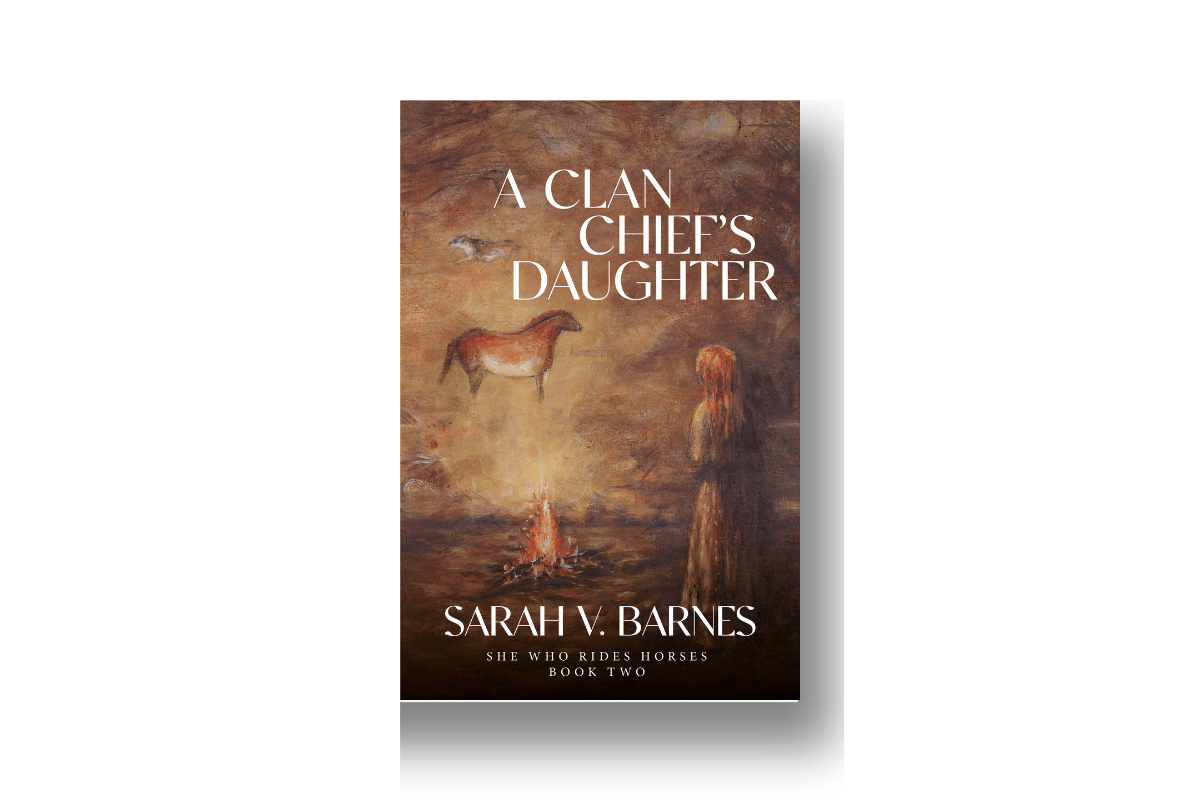
“A Clan Chief’s Daughter”
>> READ AN INTERVIEW WITH THE AUTHOR
Where to find it:
SunLit present new excerpts from some of the best Colorado authors that not only spin engaging narratives but also illuminate who we are as a community. Read more.
Rebhjo, largest of the mares, was the most upset, calling repeatedly and threatening to kick her herd mates if they strayed too close. The others whom Naya recognized – Mus and Ghrasom, along with their yearling offspring MiMus and Bhrounos – did their best to give the big mare space but in their own agitation could not always stay out of her way. Rebhjo’s filly, Melos, seemed to have attached herself to a new member of the herd, a small, pale-coated mare with an even paler star-shaped mark on her forehead, who was heavy with foal. BeHregs must have added her to his band since Naya had last seen them. Another addition, a golden dun mare with a dark dorsal stripe, had a tiny foal at her side who couldn’t have been more than a few days old.
Seeing the little one, Naya pushed the image of another small, vulnerable creature out of her mind. Only two days had passed since the awful morning of the lion attack, when she’d held the blood-soaked body of MeHnd’s month-old colt as he died in her arms. The other horses who’d been with them – the colt’s mother MeHnd, the outcast gray stallion Šuurgan and MeHnd’s three-year old red filly Réhda, with whom Naya had a special bond – had disappeared immediately afterwards. Only two days! Naya thought. Yet so much had changed. For the first time since Réhda and the others had vanished in the wake of the attack, she was glad there’d been no sign of them. At least they weren’t trapped with the herd below.
Naya pressed her forehead into her folded arms and squeezed her eyes shut, willing the dizziness she felt looking down at the horses to stop. Wishing she could block out the memory of the dead colt as well, she recalled instead everything that had happened since yesterday, when she and her mother and the others had arrived at the clan’s settlement.
The previous afternoon…
Rather than the warm welcome they’d expected after their long absence, they’d found the encampment temporarily deserted, with no one on hand to greet them. Climbing up to the bluff top above the settlement, they discovered the whole clan gathered on the opposite side, looking over the cliff’s edge into a steep ravine, pointing and exclaiming about whatever was below. At first, no one had noticed their arrival. As soon as Naya spotted her father, she’d raced across the distance separating them and thrown herself into his embrace. As much as she’d anticipated the triumph of riding into the clan’s settlement astride the red filly, she longed even more to feel her father’s strong arms wrapped around her. Safe in the protective circle of his love, she could forget the anger, grief, betrayal and guilt of the last few days and cling to him instead.
“What is everyone so excited about?” she’d asked him once he set her down.
“We’ve captured a herd of wild horses.”
“Let me see!” she begged, trying to get a glimpse down into the ravine.
“Not now,” he’d insisted, pulling her away from the cliff’s edge. “First we need to celebrate. Thank the gods, you’re home!”
Joy lighting his face, he’d picked her up again and spun her around, just as he’d done when she was a little girl. Afterwards, they were both swept along by the crowd, so that she had no chance to go back and see the captured horses for herself, and once they’d returned to the settlement, her father kept her with him, even dissuading her when she would have gone in search of her grandmother.
“Awija will greet you soon enough,” he told her. “Right now, you and I must oversee the festivities.”
He’d made clear that she was to remain by his side, and she felt flattered to be given a seat next to him in front of the central fire. The place of honor to his right, however, was reserved for the clan’s distinguished guest, the young warrior who, she learned, had been visiting for several days and was responsible for the plan of capturing the wild horses. Even before being officially introduced to him, she recognized the young warrior as Wailos, son of one of the tribe’s other clan chiefs. Her cousin Melit had pointed him out at last year’s Gathering, remarking on how handsome he was, but at the time Naya hadn’t paid much heed. Now, however, his feat had become the focus of everyone’s attention, including her father’s, thereby overshadowing her own homecoming. Worse, along with her father’s admiration and respect, the clan’s visitor had evidently stolen Naya’s idea, or at least a version of it.
If only I could talk to Papa alone, she thought. She wanted it to be just the two of them so she could tell him about everything that had happened with the red filly over the winter while she’d been away. She would explain to him that her vision for the horses had nothing to do with taking away their freedom. But the filly was only part of the reason she wanted to speak to her father in private. He deserved to know the truth about what she’d witnessed going on between her mother and Oyuun, the stranger who had stayed with them throughout winter, keeping them safe.
Instead, Naya had been required to remain demurely by her father’s side, surrounded by other people, behaving politely while trying to hide her mounting impatience. She’d grown especially frustrated listening to the other men extoll Wailos’s knowledge of the nature and habits of wild horses and asking for his views about how to tame them – for what purpose Naya still wasn’t exactly clear. She was supposed to be the one with the special relationship with the horses. She was the one who knew how to tame them, how to ride! As badly as Naya had wanted to interrupt, however, she’d held her tongue, afraid no one would give any credence to what she had to say. After all, she was only a girl.
Almost as irritating, she’d had to endure watching Krnos, her childhood tormenter, be recognized for his contribution to the wild herd’s successful capture. Apparently he’d been the scout credited with sighting the horses and alerting the others. Watching as he ducked his head in feigned modesty while Wailos sang his praises, Naya could see Krnos had become a great favorite of the clan’s esteemed guest, whom he clearly hero-worshipped in return.
As if Krnos felt her eyes on him from across the fire, he’d pinned her with a derisive smile. “Naya,” he’d called, loud enough to be heard above the babble of voices, his tone just shy of mocking. “Tell us, how did you manage to make it through the winter?”
Caught off guard, Naya stared back. With everyone’s attention focused on her, she’d stubbornly refused to look away, which made her failure to respond seem rude. In reality, she hadn’t trusted herself to speak. Before the moment could grow even more awkward and her father find it necessary to rebuke her for her lack of manners, her mother stepped forward and offered to tell the story of their survival.
Naya should have been relieved – grateful even – but she wasn’t. Listening to her mother’s account of what had befallen them, she’d grown even more upset. On top of giving all the credit for their survival to Oyuun and Aytal – the stranger and his son who’d rescued them – her mother managed to avoid mentioning the red filly and the other horses entirely, not even the poor colt. Outraged, Naya wanted to object to her mother’s version of the story but was afraid that she might burst into tears. And so she sat there, letting her mother speak in her stead.
The only person to whom she might have turned for sympathy was off limits. Even had both her parents not warned her against speaking to Aytal, neither need have worried. Now that they had returned to the settlement, Naya wanted only to avoid him. Not because of Aytal’s errant arrow that had almost ended her life. She’d forgiven him for that, unlike her father who had made clear that justice still needed to be served. But after everything else they’d been through, including the lion attack, Naya’s feelings for Aytal were complicated. She needed time to sort them out before confronting him.
He and his father had found a place at one of the smaller fires surrounding the central blaze where they stayed throughout the evening. At one point Naya saw Aytal’s younger brother Dayan join them, but after a while the boy left to rejoin her uncle’s family, with whom he’d been living. As the festivities wore on, Naya found her gaze turning in Aytal’s direction but whenever he looked up, she quickly glanced away. She wished he would stop wearing that remorseful expression, which just made her feel more irritated. If only she could bring herself to be truly angry with him, things would be so much easier.
Eventually, tired of brooding and as annoyed with herself as with everyone else, Naya decided to go back to her family’s dwelling where she could at least pretend to sleep. By now, she was sure, she had little hope of attracting her father’s attention, let alone talking to him. Why couldn’t he understand? She wanted him to tell him how she’d succeeded in taming not only the red filly, but the mare and the gray stallion as well. She was even willing to give Aytal his share of the glory. She wanted to describe what it had been like to ride, galloping across the vast grasslands, as free as an eagle soaring on the wind. She wanted to confess what had happened to the colt, how guilty and devastated she felt about his death, and she’d wanted to warn her father of her mother’s betrayal.
Absorbed in talking to the other men around the central fire, her father didn’t seem to notice her unhappiness. Not until she rose abruptly did he put out a hand to stop her, asking where she was going.
“I’m tired Papa,” she’d said, evading his grasp. Swallowing hard, she managed the smile she knew he would want to see. “It’s been a long day,” she apologized. “I need to go to bed.”
Hurriedly, before the light from the fire could betray the tear-tracks staining her cheeks, she’d excused herself, disappearing into her family’s shelter.
Back at the bluff top …
From below Naya’s hidden perch, a loud and disgruntled moooo echoed off the limestone walls. Lifting her head, she scrubbed away grit and tears with her knuckles. Enough, she admonished herself, determined not to give in to her feelings. She looked down once more into the steep-sided gorge. Next to the large corral that held the horses stood a smaller pen, also constructed of brush and saplings bound with stout rope, containing what remained of the clan’s livestock. A pair of her male cousins had taken down the enclosure’s makeshift gate and, with the help of a couple of dogs, were driving the animals through the opening. As they passed, Naya counted: ten lāpos – young female cattle – one bullock, eight ewes, and seventeen she-goats, including the two she and her mother had brought back with them. The lāpos were too immature to have been bred this season, which accounted for the lack of calves. But no new lambs or kids cavorted at their mothers’ sides either. Missing as well were the clan’s two rams, six buck goats and the magnificent young bull who had cost her father so dearly when he’d traded for him at last year’s Gathering, not to mention the majority of the clan’s other cattle as well as the most productive of the dairy goats and the best wool producers among the sheep.
The loss, Naya realized, was staggering, especially the absence of youngsters and breeding males. Without them, there would be no means of rebuilding the herds, and little likelihood of the remaining sheep and goats continuing to produce milk. As for the upcoming rites of Sāwel-Dom – the sacred marking of the sun’s still point in the summer sky – her people would be unable to make their expected contribution unless they gave up nearly all the animals that remained. Even if the other clans attending the Gathering could be persuaded to help, Naya knew her family’s future looked extremely uncertain. The alternative was for them to go back to depending solely on hunting, fishing and gathering what they could from the land, with all the loss of status such an existence entailed.
From what Naya had gleaned last evening listening to the talk around the fire, her clan’s only hope of avoiding such an outcome had something to do with the captured horses. Did her father know that the animals trapped in the corral belonged to the red filly’s band? That they were her horses? If she’d been allowed to see them for herself yesterday, she could have explained to him how special they were.
She watched now as the mother of the new foal finally stood still long enough for the youngster to nurse. Dark patches of sweat stained the mare’s flanks. The sun had gained in height and the cliff wall no longer cast much of a shadow. Naya worried about the lack of cover for the horses. She looked over to where a group of men stood several paces away from the corral gate, enjoying the shade of a large oak tree. They’d been there all morning, talking. Clearly they were discussing the horses, but Naya was too far away to hear their words. At the moment, her father, her uncle Tausos, and two of her father’s cousins were listening intently to Wailos. As had been the case last evening, the other men apparently regarded their guest as the expert.
All of this is my fault, Naya thought…
Sarah V. Barnes is both a historian and a horsewoman. Her first novel, “She Who Rides Horses: A Saga of the Ancient Steppe,” received the 2022 Best Indie Book Award for Historical Fiction, among other prizes. “A Clan Chief’s Daughter,” finalist for the 2026 Nautilus Prize for Historical Fiction and the 2026 Colorado Book Award for Historical Fiction, represents the second installment in the “She Who Rides Horses” series. Barnes lives in Boulder, Colorado.