
Helen Mirren Is a Delicious Highsmith
We’ve grown so used to seeing Helen Mirren imperiously slumming her way through boilerplate grande dame roles in recent years that it’s a genuine thrill to see the actress bare her teeth in “A Talent for Murder” — playing no less compromising a character than Patricia Highsmith, embodied here as a woman every bit as vicious and cold-blooded as her celebrated crime novels. That may be close to the truth — Highsmith was famously a hardass, to use a kinder term than many would — but Anton Corbijn‘s film is wholly fictional: a playful metatextual literary noir in which the author is both storyteller and villain, pitted against a young publishing agent who’s also a slippery proxy for Tom Ripley, her most famous creation.
Adapted by Australian playwright Joanna Murray-Smith from her play “Switzerland,” “A Talent for Murder” — a bit of a DTV-sounding title, though you can see why it was changed — sets out as a taut, concentrated two-hander. Edward Ridgway (Alden Ehrenreich), a bespectacled, butter-wouldn’t-melt employee at Highsmith’s New York publishing house, pays the reclusive author an unwelcome visit at her chalet in the Swiss mountains, with a contract in hand for a sixth Ripley novel; she’s immediately loath to sign it. How he gets her to change her mind is already something of a psychological cat-and-mouse game, and that’s before the film splinters into other narratives — one an evolving blueprint for the book she may or may not write, in which Ehrenreich doubles up as its duplicitous antihero, and another in which the burgeoning real-world relationship between Edward and a fellow American abroad is either imitating or inspiring the art at hand.
It’s a tricky, sexy buildup that’s finally more satisfying than the payoff. 105 minutes is a tight, even cramped, running time for a conceptually busy psychothriller that also wants to proceed as an elegant slow burn, and the film’s strands never knot together in quite the complex, devious way that a Highsmith homage really should. But “A Talent for Murder” still has chic pleasures aplenty, beginning with Mirren’s hawkish, caustically funny performance, and extending through the characteristically cool, ambient qualities of Corbijn’s filmmaking. Following its gala premiere at Toronto, Bleecker Street will release the film Stateside on Oct. 23 — apt timing for an upscale adult diversion palpably imbued with the chill of early fall.
It begins, fittingly enough, with strangers on a train. The year is 1995 — mere weeks before Highsmith’s death, if that fact applies to this fiction — and Edward, having flown over from the Big Apple, sets off by rail from Zurich to the hillside village nearest the author’s home. On board, he meets the attractive Clementine (Olivia Cooke), who’s visiting an elderly aunt in the same region, in the hopes of securing a family inheritance; as they chat, they discover that they’re both New Yorkers, and both orphans.
Already, Edward’s foolhardy work trip is taking on the shape of a story by his hostile client, and that’s before he comes face to face with her: a hard-drinking, chain-smoking fount of invective, seeking to break him early and send him from whence he came. (Or elsewhere: Edward’s predecessor in the job attempted a similar visit and was never heard from again.) She’s a practiced all-rounder when it comes to verbal abuse — racist, anti-Semitic and, despite her own queerness, homophobic — and is somewhat irked that Edward, softly polite but also resolute, stands his ground, insisting on his professional expertise regarding her work, and his confidence that she’ll come around. “I don’t think I’m deluded,” he says firmly. “That’s because you are deluded, genius,” she spits in response.
Oh so gradually, he starts gaining ground, and she begins to entertain the idea of a new Ripley narrative, teasing out its possibilities in gorgeous, Rome-set interludes that star Ehrenreich and Cooke as more glamorous versions of the characters we’ve already met. Ehrenreich’s doppelgänger act is particularly deft: a slight change in stance and the pitch of his voice, along with a crisped-up wardrobe, is all that separates the vulnerable, nebbishy agent from Highsmith’s slick psychopath, and with Ripley himself being such a social shapeshifter, we begin to wonder what the eager young Edward is capable of.
Master DP Robbie Ryan, meanwhile, marks the porous boundaries between fantasy and reality with subtle changes in light. The Swiss scenes are marked by the cold, bleachy glare and long, stark shadows of the Alpine sun; Rome, by contrast, is draped in the warmer, more velvety darkness of stylized noir. The faintly fuzzed, resplendently ominous strings of Dickon Hinchliffe’s marvelous score span both realms.
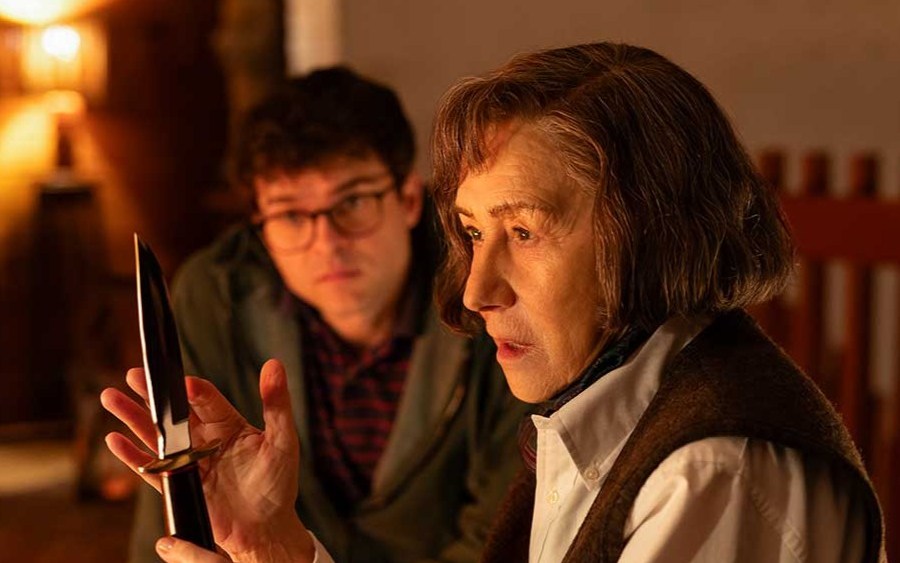
Dimitri Capuani’s superb production design tells us as much about Highsmith as the venal details of Mirren’s performance: Her home, with all its dated pine paneling and nicotine-stained paperwork, has a stuffy, fetid atmosphere suggestive of a woman still stubbornly living in a heyday that was never all that happy to begin with. It says everything about Highsmith — or, at least, the gleefully horrible version of her imagined here — that she demands Edward bring her three things from abroad to sweeten the deal: a pile of Brooks Brothers shirts, a stash of Campbell’s soup cans, and another French hunting dagger for the impressively lethal collection on her living room wall.
The weapon gives Mirren yet another pleasingly sinister prop to play with, though her performance doesn’t need too many such accoutrements: Her beady, deeply searching glare and ashy, unyielding vocal delivery are vivid enough. For all its clever-clever switches in story and perspective, “A Talent for Murder” is never more compelling than when focused on the author herself — never leaving her rotting, largely unvisited home, never giving any quarter to those who do make it inside, never not thinking about death and all its rich, acrid, ugly possibilities.