
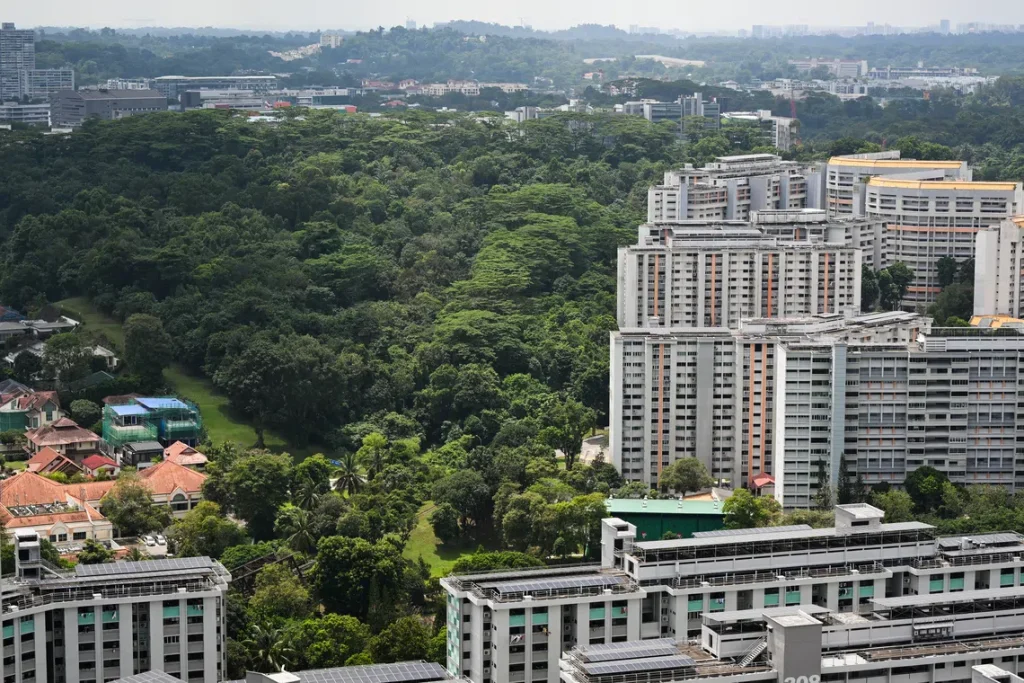
Decision to consider building homes on greenery, heritage sites not made lightly: Indranee
SINGAPORE – The Government’s decisions to consider building homes on greenery or heritage sites are not made lightly, and are only undertaken if there are no suitable existing or brownfield sites, said Second Minister for National Development Indranee Rajah.
She added that the authorities deal with land constraints in two ways: by balancing competing needs in every decision on land use, and by enlarging space – for example, reclaiming land, building taller or going deeper – to create options for current and future generations.
Indranee was speaking to young people on Sept 14 ahead of a closed-door dialogue on housing. It was jointly organised by her ministry and the National Youth Council and held at *Scape Ground Theatre.
In her speech, she noted that people are living longer, with many seniors choosing to age in their own homes. Meanwhile, more young people and singles want their own homes, she said. As a result, the average household size in HDB units has declined from almost five in 1980 to less than three in 2025.
With the demand for more flats, the authorities have to find more sites to build on, she said.
To make the best use of brownfield sites – that is, previously developed land – the strategy is to build higher where possible. For instance, an upcoming housing development at the foot of Pearl’s Hill in Outram Park will be over 60 storeys.
The authorities are also redeveloping golf courses after their leases expire.
By 2030, it will have taken back more than 400ha of golf course land, or the size of almost 600 football fields, for redevelopment. This includes the former Keppel Club golf course where the new Berlayar estate will be built as part of the Greater Southern Waterfront.
Minister in the Prime Minister’s Office, Second Minister for Finance, and Second Minister for National Development Indranee Rajah speaking at SG Youth Plan’s Adulting 101 series at *Scape on Sept 14.
ST PHOTO: JASON QUAH
“If there are no suitable existing or brownfield sites, we need to consider developing housing on sites where there is greenery or (sites that) have been around for a long time,” Indranee said.
“In shaping the plans, greenery and heritage are important to us too,” she added, saying that the Government also takes in feedback from technical experts in nature and heritage groups, and tries to minimise and mitigate any impact on the environment or heritage.
Said Indranee: “So, as we build more to meet housing needs, we will do so carefully and responsibly, and decide in the best interests of Singapore and Singaporeans.”
In July, the HDB published reports of environmental studies for Gillman Barracks and Sunset Way in Clementi, where parts of forests are expected to make way for public housing.
Following public feedback, Minister of State for National Development Alvin Tan said more green spaces in Gillman Barracks and Sunset Way’s Maju Forest will be retained, but fewer homes can be built there.
Turning to the supply of public housing, Indranee noted that the Government has committed to launching 55,000 Build-To-Order (BTO) flats from 2025 to 2027, and will exceed this number if demand remains strong.
The supply of two-room flexi flats will be increased by nearly 50 per cent from 2026 to 2028, compared with 2023 to 2025, to meet the growing demand from seniors and singles.
The increased supply has allowed the authorities to raise the income ceiling for subsidised flats to allow more Singaporeans to buy an HDB home.
Prime Minister Lawrence Wong announced at the National Day Rally in August that the income ceiling for BTO flats will be increased to $16,000 for families and $8,000 for singles.
Indranee said her ministry is studying lowering the BTO eligibility age for singles, and also reviewing schemes to better meet the needs of other groups of singles, such as those who wish to buy a bigger flat with their family members.
At present, singles are allowed to apply for only two-room flexi flats from age 35.
Indranee said that housing in Singapore is affordable because BTOs are heavily subsidised, and there are various housing grants available.
“BTO flats are priced for affordability, not cost recovery,” she said.
In 2025, nine in 10 first-timer families who collected the keys to their BTO flats were able to service their HDB housing loans using their CPF, with little or no cash outlay.
And in a move to support young Singaporeans in securing a flat, first-timer families with or expecting children will receive one extra ballot chance for each child, she noted.