Review: “Carsten Höller, Two” at UCCA Center for Contemporary Art
We’re in the era of legal weed and “immersive art experiences” that purport to take you inside the works of famous artists. These entail renting out a warehouse and projecting onto the walls the work of Vincent van Gogh, or some other artist whose work is outside copyright, with tickets that are more expensive than a visit to a museum. Allow me to share my own immersive art experience: I hadn’t worn a certain sport coat in some time and casually reached into one of the pockets to emerge with a handful of unlabeled pills. Then I remembered that I’d taken this jacket to Basel, Switzerland, and that these pills were the work of Carsten Höller (b. 1961).
Höller trained as an agricultural scientist, with a doctorate on insect scent communication, before turning to art in the early 1990s, where he could begin to experiment on humans. “Two,” his first institutional solo exhibition in China, turns the Great Hall of Beijing’s UCCA Center for Contemporary Art into what he calls a “Laboratory of Doubt.” Curated by Philip Tinari with Jiashu Zou, it has two entrances. The visitor is assigned one at random. From there they walk a version of the exhibition in color or in black and white, with mostly the same works, but never the same conditions. The show was built to be seen once and compared with someone else’s account.
|
“Carsten Höller: Two“ |
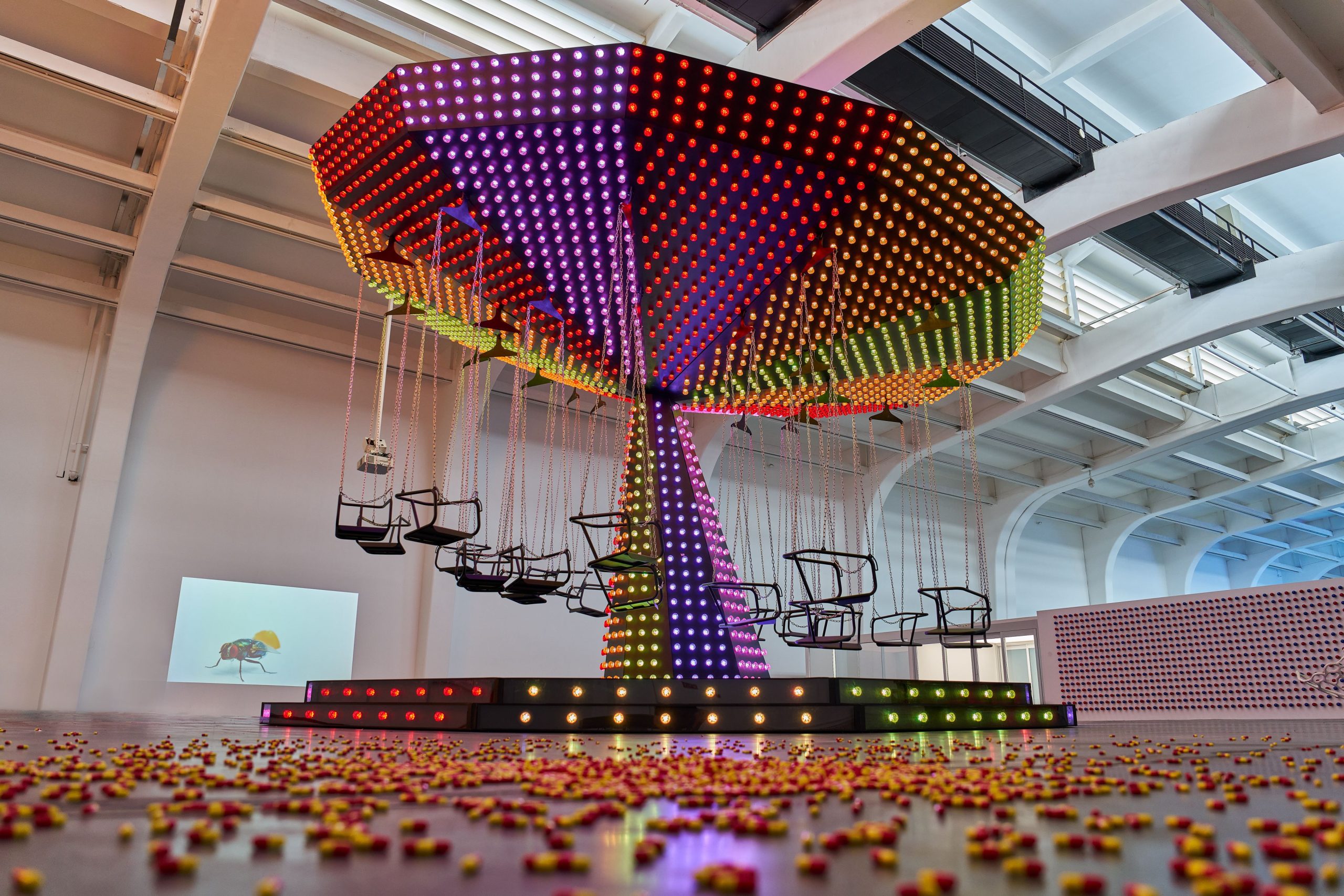
I’d seen a version of Pill Clock in Basel, hence my souvenirs, and in Beijing it could be considered the subtle but beating heart of the show. At first glance it’s just a heap of pills on the floor. Every three seconds a mechanism from high above drops a new one onto the pile. Three seconds is a period of time identified by the artist as “the present,” but the piece runs for months, and in Basel I had caught the end of it. At that point you’re confronted with a pyramid of pills containing an “undisclosed substance” that “can be swallowed,” according to press materials. The powder inside is likely sugar, but why risk it when the artist’s whole deal is playing with your perspective?
Tilted Carousel (Five Colours) (2026), with its monochrome twin Tilted Carousel (Two Whites) on the far side of the hall, feels made for social media, but there’s no doubt that Höller values the experience over the photos. The carnival bulbs run from magenta through red and amber to acid green. The two carousels turn in opposite directions and at a pace that turns a fairground ride into a waiting room: once you’re aboard you’re stuck until the rotation completes, watched by whoever stands on the floor. Behind it hangs a clock made of concentric rings of yellow neon accumulating the hours and minutes, so you can better experience the slowness—and how dumb you look. How’s that for immersive?
Sluice (2026, with Valia Fetisov) might be a little too immersive for some. Glass sliding doors admit you then lock like an airlock. It’s something of an escape room, without any clues, though the trick can be shouted at you. The other side won’t open unless you stand completely still for 30 seconds. The world is awash with distractions and gimmicks. Höller pretends to be just another one of these, right up until the moment he pierces your brain.