How Art Is Shaping Cocktail Menus in New York, London and More
At a newly opened New York restaurant and several London hotel bars, artists’ work is giving entire cocktail menus a distinct identity. The impulse is old: bartenders have named drinks after painters since the Bellini. But it is turning systematic: a house collection or an artist’s archive is becoming a continuing source of ideas as recipes change. The approach is hardly confined to these two cities, but New York and London, art-market capitals whose hotels tend to hang serious collections, are where it is sharpening into a menu-level idea. The timing isn’t an accident: as high-end bars compete to feel like more than a room with an impressive list, a collection gives the whole menu a point of view. Some bartenders find names and visual affinities for cocktails they have already developed. Others let an image guide what goes into the glass.
Miroo Kim, formerly the bar manager at Atomix, New York’s Korean fine-dining restaurant, now oversees the cocktail menu at Romy, a new restaurant in Soho that debuted Sept. 29. Her recipes were already complete when the team learned that work by the American painter George Condo would be displayed in the restaurant.
“The cocktails actually came first,” Kim tells Observer. The team began discussing names that same day, and her brown butter carajillo, a coffee-and-liquor cocktail, became Internal Riot, a title shared by a 2020 Condo painting and his 2020-21 New York exhibition. Romy occupies the former Little Prince space at 199 Prince St., where interior designer Rafael de Cárdenas framed the art with oxblood- and black-lacquered paneling, burled wood and leopard-patterned carpet. Condo’s portraits allow delight and distress to share a single fractured face, an approach he calls “psychological cubism.” Kim looked for images and titles that resonated with her recipes. “I didn’t want it to feel like we were just going through a list of Condo titles and picking ones that sounded good,” she says.
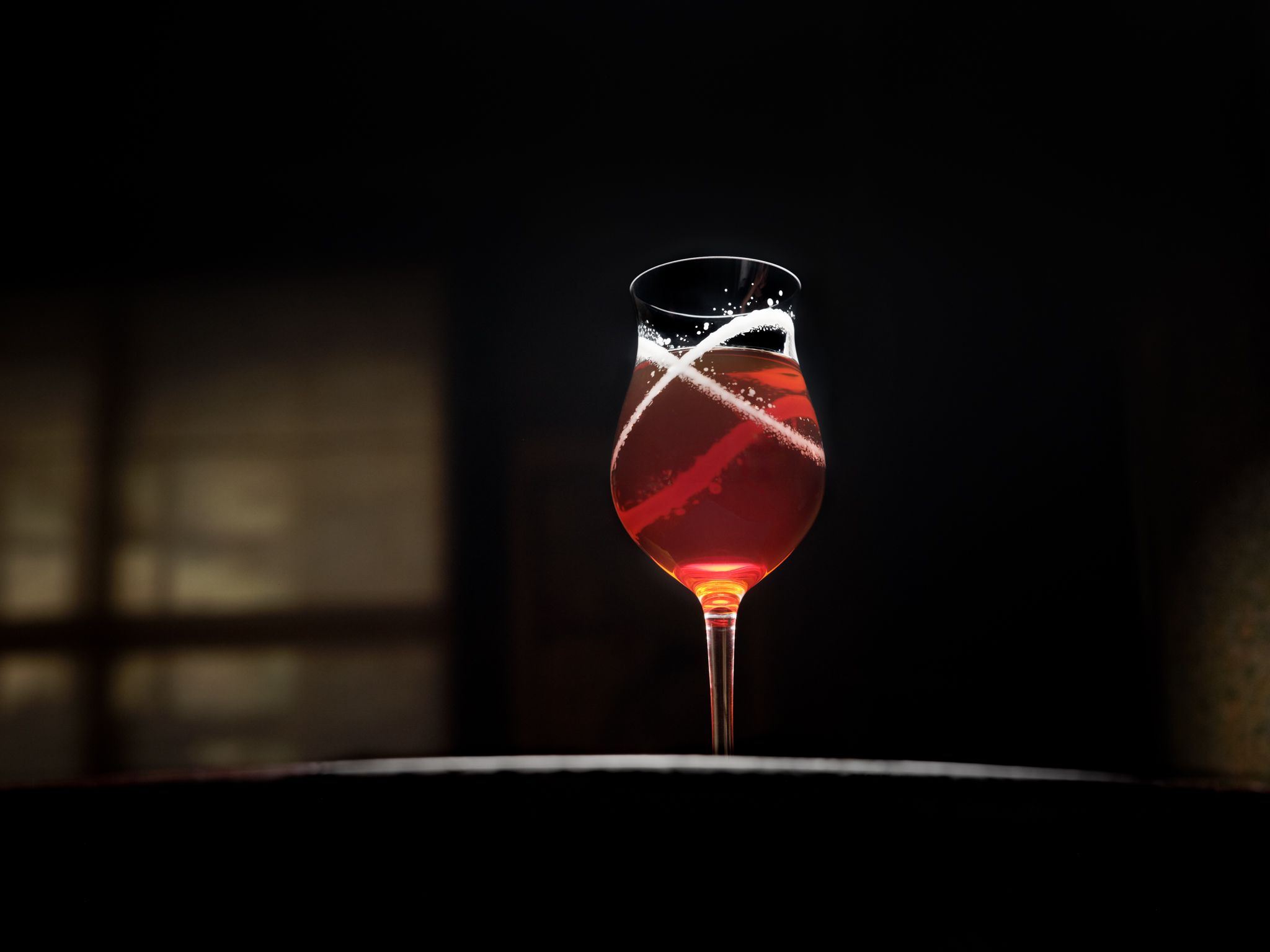
Internal Riot’s cacao-infused reposado tequila and coffee had a dark, roasted character that Kim associated with Condo’s imagery. The title carried her joke about caffeine and liquor: “You have liquor and coffee together, which are two things doing very different things to your body at the same time.” Her lychee martini, Mary Annette, takes its name from Condo’s 2003 painting. The title reminded Kim of Marie Antoinette, France’s 18th-century queen, an association that suited the drink’s coconut oil-washed vodka and pink lychee gummy. She also found a visual kinship in the nearly opaque white drink, held in a tall, delicate glass, the gummy casting a faint pink hue through it. The drink names draw from Condo’s wider archive; the works selected for the restaurant are Blue Rodrigo (2009) and Bewildered Man (2025). “It was more like it gave us a language for naming them and, in some cases, brought out a personality in the drink that was already there,” she says.
The Bellini cocktail offers a familiar precedent: in 1948, Giuseppe Cipriani, founder of Harry’s Bar in Venice, named his mixture of puréed white peaches and Prosecco, an Italian sparkling wine, for the Renaissance painter Giovanni Bellini. At New York’s Baccarat Hotel in 2022, bar manager Mark Tubridy drew on the hotel bar’s collection for his L’Art du Cocktail menu. Dark Sky echoed an image of ominous clouds against a pale background with cinnamon-oat milk beneath a float of dark rum, a variation on the Dark N’ Stormy, the rum-and-ginger-beer classic.
At London’s One Aldwych hotel, the Lobby Bar’s second Gallery menu pairs cocktails with works from its collection. Artist Richard Bartle’s Beach Scene provides the starting point for a Gooseberry Margarita made with tequila, gooseberry eau de vie (a clear fruit brandy) and elderflower. The menu also identifies where guests can find the original artwork, bringing the collection into the experience of ordering a drink.
For its 2026 pop-up at Frieze Masters, London’s historical art fair, Ham Yard Hotel’s Liquid Art menu includes the Sculptural Mule. The drink draws on Liverpool-born sculptor Tony Cragg’s bronze Group in the hotel’s Soho courtyard. The drawings set the premise at Scarfes Bar, inside the Rosewood London hotel in Holborn. The bar is named for Gerald Scarfe, the British cartoonist whose political caricatures made a career of puncturing grand reputations, and who created the disturbing imagery for the British rock band Pink Floyd’s The Wall album and film. His paintings line a room of velvet chairs and bookshelves, with a fireplace offering a distinctly civilized setting for all that cheeky provocation.
Launched in April, Scarfes’ Heroes & Villains menu draws on Scarfe’s book and exhibition of the same name. Twenty cocktails interpret 10 figures in pairs, with each villain revealed by a concealed pullout. The menu carries Scarfe’s satirical approach into bartending itself, pairing restrained recipes with more extravagant counterparts. For Andy Loudon, Rosewood London’s director of bars, Charles Darwin’s pairing explores the distance between the British naturalist and his caricature. Natural Selection is a whisky highball with raspberry, carrot and dry fino sherry. Evolution takes inspiration from the excess of the Zombie, a potent rum cocktail, using bourbon, pistachio orgeat (a sweet nut syrup) and sour pineapple. Loudon describes its development as “More ingredients, more texture, more indulgence and absolutely no interest in moderation.”
Getting those personalities into a drink takes less romantic work at the bar. Loudon’s team tests extraction times for infusions and adjusts a cordial’s sugar and acidity before trying each version in the cocktail itself, a process that can run to dozens of iterations. “If an element strengthened the narrative but weakened the drinking experience, it was refined, simplified or removed entirely,” he says. How much of that work reaches the table depends on the guest. Some want a 20-second introduction; others welcome three minutes on the figure portrayed or the techniques behind a recipe. “For me, it’s important that the team are given building blocks rather than a script,” Loudon says. “I never want service to feel rehearsed or repeated.”
Taken together, the bars are after the same thing: keeping the art at work long after opening night. Kim can revisit Condo’s archive as Romy’s recipes change. At One Aldwych, the menu sends guests back to the collection that inspired their drinks. Loudon’s team carries Scarfe’s satire into flavor, then tests whether the idea improves the cocktail. “The story can inspire the drink, but flavor has to win,” he says. While the artful reference may reward a second look, the pleasure needs no footnotes.