What’s behind the protests in France, Spain and Italy?
Protests and violent clashes have gripped France, Italy and Spain in recent weeks, but what’s behind the unrest in each country and is it motivated by the same grievances? Our editors in each country look at the causes of the unrest and what lies ahead.
Let’s start in France… (Emma Pearson, Editor, The Local France)
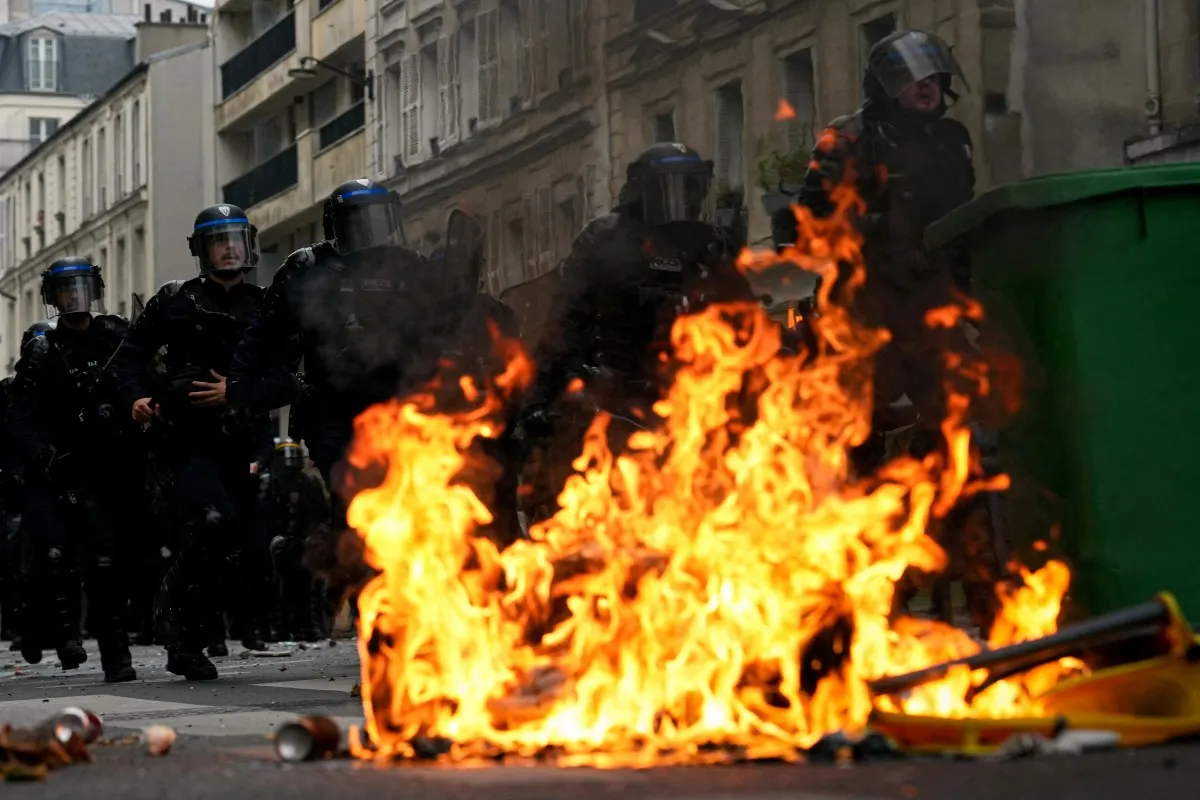
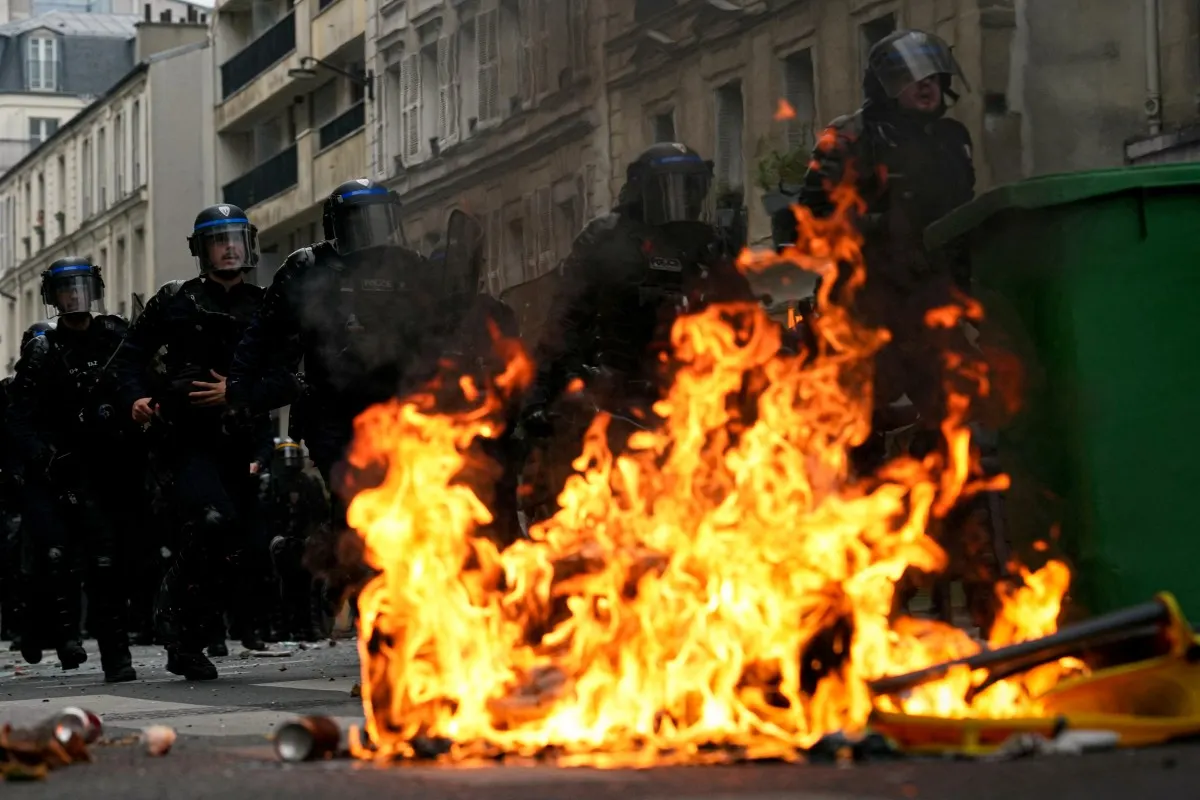
The protests in France on Saturday, in which a minority embarked on a headline-grabbing rampage of burning and looting, were what’s known in the country as a ‘convergence des luttes‘, that is, when several different protests join forces.
The October 17th day of protest was originally called by the remnants of the ‘yellow vest’ movement over the increase in the cost of living, especially the spiralling fuel prices in the wake of the American and Israeli attacks on Iran.
They want the government to do more to lower the cost of fuel, and to help people out with rising prices – those demos were joined by people of all ages, from pensioners to families with young children.
Limoges town hall burning after a group of individuals forced entry into the building during ongoing protest action against the “high cost of living”, in Limoges, central France on October 17, 2026. Photo by Melaine PAYZAL / AFP
Those protesters were joined by students from French lycées (high schools) – these teenagers have been staging protests since mid September over a lack of resources for the education system. They complain of a lack of teachers, crumbling school buildings and shortages of basic items like textbooks and chairs. Their protests began as blockades of their schools, but have also included street demonstrations.
Some of the leftwing political parties, including the hard left La France Insoumise, called on their members to join the protests, as did one of the country’s largest unions. Their main focus was the cost of living, although they also support the students.
Across the country on Saturday 550,000 people took part in peaceful protests, including 110,000 in Paris – the violence came from groups of ‘casseurs‘ (rioters) who mainly have extreme left and anti-capitalist beliefs. These are the ones who were filmed forcing their way into the town hall in Marseille and burning the mairie in Limoges.
READ ALSO: ANALYSIS: Who are France’s ‘casseurs’ and why can’t police stop their violence?
Finally, looters – mainly petty criminals from the low-income city suburbs – took advantage of the disorder in order to pillage and steal from shops.
The protests also took place in the context of a febrile political climate ahead of the presidential election next year, in which France faces the possibility of its first far right leader since World War Two – many of the placards of the demonstrators in the big cities bore anti-Le Pen slogans.
The current political situation, with a deadlocked parliament and a spiralling deficit, perhaps contributes to a general sense of a country in decline and a future that seems uncertain and insecure – among the young lycée protesters some placards also referenced fears over climate change and the rise of AI.
More protests are planned for October 24th and 31st, as well as a cross-sector strike on November 5th – find all the latest developments here.
So what explains the unrest in Italy? (Clare Speak, Editor, The Local Italy)
Italy’s demonstrations this weekend drew on the same pressure on household budgets felt across Europe, and some of those taking part said they took inspiration directly from protest movements in France and Spain.
The demonstrations on Saturday were led by students, teachers, farmers and truck drivers, part of a wave of protests over school conditions, flat wages and soaring fuel prices that began earlier this year.
There were scenes of violence in Milan’s Piazza Duoma following an anti-government protest on Saturday and Sunday. Photo by Piero CRUCIATTI / AFP
Student groups called it “No Meloni Day”, pitching tents outside city halls to protest inaction on issues including the climate crisis and unaffordable rents.
“Even if we don’t manage to throw the country into chaos like in France or block every road like in Spain, the aim is that with all of this, at least, people will start talking about these issues again,” one 22-year-old protester told AFP on Friday.
While thousands of people took part in peaceful demonstrations and marches against the rising cost of living, they were marred by violent scenes as small groups fought with police on Saturday night and others looted shops and smashed windows in central Milan amid the unrest on Sunday.
Around 50 people were arrested in Milan, and more than 350 were taken to police stations for identification. Most appeared to be teenagers and young men from the city’s outskirts who were not affiliated with any group or political movement.
Politicians from the anti-immigrant League were quick to describe them as “maranza”, a derogatory slang term for young people from urban areas that carries racist overtones, while Prime Minister Giorgia Meloni said the majority were “of foreign origin” despite police data showing most were Italian citizens.
The government’s response was to deploy 500 soldiers to Milan to patrol alongside police, while it also created a new crime of “violent participation in a demonstration” and extended police powers to pre-emptively detain those they suspect of planning to riot.
Italy’s upcoming budget is not expected to include much relief for people struggling with the cost of living, though this will be one of the key issues when Meloni’s government faces elections next year.
Ongoing blockades by truck drivers in the south protesting the high cost of fuel have meanwhile left supermarkets in some areas short of fresh produce and forced pasta factories to shut down due to a lack of flour.
In the cities, more protests are expected this Saturday, including in Milan, Rome and Bologna. One group declared a “permanent mobilisation” with demonstrations every Saturday “until the fall of this thieving government”.
And what’s happening in Spain? (Alex Dunham, Editor, The Local Spain)
Spain’s housing protests erupted in late September after 87-year-old Maricarmen Abascal was evicted from her lifelong Madrid flat by an investment firm that quintupled her rent.
The eviction of Maricarmen, who tragically died two weeks later, became the spark that ignited the fire among a Spanish population that has grown tired of spiralling rents and unaffordable housing.
Tens of thousands of protesters have since taken to the streets and many demonstrators have set up makeshift ‘tent cities’ in central squares, the biggest of all in Madrid’s Puerta del Sol.
People in Madrid protest outside the Spanish parliament ahead of the vote. (Photo by Thomas COEX / AFP)
Spain’s ruling Socialists attempted to rush tenant-protecting legislation through Parliament, but right-wing parties voted against the decrees, spurring Prime Minister Pedro Sánchez to call a surprise snap election for November 29th.
The public’s reaction was to hold even bigger rallies, which evolved into calls for the first general strike in Spain in 14 years.
Unions have since backed the strike, scheduled for November 11th, justifying it as a form of protest against Spain’s rising cost of living overall, rather than just the housing crisis.
Despite the palpable atmosphere of tension and discontent, there hasn’t been the same degree of violence during protests in Spain as seen in France and Italy over recent days.
Police did clash with demonstrators in Madrid last week, but this occurred during an education protest as striking public school teachers denounced their working conditions.
With the general election just over a month away, and the centre right and far right expected to gain an absolute majority, Spain may well vote out the Socialists after eight years in government.
Although viewed as one of the most progressive governments in the world currently, the PSOE has been unable to find effective solutions to unaffordable housing and rising daily costs, from food to fuel.
A PP-Vox government would mark the first time since the end of Franco’s dictatorship in 1975 that the far right was in power in Spain.
This would not only see Spain fall in line with the general shift to the far right across the EU, it also signifies the discontent of Spaniards towards their two main parties, the PSOE and the PP.
More protests are likely to happen ahead of the snap election, and the ‘tent cities’ are expected to remain in place until the general strike, but so far there is little to indicate that social unrest will turn violent.