
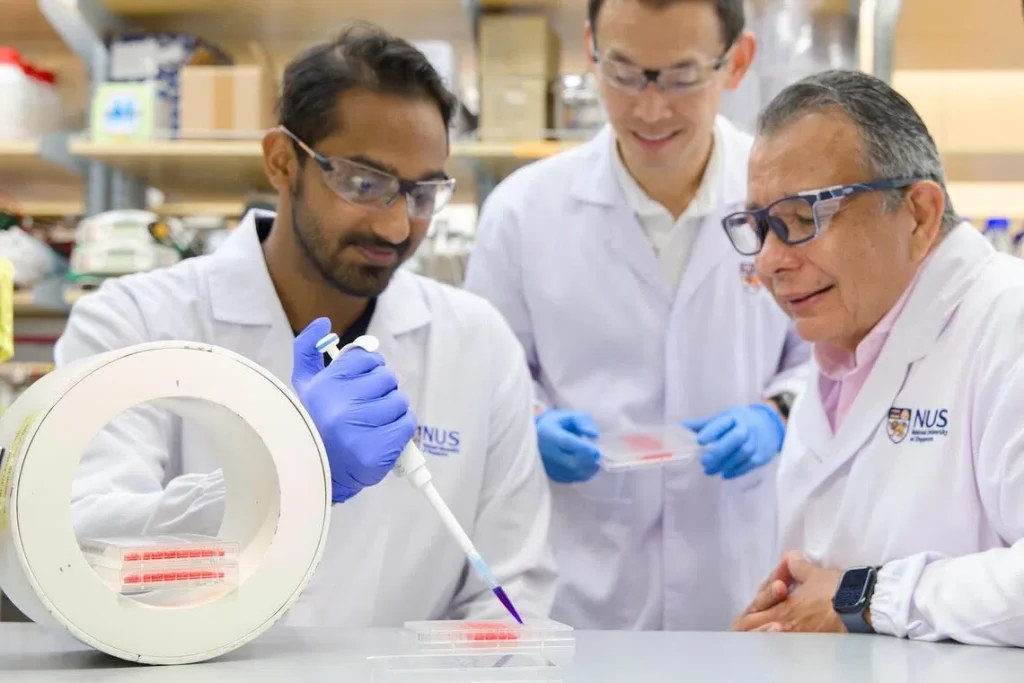
magnetic pulses reprogramme immune cells to fight breast cancer
SINGAPORE – Researchers from the National University of Singapore (NUS) have found that using intermittent, low-intensity magnetic pulses could transform a corrupted class of immune cells that typically promote cancer growth into cells that attack and destroy cancer cells.
These scientists have successfully used this approach for targeted breast cancer therapy without the use of chemotherapy.
The pulsed electromagnetic fields (PEMFs) completely eradicated tumours in 75 per cent of tested pre-clinical models after just four 30-minute sessions.
PEMFs are gentle, low-energy magnetic waves that pass safely through the body without generating heat or damaging tissue.
Alfredo Franco-Obregon, who led the research, said that rather than shocking the body, the pulses “act like a biological tuning fork”.
“When they pass through cells, they interact with specialised microscopic gates on the cell surface called TRPC1 channels, which act as biological antennae for weak magnetic fields. Opening these gates triggers a small, controlled wave of calcium into the cell that activates the mitochondria, the cell’s energy furnace,” he said.
“In healthy tissues, this acts like a brisk workout. The energy stimulates cellular repair, boosts energy production and primes the tissue to heal. In cancer cells, the excess stimulation overloads an already unstable system, making PEMFs precision tools that can either warm up or overheat cells, depending on their resting temperatures,” Franco-Obregon added.
This recent discovery, published in Smart Medicine, an international, open-access, peer-reviewed academic journal, on June 4, was built on the team’s previous work, which showed that brief PEMF exposure enhances the uptake of doxorubicin (DOX), a chemotherapy drug, by breast cancer cells.
Global breast cancer cases are projected to rise by a third, from 2.3 million in 2023 to more than 3.5 million by 2050, while annual deaths may nearly double from 764,000 to nearly 1.4 million.
In Singapore, breast cancer is the most common cancer among women, accounting for around 30 per cent of all female cancer diagnoses.
According to the Singapore Cancer Registry Annual Report of 2023, one in 12 women will develop breast cancer in their lifetime.
Yet, breast cancer treatment faces challenges such as drug resistance, treatment-related toxicities and tumour heterogeneity, which means that cancer cells are not all identical but instead show distinct genetic, molecular and physical differences.
Franco-Obregon, a research associate professor from the Department of Surgery at the NUS Yong Loo Lin School of Medicine, told The Straits Times that his team’s research focused on the calcium channel protein that “breast cancers overexpress to fuel rapid proliferation and quick spreading”.
The protein forms a tunnel in the cell membrane, allowing calcium ions to flow through – an important process for many cellular functions.
“This excess makes cancer cells uniquely vulnerable to calcium overload and mitochondrial overheating,” he added.
With targeted PEMFs, the scientists exploited this vulnerability in a two-pronged precision approach.
First, they induced acute calcium and metabolic stress, affecting the energy systems within cancer cells, without harming healthy tissue. This enhanced the uptake of standard chemotherapeutic drugs, which in turn reduced the required chemotherapy dosages and lessened debilitating side effects.
Second, the magnetic pulses reprogrammed the immune cells that promote cancer growth to consume breast cancer cells instead, restoring the immune system’s ability to detect and attack cancer.
“In our published findings, PEMF exposure halved the effective dosage required for drugs like doxorubicin to suppress cancer cells. Rather than projecting an unrealistic leap to 100 per cent eradication, our clinical objective is to maximise efficacy while slashing toxicity.
“We aim to preserve the patient’s quality of life and immune health without compromising therapeutic impact,” Franco-Obregon explained.
He added that the use of magnetic pulses to directly destroy cancer cells by burning, freezing or rupturing them, as well as to change the behaviour of immune cells, has so far been shown only in pre-clinical laboratory models.
But translating these findings into patient care “is already well under way”.
“As we have already completed our initial Phase I safety trial in breast cancer patients, we have crossed the first major clinical hurdle.
“The next step is our Phase II clinical trial, which will evaluate how effectively PEMF shrinks tumours and enhances chemotherapy in a larger group of patients over the next two to three years,” he said.
Franco-Obregon said that if the results confirm what the team had already observed in the laboratory, larger multi-centre trials would follow to support formal regulatory approval from agencies like the Singapore Health Sciences Authority and the US Food and Drug Administration.
“In practical terms, broad adoption as standard hospital care typically takes several years of rigorous validation. However, eligible breast cancer patients may have opportunities to receive the therapy much sooner by participating directly in our upcoming clinical trials,” he said.
Franco-Obregon cautioned that while PEMF represents an exciting, non-invasive frontier in precision oncology, it remains an investigational therapy that should complement, not replace, proven medical care.
“Yet, to accelerate this timeline, our team is actively seeking forward-looking clinical trial sites, oncology collaborators and funding partners to co-develop and scale this non-invasive therapy towards widespread patient access,” he said.