After Larson’s loss, CT’s 1st District will elect a new representative
Connecticut’s congressional district centered around Hartford has been represented by U.S. Rep. John Larson since 1999. Nearly three decades later, residents will have a new face representing them in Congress after the congressman’s defeat in the Democratic primary in August.
The primary dominated politics in Connecticut for much of the year, but the drama in the state’s 1st Congressional District has reduced to a simmer heading into the general election.
Former Hartford Mayor Luke Bronin goes into the Nov. 3 election with a major advantage in one of the state’s bluest congressional district, known as the “lobster claw” because it stretches north of Hartford and curves toward Torrington and down past the capital city and stretches toward Bristol. Bronin handily won the four-way Democratic primary on Aug. 11, calling it a “political earthquake.” He premised his primary campaign around calls for generational change.
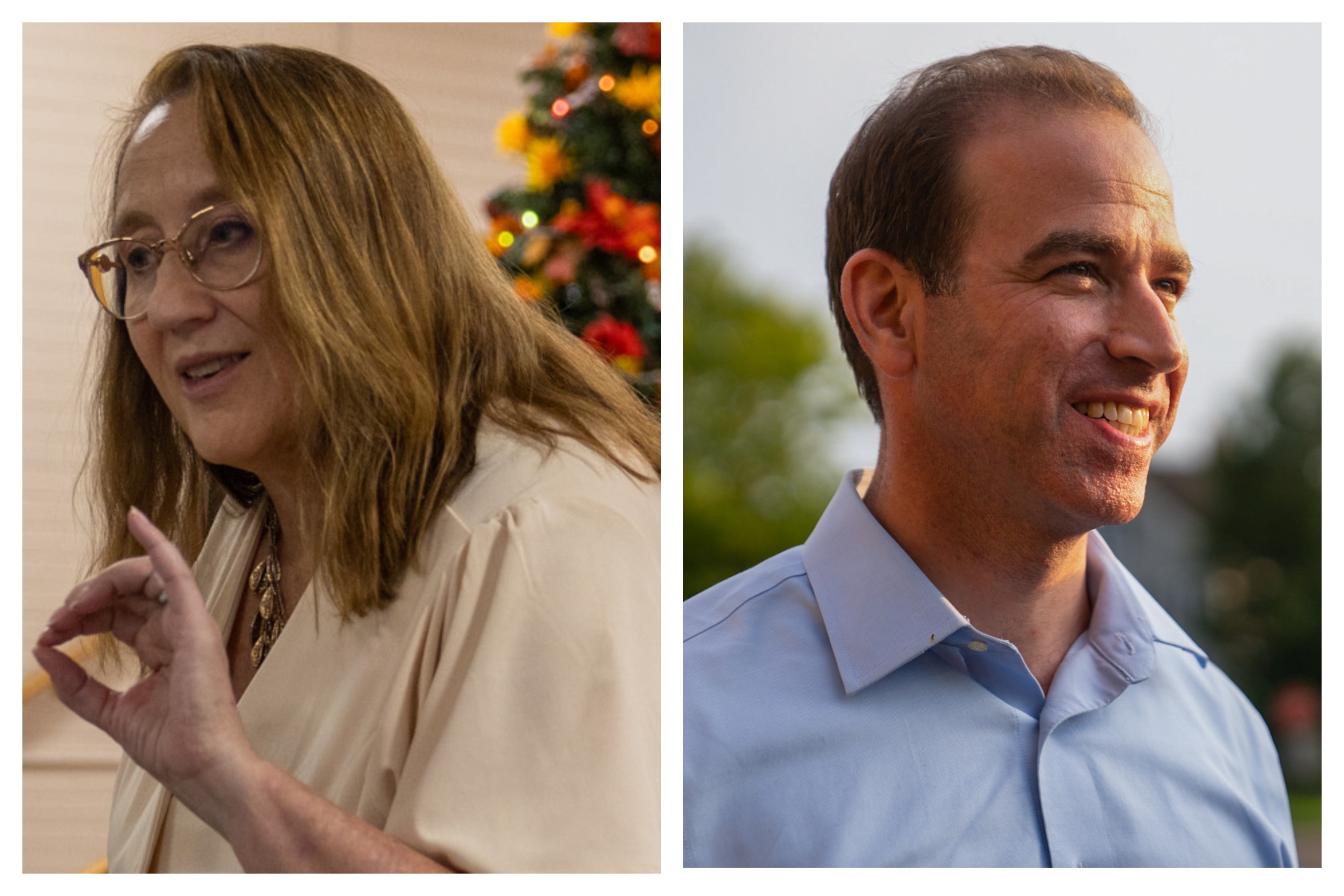
Bronin will square off against Republican nominee Amy Chai, a physician who previously ran for elected office in a different congressional district. Green Party nominee Mary Sanders is also on the ballot, and Mark Stewart Greenstein is running as a write-in candidate.
In 2022, Chai ran as an independent endorsed by the Libertarian Party against U.S. Rep. Rosa DeLauro in Connecticut’s 3rd Congressional District, which is centered around New Haven. Chai said she’ll move to the 1st District if she wins the election. She’s also been endorsed by the Independent Party of Connecticut.
Democrats have represented the seat since 1959. And this year, Republicans nationally are confronting a tough political environment in a midterm election seen as a referendum on the party in power. President Donald Trump faces sagging approval numbers.
Chai acknowledges the odds are stacked against Republicans in the 1st Congressional District and in Connecticut more broadly. That hasn’t deterred her from seeking to get her message out to voters. She said her views don’t fit neatly inside a political ideology and she described herself as an “open book.”
“I don’t really think that liberal and conservative has any relevance in today’s political climate at all. I am a pragmatist, and I have my own ideas, and some of them might be considered a little bit more ‘Democrat’ and some of them more ‘conservative and Republican,’” Chai said. “But I’ve actually been either unaffiliated or Libertarian for my whole life until last year.”
“I’m able to talk to anyone about anything. I’m not afraid to go talk to people. I’m not afraid to listen to people, and my ideas are not my-way-or-the-highway ideas,” Chai said, adding she may be seen as “a little bit ‘eccentric’ because I don’t necessarily think one way or the other way, and a lot of the policy positions that I have that are completely mine.”
Since wining the Democratic primary, Bronin, who served as an intelligence officer in the U.S. Navy Reserve and was deployed to Afghanistan, said he doesn’t take the race for granted and has kept up his campaigning since he won the August primary. He argues that this current moment in politics is about more than the midterm elections.
“I am out there across the district, talking to voters, supporting candidates throughout the district and carrying the message that this is a critical moment when we have to use every minute, every day to build a stronger Democratic Party and to build a movement that is about more than this election,” Bronin said. “It’s about turning the political tide for years to come.”
Connecticut’s entire congressional delegation backed Larson in the August primary. But those lawmakers also had working relationships with Bronin when he served as mayor of Hartford, and they have since unified. Bronin, who attended a recent event with Gov. Ned Lamont and U.S. Sen. Chris Murphy about early voting, said he looks forward to working “hand-in-hand” with the rest of the delegation if he’s elected.
Meanwhile, Republicans running for federal office in Connecticut aren’t getting much financial help or support from their party. Chai said that’s been a major challenge for her campaign.
Chai is a one-woman shop. She handles all of her campaign operations — with the assistance of bots she programmed to help with emails and other tasks.
“It’s really hard to break through,” she said. “And it’s not just the Democrats, it’s also the Republicans, who are completely not on the side of solving problems for people at all.”
While affordability — whether it’s related to food, gas, housing or utilities — is one of the main issues the candidates hear on the campaign trail, they both have a number of other priority issues.
The debate around regulating artificial intelligence continues to be a top priority for Bronin, something that has been top of mind for him since entering the race.
“I talked about artificial intelligence the first day I launched this campaign a year ago because it was clear that our policymaking is so far behind the pace of change of technology, and there are very real opportunities — and also enormous risks — if we don’t build a regulatory structure that can put some guardrails up,” Bronin said.
As whistleblowers and AI company CEOs themselves sounded the alarm over the technology, Congress seemed more willing to engage in conversations over how to address a growing fear among Americans. But hope for that quickly fizzled as lawmakers left town through Election Day and President Donald Trump propped up AI and the large data centers that power them.
Bronin said the lack of urgency from Congress is “no better demonstration of how broken things are in Washington and how unserious the Republican leadership is in Washington.”
Bronin noted that any potential committee work will focus heavily on oversight of the Trump administration and that his party needs to focus on laying out an agenda on healthcare, housing and electricity. He didn’t name any specific committee he’d look to serve on but noted the ones that have jurisdiction over some of those issues, such as the House Oversight Committee and the House Financial Services Committee.
For Chai, she first got involved in politics because she was concerned “about a lot of what’s going on in medicine.” Mental health and addiction services remain critical issues for her, saying that there’s a “massive tsunami of mental illness in very young people.”
Disability rights are also top of mind — and personal. While working as a doctor, Chai said, she privately lived with chronic pain for decades due to fibrosing mediastinitis. She was hospitalized with a collapsed lung and had part of it removed, which has left her with scarring and inflammation. But she didn’t want to tell her employer because she feared discrimination for disclosing it, particularly in a healthcare setting. But she now wants to be open about her condition.
When it comes to immigration, Chai said she agreed with efforts to secure the southern border. On U.S. Immigration and Customs Enforcement, she said she’s “fully opposed to excessive use of force” and said people deserve due process. Citizens who have been arrested by federal agents need an “apology and quick remediation,” she said.
But she believes politicians in Connecticut and protesters have also been “agitating against ICE.” Chai also argued that the lack of cooperation by the state in immigration matters has exacerbated the issue. Connecticut’s Trust Act, which was expanded in 2025, limits how state and local law enforcement can cooperate with ICE and its requests for detainers of undocumented immigrants.
“That would prevent the vast majority of these problems, but that still doesn’t give license to ICE agents to get upset or frustrated or not be able to handle the job and then do things that are inappropriate or hostile or violent either,” Chai said. “But there are two sides to the story.”
In the wake of the deaths of U.S. citizens by federal immigration agents, Bronin called for abolishing ICE and to “replace or rebuild ICE from the ground up in the longer term.”
Social Security was Larson’s main priority throughout his tenure and continues to be a paramount issue that the next Congress will try to take up. A recent report moved up the estimated timeline for when the retiree trust fund would become insolvent. Those predictions now anticipate benefit cuts by the end of 2032.
Before Congress went on recess prior to the election, there appeared to be some movement on bipartisan legislation to bolster Social Security. A bill from Democratic Sen. Elizabeth Warren and GOP Sen. Bernie Moreno would seek to strengthen the program’s solvency by lifting the cap on payroll taxes.
Larson’s own legislation, the Social Security 2100 Act, would increase benefits by 2% for the first time in more than five decades and bolster the program’s solvency by requiring higher earners to contribute more to payroll taxes.
Bronin said there’s an urgency to fixing the program, adding “the longer we wait to shore up and protect Social Security, the harder it will be.” When asked about Larson’s Social Security 2100 Act or other legislation as a possible vehicle to address the issue, he wouldn’t commit to a specific bill, saying there will be a lot of legislative options to consider and work on in the future.
Chai, meanwhile, said she’s adamantly against raising taxes, even on those in higher tax brackets, as a way of bolstering Social Security. She said funding for it should take precedence over funding for defense or foreign countries.
“You’re going to fund your obligation to Social Security recipients before you fund anything else,” she said, while adding that addressing insolvency should be dealt with by cracking down on fraud and abuse. “I would love to see Social Security be something that is a welfare for elderly people who need it, but not such a compulsory thing.”
Throughout all phases of the campaign, Bronin has maintained a major financial advantage.
Since jumping into the race last summer, he raised a total of nearly $3.7 million and spent about $3.3 million. He has about $350,000 left for the general election. Chai raised about $21,000, spent $16,000 and has a little over $300 left.
Bronin, Chai and Sanders will square off in a debate hosted by the League of Women Voters of Greater Hartford on Oct. 22 at 7:30 p.m. from West Hartford Town Hall.
In-person early voting began Monday, Oct. 19 and runs through Sunday, Nov. 1. The last day to request an absentee ballot is Nov. 2.