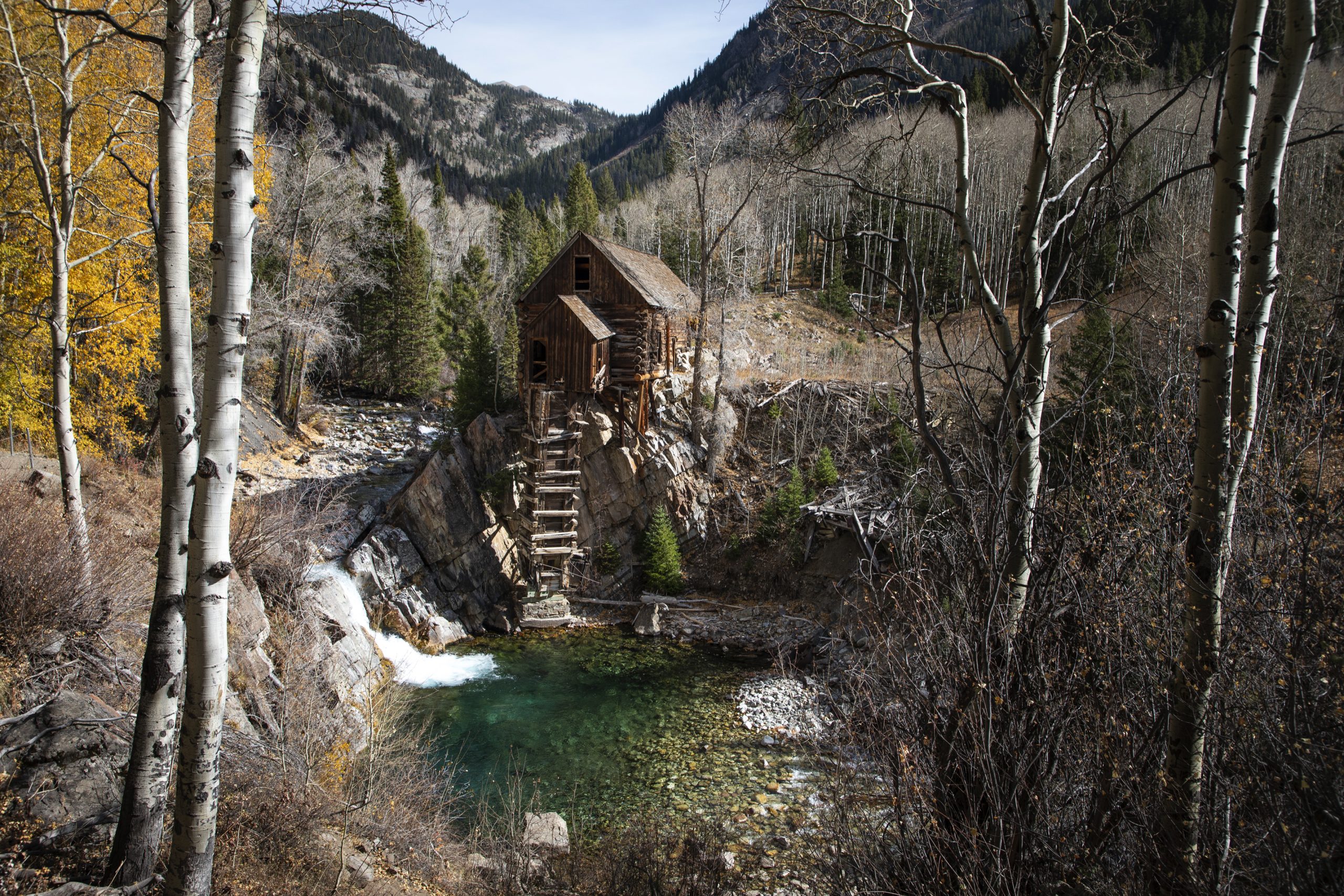
Can a proposed Colorado land swap work with the GORP Act?
A landowner above the Crystal River wants to trade acreage on the valley floor — including around the iconic Crystal Mill — for steep terrain above the river to build a private, exclusive ski area.
But those steep slopes are included in an expansion of a wilderness area in the Gunnison Outdoors Resources Protection Act, or GORP.
A representative of the landowner said it’s not a big deal because the GORP Act is “aspirational” and the ski area land exchange plan would immediately transfer 1.75 miles of riverfront along the Crystal River — land that sees as many as 30,000 visitors a year — to the White River National Forest.
“This is using private recreation to fund conservation,” Phillip Supino, a representative of Treasure Mountain Ranch along the Crystal River, told a Gunnison County committee in August.
Colorado U.S. Sen. Michael Bennet spent close to a decade working with the Gunnison Public Lands Initiative to craft the legislation. It is one of the most ambitious public lands bills ever for Colorado, with fellow Democrat Colorado U.S. Sen. John Hickenlooper joining Bennet in unveiling the plan in 2024 and last year, Colorado U.S. Rep. Jeff Hurd, a Republican, cosponsoring the bill.
The act would increase protection for more than 730,000 acres in the Gunnison River Basin while protecting existing water rights and public access. It has the support of six counties, five towns and 16 diverse advocacy groups that include motorized users, anglers and hunters, ranchers and river users.
It also proposes expanding several wilderness areas in the Gunnison River Basin by nearly 123,000 acres, including land on Treasure Mountain where the Crystal River landowners want to develop a snowcat-accessed ski area for a handful of owners.
It’s one of two proposed land exchanges in the region. And both involve Colorado’s first-term Congressman Hurd, who has met with the owners of Treasure Mountain Ranch and drafted a bill for another.
Hurd, who is a cosponsor alongside Colorado U.S. Rep. Joe Neguse, a Democrat, says his support for the GORP Act has not changed since he introduced the legislation in May 2025.
But after hearing comments from Supino, who said his talks with Hurd staff suggested the congressman’s support for GORP was waning, the legislation’s cheerleaders are wondering if the congressman is as eager a supporter of the land bill as his Democratic peers in D.C.
Gunnison County Commissioner Jonathan Houck, who helped form the GORP Act, listened to the comments at the STOR Committee meeting and called Hurd. Supino, citing Hurd staffers, suggested Hurd support for GORP was “a very strategic response.”
“He unequivocally said those statements about his position are absolutely false,” Houck said.
Houck said Hurd is meeting with groups that have concerns about the legislation “and he wants to work through those with us.”
Houck said Hurd told him he was not delaying the legislation.
“He said maybe we need to do some town halls and get people together to talk about this,” Houck said. “I am absolutely on board with that.”
A proposed land swap at the Crystal Mill
The owners of about 700 acres around the Crystal townsite and the photogenic Crystal Mill want to give the White River National Forest a little more than 300 acres along nearly 2 miles of the Crystal River on the valley floor in exchange for 367 acres of steep terrain above the valley for a small, private, snowcat-accessed backcountry ski club.
It’s a bit of a reversal of typical public land swap proposals, which typically involve developers who want valley land and they offer remote, hard-to-develop parcels up high for trade. Supino, with Treasure Mountain Ranch, presented the plan to the Sustainable Tourism and Outdoor Recreation Committee — or STOR Committee — in late August.
Jon Hare with the STOR Committee was expecting the update from Supino, the owners’ representative, to discuss how the Treasure Mountain Ranch group had adjusted its proposal to accommodate the GORP Act.
Instead, Supino lobbed a bomb that has resonated across the conservation community.
A meeting with the Sustainable Tourism and Outdoor Recreation Committee
Supino, the former community development director for the city of Aspen, told the committee at its Aug. 27 meeting that the Treasure Mountain Ranch owners are not too worried about conflicts with the GORP Act.
Supino told the committee that staff at Hurd’s office made it clear the congressman was not pushing too hard on the GORP Act. He even suggested that Hurd was not planning to introduce the legislation he is cosponsoring.
“That was a punch in the stomach,” said Hare, the advocacy director for High Country Conservation Advocates, which has been working with lawmakers to get the GORP Act in front of a committee in Congress. “We wondered if Phil was hearing something from that office that we were not hearing. It raised a red flag.”
Since Hurd introduced the bill, advocates for the GORP Act say they have not heard much from the Grand Junction lawmaker. The bill was introduced the same day by Bennet in the Senate, but has not moved forward in either chamber.
Congressional hurdles for public lands
The legislation requires a lot of scrutiny by lawmakers — especially in a Republican-controlled Congress negotiating public lands legislation around permitting reform, geothermal energy and wildfire mitigation work.
A spokesperson for Hurd, who is running for reelection against former Aspen city councilman Dwayne Romero, emailed a statement that said the congressman “recognizes the years of work that local communities, businesses, and stakeholders have invested in the GORP Act, and he takes that work seriously.”
“Legislation of this scope requires careful consideration, particularly when it affects public lands, local economies, and the communities that depend on them. He is continuing to engage with stakeholders and his colleagues in Congress to ensure the legislation reflects local priorities and has the strongest possible path forward,” the spokesperson said.
Supporters cheered when Hurd came on board, noting the decade of work to foster bipartisan support for the GORP Act across the region. Hurd, in a statement, said he was “honored” to join Bennet in sponsoring the legislation and said “this legislation reflects strong local support for the responsible stewardship of our land.”
A Republican sponsoring legislation that increases federal protection of lands diverges from current party positions that question whether the federal government should be expanding its role in public lands. Even if the GORP Act passes the House, it faces a Republican-majority in the Senate. Even if the Senate switches to a Democratic majority next month, the GORP Act would need a two-thirds majority to break a filibuster.
Bennet’s Colorado Outdoor Recreation and Economy Act, which proposes increased protection for more than 420,000 acres, was first proposed in 2018 and it has stalled every year since. Colorado U.S. Rep. Diana DeGette first proposed her Colorado Wilderness Act — which would increase protection for more than 700,000 acres in 36 areas — in 1999 and every year thereafter, with no movement.
Support for public lands may be broad in Colorado, but federal lawmakers have shown little appetite in the last decade for legislation increasing protections for federal land. Most federal land protection in recent years has come from presidents using the 120-year-old Antiquities Act, including President Joe Biden’s protection of 225,000 acres in the Thompson Divide in 2024 and designation of the 53,800-acre Camp Hale-Continental Divide National Monument in 2022. President Barack Obama created the 21,500-acre Browns Canyon National Monument in 2015 and the 4,700-acre Chimney Rock National Monument in 2012.
But those Antiquities Act designations can be political footballs, with President Donald Trump reducing the size of monuments created by Obama in Utah and Biden then restoring those monuments only to have them slashed again by Trump in his second term.
Congressional protections — like the GORP Act — are much harder to overturn. But they are much harder to pass, especially in a Republican-controlled House.
Hickenlooper “is committed to protecting the Gunnison Basin and its surrounding landscapes,” a spokesperson said in an email. “Senator Hickenlooper will fight to get the GORP Act across the finish line and preserve our public lands because it’s what Colorado wants.”
GOP opposition to expanded federal protections for public lands
Ron Hanks, a former Colorado state representative who tried to beat Hurd in the June Republican primary to represent the 29-county 3rd Congressional District, challenged Hurd’s support of the GORP Act, saying it “locked up” 730,000 acres.
Hanks pointed out that the federal government already controls more than 36% of the total land in Colorado.
“I contend the federal government is not doing a good job managing what it has,” Hanks said in a campaign video that also highlighted his opposition to a national monument proposal around the Dolores River and more protections around the Rio Grande. “We have to stop all of that.”
Hare said GORP Act supporters are wondering if party pressures are eroding Hurd’s support for the legislation. Supino’s comments bolstered suspicions Hurd was not as avid a GORP Act supporter as his Democratic colleagues in Washington.
A spokesperson for Hurd said the congressman’s position has not changed and he continues to support the GORP Act and is working to get it heard by the House Committee on Natural Resources, where it was referred after the bill was introduced. Hurd is a member of that committee.
Still, Hare said the comments by Supino “kind of made sense.”
“We have been trying to get Rep. Hurd to come visit Gunnison so we can show him some of the amazing things that can happen through the GORP Act, but we have not seen him since he came here in May 2025,” Hare said.
Colorado — and residents of the 3rd Congressional District — support public lands
Supporters of the GORP Act point to a recent poll by Magellan Strategies for the Keep it Public Colorado coalition that is promoting the GORP Act. That survey shows residents in the state’s 3rd Congressional District overwhelmingly supporting public lands. The September survey of 994 residents — including 199 Democrats and 278 Republicans — showed 84% in support of the GORP Act, including 70% of Republicans and 95% of Democrats surveyed.
Supino told the committee that the owners of Treasure Mountain Ranch support the intent of the GORP Act, but suggested that the proposed land exchange would require an amendment to the legislation.
He called the GORP Act “aspirational” where the land exchange would immediately impact access and protection of popular acreage in an area that sees as many as 30,000 visitors a year. Those visitors to the Crystal Mill deliver an economic impact of $14.1 million to local communities, Supino said, citing a study commissioned by Treasure Mountain Ranch.
Chris Cox is the co-owner of the Crystal Mill and Treasure Mountain Ranch, which owns the road leading to the 134-year-old hydro-power structure perched on a rock wall above a waterfall on the Crystal River. The mill building, about 6 miles up a four-wheel-drive road from Marble, is a wildly popular destination for photographers.
Cox closed access to the mill in 2023, saying some of the thousands of weekly summer visitors were prying boards off the mill, carving names in trees, flying drones over the property and trying to break into privately owned cabins in the town of Crystal City. One visitor pulled a gun on a Cox employee when they tried to collect a $10 fee for using the private road to the mill.
A private ski club above the Crystal River
Cox and his partners first began studying the private ski club plan five years ago. They have been slowly unveiling plans for the Treasure Mountain Ranch resort in the last year, visiting with community groups along the Crystal River and most recently venturing over the Elk Mountains to Gunnison County to drum up support for their community owned conservation ranch built for backcountry skiing. The owners have not submitted a formal land exchange proposal to the White River National Forest.
The land swap proposal in Bear Basin beneath Bear Mountain includes acreage that is part of a wilderness expansion in the GORP Act. If the GORP Act is approved, it would permanently prevent any development or mechanized travels on the slopes where Treasure Mountain Ranch proposes ski slopes.
The idea behind the land exchange, Supino said, is “using private recreation to fund conservation” around the Crystal River.
Supino, in an interview with The Sun, said Treasure Mountain Ranch owners recently sat down with Hurd and his staff. He said the group was “pleased with the congressman’s fluency about the issues and his awareness of what we want to do and our protection of the public benefits in our conservation and preservation efforts.”
Hurd is considering support for another land exchange
Hurd is apparently mulling another nearby land exchange.
The congressman has drafted a bill, the Greater Access for Multiple-use Experiences Act, or GAME Act, that would deliver 2,179 acres of land managed by the Bureau of Land Management to a ranch owner near Carbondale in exchange for that ranch owner providing nearly 2,100 acres of private land northwest of Rifle to the BLM.
The proposal comes from the owners of the Out of Bounds Ranch east of Glenwood Springs near Missouri Heights, which wants to consolidate its checkerboard private holdings on adjacent BLM land where the ranch grazes cattle. The ranch owners want to swap two ranches on the Roan Plateau — the 1,083-acre Cow Creek Ranch and the 1,020-acre Timber Valley Ranch — with the BLM in exchange for the land near its property.
A letter of support that accompanied draft legislation from Hurd — which was included in a July agenda packet for the Garfield County commissioners — says BLM ownership of the two ranches could expand access to 8,900 public acres that has “extremely limited public access due to surrounding private ownership.”
“The exchange would dramatically improve access to this parcel” by opening public access to four roads that are currently private.
Garfield County commissioners in July approved a resolution supporting the exchange, with Commissioner Perry Will recommending that the acreage being transferred to the Out of Bounds Ranch include a deed restriction that prevents any development other than agriculture and ranch use.
Hurd has not introduced his legislation. An online petition protesting the land swap — organized by landowners near the BLM property that would be transferred to the Out of Bounds Ranch — has collected nearly 900 signatures. That petition argues the privatization of public land adjacent to the Out of Bounds Ranch would “restrict access to tens of thousands of acres of BLM and Forest Service.”
The ranch owners, Scott and Tiffany Smith, in a post on their website, said they supported a perpetual deed restriction “protecting the rural and open character from residential subdivision and development.”