How a Colorado bakery is using ancient grains to save water
Can Colorado do more with less water?
Where Colorado will find the water it needs to thrive is a more urgent question than ever amid historic drought, undeniable climate change and unprecedented interstate conflicts over limited river supplies.
The Colorado Sun is embarking on a solutions journalism series asking who in the state is doing their share to save precious water. Our solutions-oriented reporting will assess whether specific water conservation projects can free up water at a large scale, or whether local conservation is always overwhelmed by uncontrollable natural conditions or immovable market realities.
The Colorado Sun series, “Can Colorado do more with less water?,” will create a body of work showcasing what may or may not be possible in creating water solutions across the state. From Akron to Aspen, we’re looking for signs of success or failure that will help lead us to water security.
At the back of Pueblo Seed & Food Company — just off the main drag of Cortez in southwestern Colorado, past the shelves bearing bags of pancake mix and seed packets, down the hall from the grain literacy display — Nanna Meyer is fighting for a food revolution.
“I’m not a trained baker,” she said as she prepared a sample of Zuni cakes paired with vanilla yogurt, Palisade peaches and a green chile sauce made from peppers grown at the company’s farm. The nutty, round cakes were filled with sunflower seeds from ancient varieties historically cultivated by the Hopi and Zuni peoples.
The cakes are also part of a growing movement to use age-old grains as a more nutritious, less water-intensive option for both farmers and customers.
Which is why Meyer — a former Olympic sport dietitian and associate professor at the University of Colorado — has set her creativity loose in the bakehouse. She calls her Swiss holiday cookies, inspired by a family recipe, the “gateway” to ancient grains. Her Pueblo chile twists and cinnamon rolls keep people coming back. Then rye sourdough loaves and Zuni cakes inspire loyalty for the health benefits, organic practices and cultural roots.
“They try all those things, and they come back,” said Meyer, who co-owns the company with her husband, Dan Hobbs. “They come back.”
Meyer and Hobbs, the company’s farmer and seedsman, seemingly can’t stop trying to tackle challenges in the agricultural industry.
When the company moved from Pueblo County to Cortez in 2021, they realized there wasn’t a food-grade facility for smaller farms to “clean” seeds, or sort out the unwanted chaff, metal fragments and waste. So they got a Colorado Department of Agriculture grant and built one.
When stores struggled to get customers to pick strange-grain loaves over the familiar sliced white? Pueblo Seed & Food Co. created a bakehouse to be a living laboratory garbed in stainless steel kitchen appliances and grain literacy posters. People can drop in, learn about the seeds and grains and try out a cinnamon roll to better imagine what can be done with unfamiliar ingredients.
This story first appeared in Colorado Sunday, a premium magazine newsletter for members.
When big industrial farming companies patented seeds, precluding smaller farmers from adapting them to local growing conditions? Well, Pueblo Seed & Food Co. started a seed repository that represents 30 years of careful seed selection and expertise — and the seeds are public domain for other farmers.
When drought and a record-dry winter cut the water supply? Hobbs turned to that repository to pick varieties of heritage grains and legumes that had deep roots, grew quickly, could withstand heat, or could produce a crop after being irrigated once or twice.
That helped stabilize the farm’s finances when its water was cut off weeks early and Hobbs couldn’t finish some money-making crops, like Pueblo chiles.
Colorado farmers and ranchers have dealt with bad drought years before, said Amanda Laban, markets division director for the Colorado Department of Agriculture.
“In any really difficult weather year, there are certain crops that actually do just fine. Then there are other ones that are disproportionately affected,” she said. “It’s not always doom and gloom.”
Pueblo Seed & Food Co. is part of a growing network of farmers, bakers, distillers, brewers, pasta makers and customers in Colorado who are turning to unique, ancient grains and legumes. They’re working with groups like the Colorado Grain Chain, which is trying to connect all of the stages of grain production at the local level and help Colorado economies.
The company’s system isn’t perfect, however. The small team doesn’t have time to put energy into large marketing campaigns or pursue all of the company’s dreams. And growing many different crops offers some stability in a drought year, but it requires a ton of different prepping, growing and harvesting techniques.
“Our strength … and our weakness is the diversity,” Hobbs said.
Hobbs’ shoes crunched over the soil as he walked toward uneven rows of corn at the company’s farm 11 miles west of Cortez in McElmo Canyon. The corn variety, called maíz concho, is an heirloom crop grown for generations in northern New Mexico and southern Colorado for tortillas, posole and chicos.
“The place hadn’t been farmed in 30-some years,” Hobbs said, “so we’ve been reclaiming it from the sagebrush.”
Normally, he’d plant 25 acres, a small farm compared with nearby operations ranging from hundreds to thousands of acres. This summer, he farmed 14 acres and fallowed the rest.
That was, in part, because of the summer drought. Parts of Montezuma County experienced severe to extreme drought from April through August, according to the U.S. Drought Monitor. Statewide, the days were 5.6 degrees Fahrenheit warmer than a 131-year average for October through August.
Nearby, farms, like the Ute Mountain Ute Farm and Ranch, expected a fifth of their water supply, or less. After a record-dry winter ended a month early, Hobbs knew he’d be in for water cuts, too. By mid-August, his water was cut off.
“I was kind of moving forward with faith at that point that we were still going to be able to do something,” Hobbs said.
That’s where ancient grains came into play.
There’s no standard definition of “ancient” or “heritage” grains. It’s a term that describes varieties of grains and legumes that were often left by the wayside as the agricultural industry focused on mass producing three big grain crops — wheat, maize and rice — as efficiently as possible. Feeding 8.3 billion people worldwide, after all, is no easy task.
(For those interested in history, this is a trend that really kicked off in the 1940s with the green revolution.)
Over time, crop varieties decreased as countries relied on high-yield seeds, slashing genetic diversity in plants and ramping up concerns about food security. Less diversity means crops struggle to adapt to changing conditions, like hotter temperatures, less water and decades of drought, according to a 2018 research study.
But some grain varieties are still genetically diverse and similar to varieties that go back hundreds or thousands of years. These grains, like sorghum, millets and rye, are often hardy because they’ve gone through different climatic cycles and can stand up to hotter, drier conditions, Laban said.
“It is more likely that an ancient grain is going to be a water-saving crop,” she said. “But it’s not exclusive to ancient grains.”
These “ancient grains” aren’t perfect. They can have low or erratic yields, are tough to grow or require specialized equipment to process. But many survive, or even thrive, in low-water drought years.
This spring, Hobbs decided not to plant as many water-loving crops, like chiles and melons. It was his smallest chile planting since around 2017.
Instead, he prioritized plants that had deep roots, needed less water and would grow quickly, like a Hopi variety of sunflowers; durham wheat, a heat-tolerant wheat originally from the Mediterranean; cow peas from the Sahel region of Africa; and purple barley.
“Purple barley. Slender seed head. Not a ton of food coming out of that,” he said, holding up the head of grains on a sunny day in July. “Barley has incredible roots that go up to 2 meters into the ground. Culinary varieties are higher in protein than the barley used for brewing.”
He planted amaranth, a species first domesticated 8,000 years ago by the ancient Aztecs and often hailed as a drought-beater.
A big winner this year: tepary beans, which evolved with monsoons to produce beans after one or two irrigations. The plants grow quickly, but the bean pods can shatter easily during harvesting. They ended up having to hand-harvest those, he said.
“It’s a lovely food, but probably not ready for a conventional farm,” he said, kneeling next to the young, green plants. He saved seeds from tepary plants that produced pods that shatter less frequently.
This year, the farm likely will scrape by financially even without moneymakers like chiles. He can sell ancient grains in niche markets alongside grains and seeds that go to wholesale buyers or the company’s bakehouse, he said.
“We’ve been just breaking even for years. We do it because we love it, mostly,” Hobbs said. “We’re constantly learning. We like being active. We like feeding people.”
Dan Hobbs, seedsman and farmer for Pueblo Seed & Food Co., describes the characteristics of tepary beans, which can produce beans after being watered once or twice. (Shannon Mullane, The Colorado Sun)
Field to … where?
Simon Martinez, manager of the Ute Mountain Ute Farm and Ranch enterprise, was thinking a lot about ancient grains in the hot midsummer months.
The 7,700-acre farm and ranch, located behind Ute Mountain and just down the road from the seed company’s fields, started out the summer with 14% of its normal water supply. As Martinez scraped together more water, eventually increasing their supply to around 20%, he brainstormed ways to maximize profits on the farm.
Ancient grains, sold in niche markets for more money, sound like an option for some fields, he said. They’ve already tried the value-added, boutique crop approach with cornmeal for the gluten-free Bow and Arrow brand.
“It seems to be working for them. Less corn, more money,” Martinez said of the Bow and Arrow brand. “People are more concerned about what they’re putting in their bodies, as far as processed food.”
But a simple problem is barring the way: His current grain storage is for gluten-free products only. He’d need to build more silos to store other crops containing gluten to prevent any crossover.
It’s a common challenge. As small farms gave way to large, industrialized farms in recent decades, local places to store, clean and process grains were replaced by semitrucks delivering large loads to far-away processing facilities.
Lisa Boldt, executive director of the Colorado Grain Chain, wants to reconnect growers to local processing facilities then to the bakers and brewers that sell directly to customers. If this local “grain chain” can be reconstructed, that would mean more jobs in Colorado and a food system that can adapt to a changing climate, she said.
“Colorado is a huge wheat growing state,” Boldt said. “But more and more, heritage grains are becoming more popular for water-saving reasons, but also for diversity of income, crop options for farmers to grow and to sell (to) people.”
Then, of course, there is the market dilemma. Farmers can grow anything.
“That’s not going to be the issue,” Boldt said. “It’s: Is there a market to sell it to?”
If you bake it, they will come
The casual customer might not immediately notice the weighty, $20 loaves of rye sourdough bread stacked in the freezer at James Ranch Market outside of Durango. It’s not easy to tell that the loaves hold ancient grains or are the result of innovative farming techniques.
And if a customer does choose the bread, they might not be convinced — at least not at first, Meyer said. Sometimes it’s the texture, the tangy taste of fermentation or the color that throws them off.
That’s why the bakery and retail space is such an important part of Pueblo Seed & Food Co.
On a Saturday in July, customers arrived in waves at the Cortez location to peruse pasta, jams, flours, fresh baked goods and bags of cereal grains.
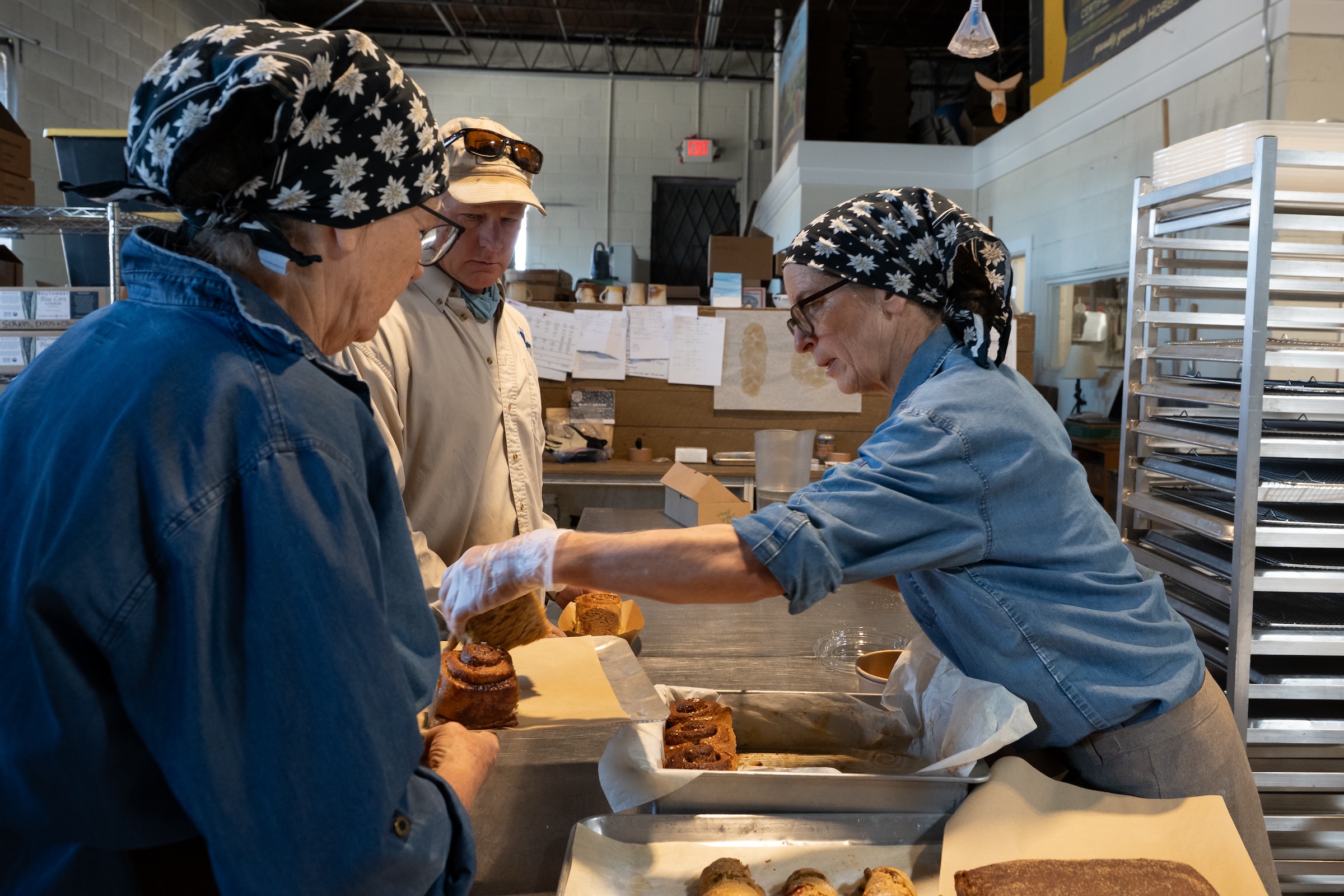
Zuni cakes come out of the oven at the Pueblo Seed & Food Co. bakehouse in Cortez. The nutty, round cakes were filled with sunflower seeds from ancient varieties historically cultivated by the Hopi and Zuni peoples. (Shannon Mullane, The Colorado Sun)
“Did you get rain in McElmo?” one of the customers asked Hobbs.
“Pretty skimpy,” he said.
One man made the one-hour drive from Durango to visit the store, which is only open one day a week. A milling demonstration station stood ready for any home baker interested in learning how to freshly mill their own grain. A recording of pan flutes played in the background, and cafe tables were ready for anyone who wanted to stop for a cup of coffee.
“We come here every week,” Michelle Drudge, a Cortez resident, said. “You cannot go wrong with anything you purchase, but I got chile grits and then I got some more flour, some cinnamon rolls.”
While people might first try the sweets, they stay for the health benefits, Meyer said.
As customers meandered around the retail space, she moved purposefully in the bakery’s kitchen, checking temperatures, taking bread out of ovens, packing loaves and prepping to restock the food in the front.
“There are a lot of questions about gluten and modern wheat and the microbiome,” Meyer said. She used to be a clinical associate professor of human physiology and nutrition at the University of Colorado. Then she developed a passion for local food systems and now infuses her baked goods with years of expertise.
People want to take care of their gut because they read about how the gut is related to the brain, diabetes, cancer, and cardiovascular and metabolic health, she said.
Fiber is the food of the gut microbiome. It’s in different grains and different forms of grains — flour, cracked grain, soaked grain, fermented. All of these different forms are accessible to the microbiota, the trillions of microorganisms in human digestive systems.
She turned to a tray of chile twists, made from a grain called einkorn — which has been cultivated for over 10,000 years — and filled with cheese and Pueblo chiles.
“That’s the oldest wheat,” she said. “Pretty brittle in the field, but super drought-tolerant and the most nutritious of all.”
The company has its fingers in almost every step of the grain process from start to finish, and it’s this vertical integration that helps tackle the stubborn issue of luring customers to try new products.
Over the past five years, they’ve built a core following. But it’s a small town, and they’re still in startup mode, Hobbs said.
In the past, the couple added food service twice a week to their normal wholesale operations. When they did it, their lunch dishes were composed of 95% local and homegrown ingredients.
They cut the food service after too many days without strong sales, but they’re considering adding back some options, like blue corn pancakes on Saturdays, he said. They also used to open the retail space three times a week, now down to one.
They advertise on the local NPR station, Instagram, Facebook, the Colorado Proud program and through a few newsletters a year. That’s about all they can manage.
The company’s retail space is a small step in a larger food movement in Colorado.
Pueblo Seed & Food Co. sends garlic, chiles and wheat to a business in McElmo Canyon, a jam-maker in Pueblo and the Boulder craft pasta maker, Pastificio. Those companies make pasta and Pueblo chile sauces and jams with local peaches, which are then sold at the seed company’s retail store in Cortez.
The store functions like something between a very grain-focused grocer and a farm store. A place where customers, like Michael Canzona, can find local peaches and cacao-chile cookies with unique flavors.
“It’s just the vision behind what they’re doing and why they’re making these foods,” he said, explaining his loyalty. “The deeper intent than just making money is what drew me here.”