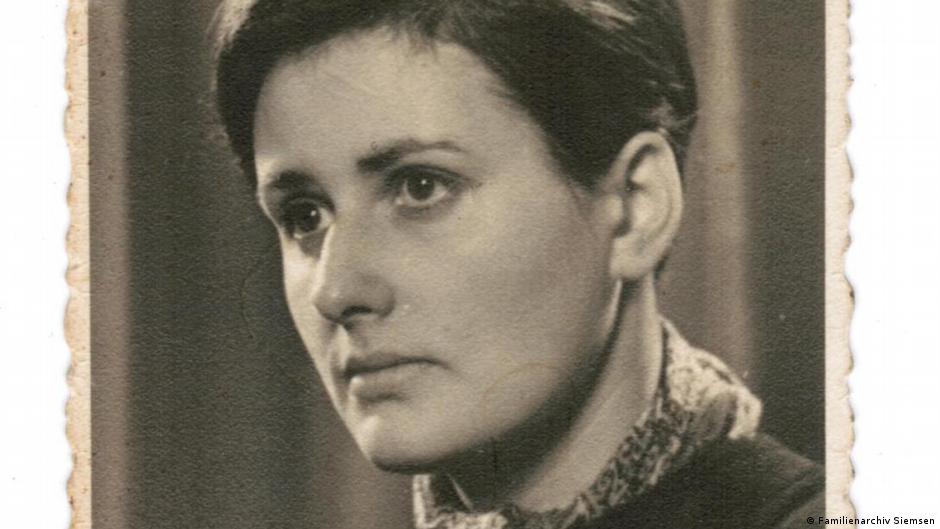
Who was Jewish anti-fascist resistance fighter Eva Mamlok?
In the history of German resistance to Nazism, some names have become symbols: Sophie Scholl, Claus von Stauffenberg, Dietrich Bonhoeffer and Georg Elser. Yet many others have remained largely forgotten.
Among them is Eva Mamlok, a young Jewish woman from Berlin whose acts of defiance began in her teenage years and continued until her murder in a Nazi concentration camp.
Now more people will get to know her story as Berlin renames Blücherplatz, a square in the district of Kreuzberg, Eva-Mamlok-Platz on October 16.
“Eva Mamlok was a very remarkable person. As a young Jewish woman from Berlin, her spirit of resistance was particularly striking,” said cultural researcher Alexandra Weltz-Rombach, who has worked extensively with the historians’ network “Gruppe Eva Mamlok.”
‘Down with Hitler’
Mamlok was born on May 6, 1918, into a Jewish family in Berlin. They ran a wholesale wine business, and the family belonged to the vibrant Jewish middle class that formed an important part of Berlin’s social and economic life during the Weimar Republic.
But Eva came of age just as Germany was descending into dictatorship. When Hitler became chancellor in 1933, she was only 14 years old. She was also a member of the Socialist Workers’ Youth (SAJ). Following the suppression of the left-wing political youth organization later that year, she became active in the underground resistance.
According to testimony from Inge Berner (1922-2012), the sole survivor of Mamlok’s later resistance group, Eva climbed onto the roof of a department store on Blücherplatz as a teenager and painted the slogan “Down with Hitler.”
“She was caught doing that, though she wasn’t arrested at that particular moment — that didn’t happen until a year later,” noted Weltz-Rombach.
Arrested for honoring socialist icons Luxemburg and Liebknecht
Mamlok first appeared in official records in November 1934, after she was arrested for taking part in commemorations for socialist leaders Rosa Luxemburg and Karl Liebknecht at Berlin’s Friedrichsfelde Cemetery.
Authorities determined that the 16-year-old held “hostile views toward the state” and placed her in “protective custody until further notice” — a euphemism the regime used to justify imprisonment without trial. She was sent to the women’s concentration camp at Moringen in Lower Saxony, where she remained until May 1935.
After her release, she continued her anti-Nazi activities despite the increasing danger, facing persecution both as a political dissident and as a Jew.
In these underground circles, she met Pieter Siemsen (1914–2004), and they remained a couple until he emigrated to Argentina in 1937. The only known surviving photograph of Eva comes from his personal archive.
She had a daughter, Tana, in 1939. The father’s identity is unknown, however. The child was placed in a Jewish orphanage in Berlin and deported in 1942 to the Auschwitz-Birkenau extermination camp, where she was murdered.
Meanwhile, because she was Jewish, Mamlok was forced to perform compulsory labor at the Berlin firm F. Butzke Schrauben-Industrie in 1940. There she met other women who shared her opposition to Nazism.
Together they formed what later became known as the “Eva Mamlok Group,” an informal resistance network of Jewish and non-Jewish women. They distributed anti-Nazi leaflets and wrote slogans critical of Hitler.
They also shared banned books. “They were books that are today part of Germany’s educational canon,” from Thomas Mann to Lion Feuchtwanger, said Weltz-Rombach. That the Berlin Central and Regional Library (ZLB), Germany’s largest public library, stands on the new Eva-Mamlok-Platz is a fitting symbol of this act of resistance and the importance of books, she added.
Mamlok and others in her group were arrested for distributing this forbidden literature. On January 13, 1942, she was deported from Berlin to the Riga Ghetto in occupied Latvia.
According to Inge Berner’s testimony, Mamlok remained active in the resistance there too. For example, she arranged for a contact still in Berlin to send her a cake with a miniature camera hidden inside it to document persecution in the ghetto.
In October 1944, she was sent to the Stutthof Nazi concentration camp, where she died in December of that year.
Replacing old symbols of Franco-German hostility
Blücherplatz was named after the Prussian field marshal Gebhard Leberecht von Blücher, whose most renowned achievement was leading his army against Napoleon at the Battle of Leipzig in 1813 and the Battle of Waterloo in 1815.
Several places, including streets and parks, have been named after him in Germany.
“There is no shortage of Blücher memorial sites,” said Weltz-Rombach. “And perhaps it’s also time to put an end to this old Franco-German enmity — which is, of course, inherent in the name Blücher, given its Prussian tradition — and to establish, in its place, a different form of remembrance.”
The square also happens to be the site of the Carnival of Cultures, a multicultural street festival and parade held every year to celebrate Berlin’s global diversity.
Role models for a new generation
Having first heard about Mamlok when a Stolperstein commemorating her was laid in 2011, Weltz-Rombach has been researching her biography for the past few years. The Berlin-based filmmaker, producer and curator has also been sharing the resistance fighter’s story through various projects, including an exhibition in 2024 and a podcast series with young Berliners.
Since Mamlok was only a teenager herself when she became politically active, the workshop participants can easily relate to her fate.
These teenagers learn about Mamlok’s experiences at the actual locations where she was active, helping them imagine what it would be like to be arrested and imprisoned for six months without trial for doing things that normally wouldn’t be considered crimes — such as simply expressing an opinion publicly or laying flowers at a commemorative event, explained Weltz-Rombach.
“Above all, she is, of course, a role model — an example of how one would like to act oneself, and how courageous one would like to be.”
“[Women’s] resistance was often of a more everyday nature, rather than planting bombs,” said Weltz-Rombach. Their stories offer examples of “forms of resistance that have only recently received more attention.” Other examples include a 2024 exhibition and the launch of a database dedicated to female resistance fighters.
Even though many of the eyewitnesses are now dead, Weltz-Rombach believes there are still many more of these stories that deserve to be brought into the spotlight: “There are definitely many names we do not know, that are waiting to be further researched.”
Edited by: Joshua Lang