MRT reliability hits new all-time high in Singapore
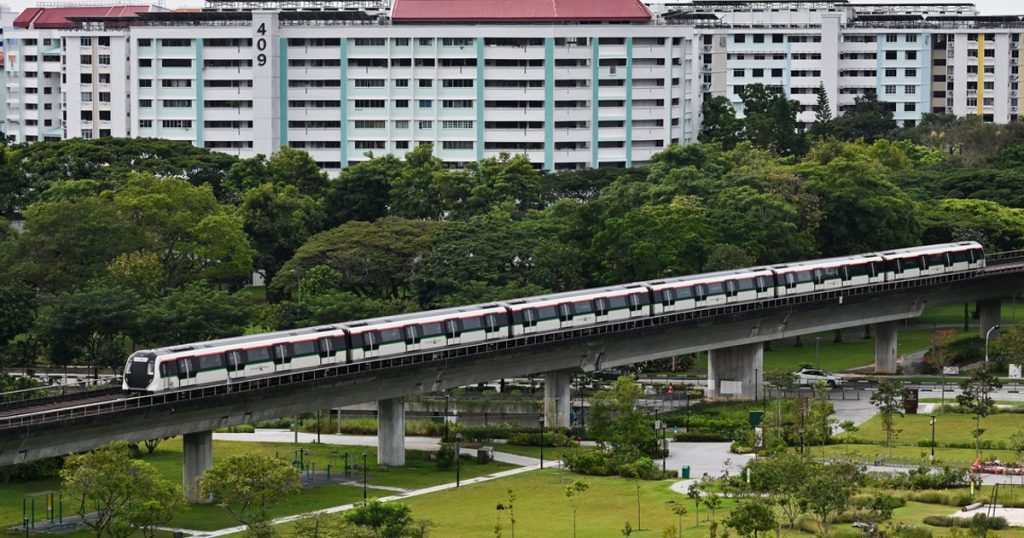
SINGAPORE – The MRT network has reached an all-time high in reliability, with four of the five mature rail lines recording improvements in September.
Between October 2025 and September 2026, MRT trains clocked an average of 3.38 million train-km between delays lasting more than five minutes, the Land Transport Authority (LTA) said in its latest rail reliability report published on Oct 15.
This is triple the Republic’s rail reliability target of one million train-km for the entire MRT network, as measured by mean kilometres between failure (MKBF).
MKBF is a widely used engineering measure of rail reliability and shows how far a train travels before it encounters a delay lasting more than five minutes. LTA’s figures are based on a 12-month moving average.
The latest data marks the first time the network’s MKBF has surpassed three million train-km. It is also the sixth consecutive month that the network’s MKBF has exceeded two million train-km.
The East-West Line (EWL) and North-South Line (NSL), both operated by SMRT, recorded the biggest gains in reliability.
The reliability of the EWL rose from 2.52 million train-km between delays to 3.36 million train-km, while the NSL’s increased from 1.65 million train-km to 2.48 million train-km.
The Circle Line, also run by SMRT, saw a slight improvement from 2.51 million train-km to 2.57 million train-km.
The North East Line (NEL), operated by SBS Transit, remained the most reliable MRT line, with its MKBF rising from 4.48 million train-km to 4.5 million train-km.
However, the other SBS Transit-operated line, the Downtown Line (DTL), experienced a sharp dip from 8.37 million train-km to 4.19 million train-km.
Only the DTL had a major delay exceeding 30 minutes in September, on Sept 29, which affected fewer than 5,000 passengers, LTA said.
Speaking to reporters at the Ten Mile Junction depot on Oct 15, Transport Minister Jeffrey Siow described the six consecutive months in which the network’s MKBF exceeded two million train-km as “quite unprecedented”.
“It shows that we have been working really hard at making sure the reliability of the system is good.”
He noted that train systems are complicated systems, with many components and many parts.
“It is invariable that sometimes, occasionally, there will be faults in the systems, or components that are not working, and there will be a delay or a disruption. This is inevitable. But we will work very hard to minimise these occurrences,” Siow added.
However, he cautioned that the MKBF will not be able to go up forever. As it is calculated on a rolling 12-month basis, a line that does not experience a disruption for a whole year would have reached its theoretical maximum threshold.
Siow noted that the NEL in particular had not experienced a disruption for a year.
Train punctuality and the proportion of train services that operated on schedule also saw improvements.
Overall train punctuality improved from 99.03% to 99.36%, with only the NEL experiencing a slight dip from 99.08% to 98.61%.
It similarly recorded a small decrease from 99.9% to 99.86% when it came to operating on schedule, while all the other MRT lines had improvements, or in the case of the EWL, remained the same.
Overall, 99.84% of train services operated on schedule in September, up from 99.62% the previous month, the report said.
The figures for the network’s newest line, the SMRT-run Thomson-East Coast Line (TEL), are excluded from the overall report, as MRT lines in their early stages tend to have significantly lower mileage due to relatively low ridership and trains not running at typical frequencies.
The TEL’s reliability went up in September, averaging 498,000 train-km between delays, up from 415,000 train-km the previous month.
It also did not encounter a major delay exceeding 30 minutes, and LTA said it expects the line’s performance to improve after it fully opens in 2026 and operations have stabilised.
The fifth and final stage of the TEL, comprising Bedok South and Sungei Bedok stations, will open later in the year.
On the LRT front, there was a dip in reliability, with trains averaging 622,000 car-km between delays, down from 734,000 car-km previously.
While the SMRT-operated Bukit Panjang LRT’s (BPLRT) reliability remained unchanged at 443,000 car-km between delays, the Sengkang-Punggol LRT, run by SBS Transit, recorded 776,000 car-km, down from 1.08 million car-km the month before.
LTA noted, however, that the BPLRT has achieved its highest MKBF, having started with an MKBF of 53,000 car-km in 2017 before renewal works in 2018. This is because a substantial amount of renewal works was completed this year.
The authority added: “This was only possible because of our transport workers and rail operators.
“Our high MKBF levels over the last six months reflect their sustained effort and dedication to uplift reliability and improve their response to faults and incidents, as well as the constant upgrading and maintenance work on our rail systems.”