Republicans outspend Democrats to block Colorado Capitol supermajority
Republicans are spending more than $1.6 million to defend a state Senate district in Douglas County they have held comfortably for the last 15 years in what appears to be a desperate attempt to prevent a Democratic supermajority at the Colorado Capitol.
Democrats are just one House seat and one Senate seat shy of what lawmakers say would be their first bicameral supermajority, meaning they would control two-thirds of the seats in both chambers of the legislature, which would allow them to override vetoes from the next governor and put constitutional amendments on the ballot without any Republican votes.
But a supermajority may not be on every Democrat’s wish list.
It would weaken the next governor, likely to be Democratic Attorney General Phil Weiser, and force Democrats in the legislature to reconcile tough questions about policy choices that they’ve been able to avoid over the past eight years by using the threat of a veto from Gov. Jared Polis as cover.
Based on the spending so far, Republicans appear to want to prevent a Democratic supermajority far more than Democrats want to achieve one.
In three competitive Senate and House races in Pueblo, Highlands Ranch and Loveland, Republican state super PACs had spent about $6.7 million as of Oct. 10, more than four times what Democratic groups had spent. In Senate District 30, the Douglas County seat on which a Senate supermajority could hinge, Democratic groups had spent no money to defeat GOP Sen. John Carson as of Oct. 10.
For Republicans, Democratic supermajorities at the Capitol would spell a new level of disaster and embarrassment for a party that finds itself increasingly irrelevant and signal that Colorado’s transition from a purple state to a blue one is largely cemented.
Republican operative Daniel Cole, who manages major GOP spending in state Senate races, called the prospect of a Democratic supermajority the “worst case scenario.”
“That’s a hypothetical I don’t want to entertain,” Cole said. “We’re fighting to make sure it doesn’t happen.”
Big GOP spending
Senate District 30 encompasses the northeast part of Douglas County, including Highlands Ranch, Castle Pines, Lone Tree and Roxborough Park. It’s home to people who are older, whiter and wealthier than the average Coloradan and has been represented by a Republican since at least 2010, despite wins by Democratic presidential candidates in 2020 and 2024.
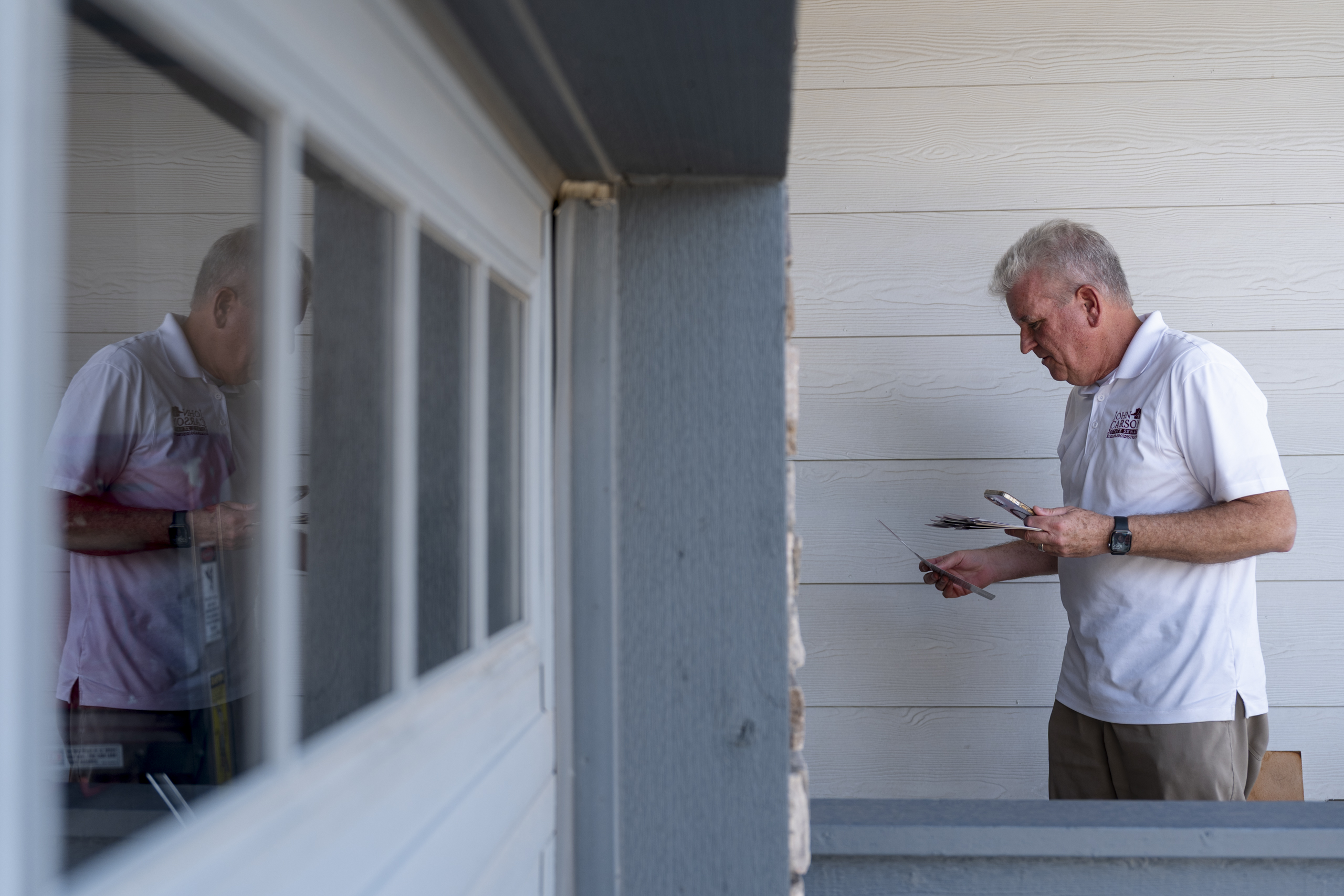
Carson, of Highlands Ranch, who was appointed to the Senate District 30 seat by a vacancy committee in 2025, likes his chances. A lawyer with experience on the Douglas County school board and the University of Colorado Board of Regents, he describes the district as purple and hopes that voters will keep him around for a full term where he said he’ll focus on lowering taxes and increasing penalties for drunk drivers.
He touts his short state legislative record of passing bipartisan bills to help protect kids from AI chatbots and increase penalties for drivers who kill people in traffic crashes.
“It’ll be close, I’m working hard,” Carson said as he applied sunscreen to his face before knocking on doors in the Sterling Ranch subdivision on a recent weekday morning. “I feel good about my positions, so we’ll see.”
Carson’s supporters appreciate his calm demeanor above all else.
“He’s reasonable,” said Renee Anderson, 62, of Highlands Ranch. “He’s one of the kindest people and not afraid of difficult conversations.”
Republican groups have spent more than $1.6 million to support Carson and oppose his Democratic challenger, Kevin Leung, which is more than some statewide major-party candidates have seen spent on their behalf this year.
As of Oct. 10, the Senate Majority Fund has spent more than $1 million in the race, followed by more than $270,000 from Lower Energy Costs Colorado, and more than $190,000 from Republican State Leadership Committee, a federal super PAC. Among the largest known contributors to the Senate Majority fund since August are a federal super PAC called GOPAC, the Anschutz Corporation, Xcel Energy, Amazon and Chevron.
Messaging about the threat of a Democratic supermajority has not been very effective in the past, said Cole, the Republican operative. That is different this time around. It’s a message Cole said canvassers are prioritizing when they knock on doors.
“Now people are aware we have a lopsided government and the consequences of that are not good,” he said. “The message is much more impactful.”
Dem candidates are on their own
Bolstered by Vice President Kamala Harris’ win in the district in 2024, voters’ rejection of a home rule charter petition and a sweep by progressive candidates to the Douglas County school board last year, Democrats claim Senate District 30 is in play.
But so far, Democratic groups haven’t spent any money to support Leung.
Senate President James Coleman of Denver, who advises the Democratic spending group All Together Colorado, said there is still time for money to drop.
“Our primary focus is and always has been to protect our incumbents,” he said. “And our hope is to also support candidates running to flip seats.”
Spending in a House race in Highlands Ranch is just as lopsided, with Republican groups so far spending more than $760,000 to back Nate Marsh compared with Democratic groups’ $0 in support of incumbent state Rep. Bob Marshall.
A national group called the Democratic Legislative Campaign Committee lists Leung, a Castle Pines businessman who has served on the Douglas County Public Schools board and South Metro Fire Rescue Board, as one of its priority candidates. But the group hasn’t spent any money to back Leung or other Democrats in competitive districts.
Leung sees himself as the first serious Democratic challenger for the seat in recent memory. Like Carson, he considers himself a moderate.
He was a never-Trump Republican until 2020, when he became a Democrat.
He hasn’t decided how he’ll vote on Amendment 87, the graduated income tax ballot question, but said he backs Proposition NN, which would eliminate Taxpayer’s Bill of Rights refunds for the foreseeable future and give that money, for at least a decade, to K-12 public schools and early childhood programs.
Carson is a no on both measures.
Leung has no shortage of business cards: He is the owner of the Magic Rabbit car washes in Highlands Ranch, Aurora and Parker, and works as a computer scientist at the newly renamed National Laboratory of the Rockies. His campaign has spent more than $70,000, compared with just over $31,000 by Carson’s.
“I know the pain of the small business people,” Leung said. “I care about the average person, I care about the teacher, I care about the student.”
While knocking doors in Highlands Ranch, Leung was able to engage voters in conversation, even those who appeared unlikely to vote for him. He approached people with seemingly boundless energy and enthusiasm, a literal spring in his step, talking about his goals to cut red tape for small businesses, create more avenues to employment for young people and regulate data centers.
He spent 10 minutes speaking to a man who had a “You Missed” flag, featuring the image of President Donald Trump’s defiant post-assasination fist pump, and another 10 talking to a woman with an elaborate “Alice in Wonderland” Halloween display. He found things he could agree on with both, he said.
“I think a lot of people vote for the person, not the party,” he said.
State Sen. Robert Rodriguez of Denver, said his group, the Democratic Senate Campaign Fund, recruited Leung to run. He said he can’t speak to why Democratic groups haven’t spent any money in Leung’s race. But he thinks the huge amount of Republican spending is a good sign.
“I think it’s a credit to Kevin Leung’s campaign that he’s forced them to spend money on that seat,” Rodriguez said. “It signals there’s concern there that it could be flipped. Obviously the Republicans see it as a threat.”
Pueblo, Loveland also in play
Spending in competitive legislative races in Pueblo and Loveland so far are just as lopsided.
Trump won Pueblo’s Senate District 3 by more than 5 points in 2024, but voters have sent a Democrat to the statehouse for the last 15 years.
Democrat Aaron Gutierrez faces Republican Dana Charles. Republican groups have spent nearly $2 million backing Charles compared with Democrats’ nearly $900,000 for Gutierrez.
In the House District 46 race in Pueblo, things are a little more even.
Democratic incumbent, state Rep. Tisha Mauro, has benefitted from about $228,000 in outside spending, while Republican challenger Jonathan Post has been aided by about $328,000.
And in Loveland’s Senate District 15 race, where Harris beat Trump by nearly 8 points in 2024, Democratic incumbent state Sen. Janice Marchman faces Republican Rob Woodward. Marchman beat Woodward in 2022, switching the seat from red to blue for the first time in recent history.
Republican outside groups have spent nearly three times as much as Democratic outside groups on the race, with about $1.2 million for Woodward and about $454,000 for Marchman.
In House District 51, also in Loveland, Republican groups have spent more than $800,000 to keep the seat red, backing Amy Parks. The incumbent, Rep. Ron Weinberg, a Republican, is not seeking reelection. Parks’ Democratic challenger, Jacki Marsh, has seen $0 in outside spending to support her so far.
Spokespeople for Democratic House spending groups declined to comment.
Nick Paprocki, who works with Democratic House campaigns, said his group, the Colorado House Majority Project, plans to spend the maximum amount allowed on the three House districts in Highlands Ranch, Pueblo and Loveland — around $20,500 each. Though that amount is dwarfed by what outside groups can spend, he said he’s still hopeful it will make a difference.
“I see Douglas County, Loveland and Pueblo as key battleground districts,” he said. As for a supermajority, he said, “I want that victory. That’s what’s getting me out of bed in the morning.”