CENTCOM chief Brad Cooper’s ups and downs in shaping Trump’s war on Iran
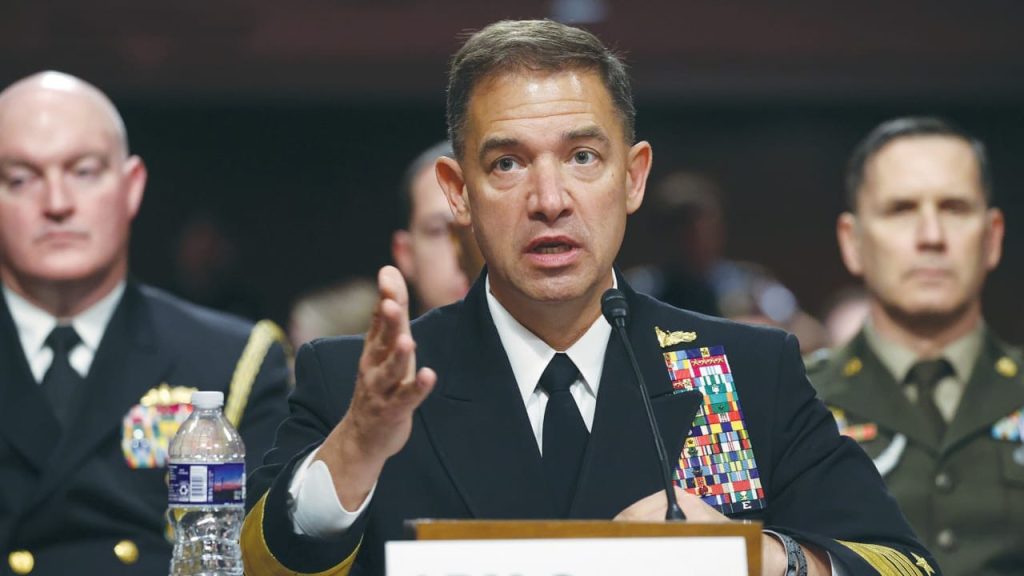
While US President Donald Trump and Prime Minister Benjamin Netanyahu make their next decisions on Iran and the Middle East conflict strategy, The Jerusalem Post now reveals the major impact that US Central Command (CENTCOM) chief Adm. Brad Cooper has had in this regard.
In April, the Post reported that Cooper has, in some ways, taken a more passive role than his predecessor, Gen. Michael “Erik” Kurilla, in communicating his broad strategy views to Trump, preferring instead to convey them to US Joint Chiefs of Staff chairman Gen. Dan Caine.
The Post can now add that, at times, some say that Cooper conveys views directly to US Secretary of State Marco Rubio or to US Defense Secretary Pete Hegseth, along with Caine, depending on the issue.
Cooper, the Post understands, views this as his proper role as a theater combat commander and says communicating with these top officials, rather than Trump, lets him get his concerns heard at the highest decision-making levels.
All parties credit Cooper with tremendous success as deputy chief of CENTCOM in the June 2025 war with Iran, where he worked closely with top Israeli officials and managed much of that relationship and coordination.
All parties also credit Cooper with excellent military operational planning and execution in many areas as CENTCOM chief during the early 2026 war with Iran.
They have also been impressed by his ability to capitalize on his special naval expertise during the ongoing Strait of Hormuz conflict.
However, questions remain about his role and impact in areas where the American public is critical of the war’s results.
The Post now reveals a range of Cooper, CENTCOM, US military, and Israeli military views about areas where many Americans have criticized the results of the war.
Much of Iran’s closure of Hormuz ‘fake’ until April
The biggest black eye for the Trump administration has been the Strait of Hormuz. Whether current US operational control there succeeds going forward, the US and the world economy have been shaken by Iran’s closure of the strait for much of 2026.
Many experts have slammed Trump and US military officials for failing to secure the strait in the opening plays of the war.
If questioned about why the US military did not focus its first moves in early March on cleaning up or blocking any Iranian efforts to blockade the Strait of Hormuz, the Post understands that Cooper would explain that the strait “clean up” could not happen until the main drone, ballistic missile, and large vessel Iranian naval threats were cleared.
Estimates were that this was going to take at least a month. Several US military officials argue that many observers wrongly superimpose the situation now when they go backward to analyze the state of play way back in early March.
They fail to consider the months it took to wear down the broader Iranian threats, such that there can be a more surgical focus on the strait now. In other words, there was no way to immediately neutralize the strait problem.
Based on this, Cooper would argue that such backseat quarterbacking is misinformed and irrelevant.
Questions do remain about whether the US, Israel, and CENTCOM could have pursued a different operational strategy, as Gen. Kenneth Franklin McKenzie Jr. told the Post on April 9.
McKenzie suggested seizing Kharg Island, or using consistent firepower to prevent Iran from operating there or around the Strait of Hormuz.
But given the limits of Trump not wanting to lose marines or hobble Iran’s non-military economic capabilities longer term, it is unclear exactly how some of those other operational options would have played out.
In addition, in a staggering revelation, when Iran announced that it had closed the Strait Hormuz in early March, Cooper would assert that this was a partially fake declaration.
Iran’s declaration was real in the sense of the danger felt by ships worldwide that stopped traveling through the strait and regarding the threat of hundreds of daily missiles and thousands of daily drones.
However, the Post can now disclose that Iran’s claims that it was already mining the strait back then were mostly fictitious.
Over time, the US Navy inspected suspicious objects in the sea and found that the vast majority of the supposed 80 mines were duds, the Post has learned.
What about reports by The Wall Street Journal, CNN, and others in early and mid-March claiming that Iran had already laid significant quantities of mines in the ocean and that the US was facing difficulty in removing them?
According to American sources, while the missile and drone threats were real and the US military was dealing with those from the start of the conflict, it later turned out that any reports backing Iran’s claims of heavily mining the strait in early March were untrue.
The Post can now disclose that it understands that Iran did not deploy mines in Hormuz before the April 7 initial ceasefire.
This might seem like too convenient an answer for US sources to give, since they can blame any shortcomings on the absence of continuous military operations.
But one significant piece of evidence for this narrative is that no reports show ships damaged by sea mines. By May 2026, CENTCOM said it had destroyed over 90% of over 8,000 Iranian sea mines (many were destroyed before they could be deployed).
New dimensions to the Cooper call to Zamir to eliminate Tangsiri
It has recently been reported that around March 19, Cooper made a secret call to IDF Chief of Staff Lt.-Gen. Eyal Zamir to request that Israel eliminate IRGC Navy chief Alireza Tangsiri, considered a serious threat to Hormuz and the naval conflict in general.
Zamir approved, and on March 26, Israel assassinated Tangsiri.
This incident raises the question: Why would Cooper secretly call Zamir on March 19 to ask him to remove Tangsiri as a threat, if US sources want to claim that Iran was not carrying out significant, real sea mining until the conflict paused sometime in mid-April?
The Post has learned that the US was confused and had varying levels of confidence when it learned of Iranian discussions about what Tehran was really thinking about doing regarding mining.
Whatever the concerns were, both Israeli and American sources have acknowledged that they were not the same as issuing actual orders on the matter.
In that sense, the Post understands that Cooper’s call to Zamir was, in many senses, a call for a preemptive move to head off a possible future strategic problem.
The Post also reported earlier on Thursday that some top Israeli officials worried Tangsiri could emerge as the next head of the IRGC and that he would be a much tougher adversary than Ahmad Vahidi, who eventually became the new IRGC chief.
In contrast, many top Israeli officials viewed Tangsiri as a highly creative and resourceful commander. Vahidi was largely seen as a deputy to a deputy of top commanders, lacking the power to shape the broader security posture.
What role or influence has and will CENTCOM have on the war’s strategic goals over time?
There are multiple parts to this question, starting with resolving the Hormuz crisis. The other parts involve regime change and Iran’s nuclear program.
Regarding regime change, even at the start of the war, American voices opposing or doubting that regime change plans pushed by Israel would pay off leaked out.
As the war has drawn out, the divergence between US and Israeli strategy and focus on these issues has grown even larger.
Even the targeting carried out by the two militaries during the main conflict saw Israel assassinating Ayatollah Ali Khamenei and other top Iranian officials. At the same time, the US mostly stayed away from that, focusing on degrading Iranian military capabilities.
A disconnect on the US side over regime change complicates the picture.
Trump himself has repeatedly made comments encouraging regime change or using metaphors about wiping out Iran as a functional nation.
However, the Post has learned that behind the scenes, Trump and his other top lieutenants have given zero directives to the military and CENTCOM about making efforts toward achieving this.
Also, US sources would note Trump has made at least as many or more statements demurring from regime change as a goal – it just happens to be that this American president does not try to keep a consistent public message on the issue.
However, the nuclear dilemma is different.
All US officials and most of the world know that getting Iran to make nuclear concessions (once negotiations were viewed as having failed) was the minimum primary strategic goal and starting point for the war with Iran.
In that sense, the purpose of striking Iran’s drones, missiles, and navy has been to remove Iran’s strategic threats that have held back the US, the West, and Israel from confronting it about the nuclear program more directly all these years.
Striking Iran’s military programs had benefits on their own, but the real goal was to pressure Tehran into nuclear concessions.
How would Cooper and CENTCOM judge overall success on these goals at this point?
The jury is out, but the story isn’t over yet.
What does that mean?
It means that Cooper and CENTCOM, like Israel and much of the world, are waiting to see what Iran’s breaking point is, given all of the economic and military pressure it has been under.
This last point may make sense after a few weeks or a few months, but seems problematic after seven months.
Yes, Iran has been hit much harder. But American bases, soldiers, allies, and the US and world economy have also been hit hard for seven times longer than Trump publicly promised this conflict would go on for.
Is there a point where Cooper and CENTCOM would press Trump harder and more directly to either end the conflict or reengage militarily to break the logjam?
The Post’s understanding is that even if this conflict is stuck for a full year or even a few years (however unlikely), Cooper’s and CENTCOM’s position would not change: strategic feedback should come only through lower channels, including Caine, Rubio, and Hegseth.
Former CENTCOM chief McKenzie warned US bases would be vulnerable to sustained Iranian attacks
In 2024, McKenzie, discussing American military bases in the region, warned that “the United States will not be able to maintain these bases in a full-throated conflict, because they will be rendered unusable by sustained Iranian attack.”
Previously, the Post and others have reported that CENTCOM and the US in general did not heed McKenzie’s warnings.
Cooper only took over CENTCOM fully in August 2025, so there is only so much he could have done, but his previous efforts on the issue had not been reported in any significant fashion.
In contrast, the Post has learned that there is a counter-narrative on the issue.
According to it, the winding down of many US bases and assets in the region did start before the war, especially in Iraq and Syria.
Since the war, more winding down has occurred in Iraq and Syria, and eventually in Kuwait as well. Notably, the US has not talked about reducing its footprint in Jordan and Saudi Arabia, though its bases there have been hit hard and repeatedly.
Another area where Cooper’s and CENTCOM’s narrative would likely differ from the narrative reported by most of the media to date relates to how unexpected the billions in damage to US bases from Iran have been.
Another disconnect within the administration is that Hegseth has often publicly denied the extent of the damage and has been accused of trying to cover it up.
But the CENTCOM view would be that such damage was, in fact, expected.
CENTCOM would ask rhetorical questions like: Since when has there been a war with no damage to one of the sides?
In addition, CENTCOM would note that a modern war in which bases were spread like peanut butter across a region was obviously vulnerable, and anyone who did not recognize this grossly misunderstood the weaknesses of America’s basing posture, a leftover from earlier eras of warfare.
But decades of basing cannot be changed overnight, especially in the enormous US military, which is known for being slow to transfer large forces between bases or military theaters.
It seemed to be implied that the much more recent expanded and evolving drone threat changed the security posture for US basing much more rapidly and radically than the decades-old missile threat.
Alternatively, elements of the Trump administration may not have thought Iran would succeed at firing off as many missiles at US bases as it did.
In contrast, Cooper would take significant pride in the success of America’s regional air-defense architecture with its Middle Eastern allies.
Meanwhile, the war might have heavily degraded the US supply of interceptors for missiles and drones. Some internal US defense establishment reports have said there could be shortages if there is a war in the near future with another adversary like Russia or China.
Cooper might have communicated this risk to Caine and Hegseth. However, both the US defense secretary and Trump have denied any combat impact from interceptor shortages – without explaining how a shortage would affect combat readiness.
In addressing these problematic byproducts of the war, the Post understands that Cooper’s view is that what matters most is that Iran was hurt by the war exponentially more than the US.
Put simply, Iran lost $200-$300 billion in its defense sector from US and Israeli attacks, while the US lost only around $5b.
In addition, some have said that absent the superior US-allied air defenses, Iranian missile fire could have potentially killed millions of people in worst-case scenarios.
Other estimates put the risk from Iranian missile fire more in the tens of thousands. But either way, the point about how ready Iran was to commit mass murder across the region, absent strong CENTCOM regional air defense, remains clear.
Some American sources have questioned whether this is the right way to evaluate the mission’s and the war’s success or failure.
They ask: What if Washington had an option to achieve its strategic goals with Iran without losing $5b. in damages to its bases?
US military sources believe that part of the problem with the public perception of the war could be that portions of them thought the Iran war would go as quickly and as easily as America’s effective coup in Venezuela in January of this year.
Unspoken by US military officials in this criticism, but obvious from public comments by the US president about how surprised he has been that Iran did not “crack” sooner, is that many military officials believe that Trump himself was swept up by the quick “win” in Venezuela.
Trump administration claimed Iran’s ballistic missile threat would soon be eliminated
During the war, Trump, Caine, and Hegseth repeatedly made public claims indicating that Iran’s ballistic missile apparatus had been decimated and that its threat would almost entirely disappear within days or weeks.
Israeli defense and intelligence officials also told the Post in March and April that Iran’s missile capacity had fallen to possibly as few as several hundred missiles.
Iran fell from 2,500 missiles to 1,600, and its production capacity fell from an expected 2,000 by the end of 2026 to original pre-war estimates that, absent outside intervention, it might reach 6,000 missiles by the end of the year.
In that sense, the Post has learned that CENTCOM’s view would be that Iran’s missile threat is substantially weaker now than pre-war.
However, the predictions by Trump, Caine, and Hegseth seem substantially off base.
Even the predictions by Israeli defense and intelligence officials have turned out to be significantly overly optimistic.
If Iran is “not the same Iran,” as CENTCOM and Israel would both argue, it has still managed to fire dozens of ballistic missiles and drones at will throughout the Middle East. This includes firing on American ships during any period of renewed military conflict between Tehran and Washington.
These missile launches have paled in comparison to the hundreds of missiles and thousands of drones Iran was able to launch per day at the start of the war. They have been far more than the drizzle that some American and Israeli officials predicted, and remain a strategic-level threat.
Certainly, Iran cannot threaten the region as a “bully” the same way it could before. But the US and Israel are still refraining from going directly to control Iran’s remaining nuclear assets by force out of fear of what remains of the Islamic Republic’s capabilities.
All of this paints a nuanced picture of CENTCOM under Cooper as the region’s lead shaper in some respects, but one that avoids sticking its neck out too much in others.
Many top American generals who have spoken up when they disagreed with some aspect of Trump’s or Hegseth’s ideas have been summarily dismissed in numbers unseen in years.
Cooper’s preference for conveying his views through Caine, Hegseth, and Rubio has not only been a way of operating within the chain of command, but has also saved him so far from the rash wave of firings.
It will be years before history can fully judge the mix of undeniable major contributions Cooper has made to Middle East security, alongside major dilemmas where he steered clear of rocking the boat too much.
In the meantime, much of the region is thankful that, even if Trump and Washington are wildly unpredictable, they have the benefit of Cooper’s steady hand.