
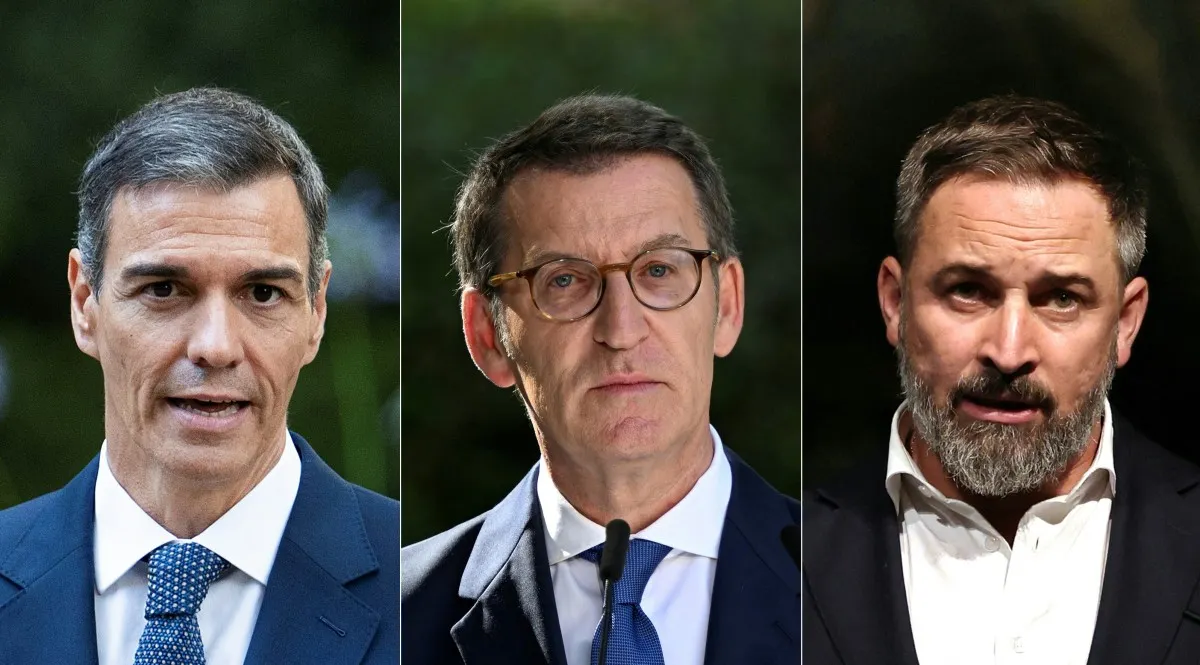
Who are the three main candidates in Spain’s snap election?
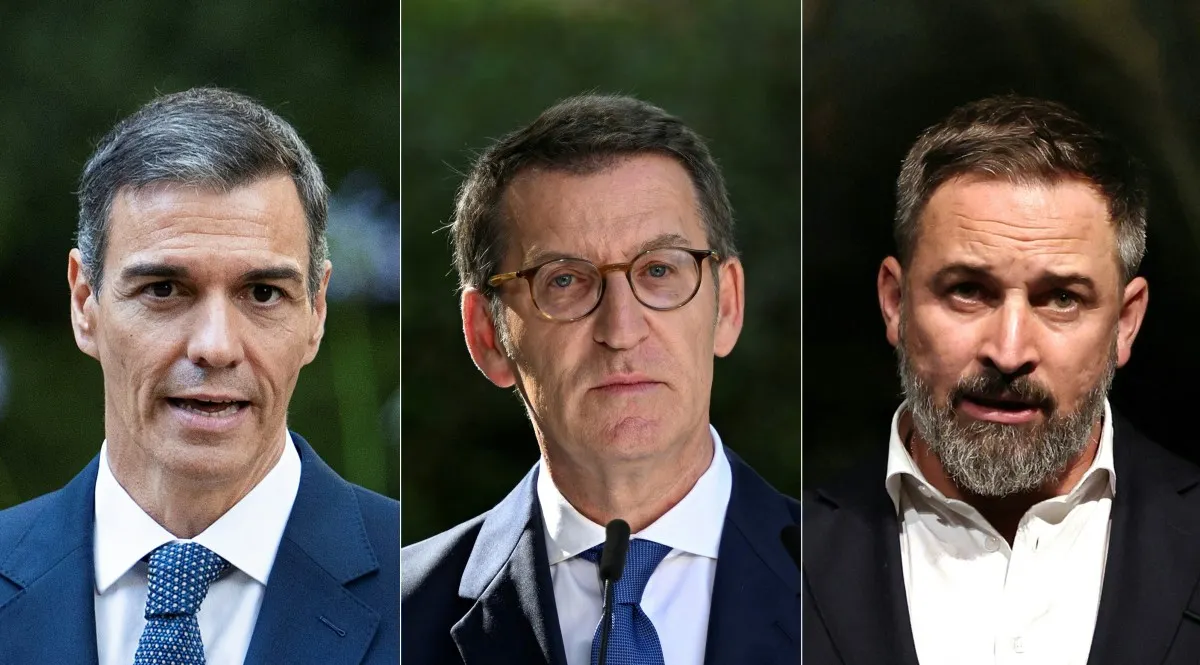
Spain faces a snap election on November 29th, with three party leaders in focus after Socialist Prime Minister Pedro Sánchez called the vote following parliament’s rejection of his proposed housing measures.
Sánchez’s main rival, conservative Popular Party (PP) leader Alberto Núñez Feijóo, is seeking a second chance at forming a government, while far-right Vox leader Santiago Abascal is positioning his party as a potential kingmaker.
Here is a look at the three main candidates:
The survivor
He has been written off politically several times, only to stage a comeback each time.
Since taking over as leader of the Socialist Party in 2014, Sánchez has built his career on unexpected gambles, but bringing forward the election is one of his riskiest yet.
The telegenic 54-year-old leader, who has been in power since 2018, goes into the election weakened by corruption scandals, with opinion polls consistently putting him behind Feijóo.
He also needs a strong result from the far left, a political space that stood under a united platform in 2023 but is now deeply divided and weakened.
READ ALSO: The four stumbling blocks for Spain’s PM ahead of snap election
“There is not a single poll that gives Sánchez even a remote chance of reproducing the coalition government,” said Pablo Simón, a political scientist at Madrid’s Carlos III University.
Sánchez’s strategy is to “concentrate all the useful vote of the left” in order to finish ahead of the PP, even without any guarantee of being able to form a government, he added.
The trained economist has highlighted his international profile and Spain’s strong economic performance, while seeking to motivate left-wing voters by backing measures to improve access to housing in response to a wave of protests.
Don’t miss our journalists’ daily news roundup from Spain
The former civil servant
After dominating regional politics in his native Galicia in northwestern Spain for more than a decade, Feijóo moved to Madrid to take the helm of the PP.
But he suffered a major setback when the party finished first in the 2023 general election without securing enough support from other parties to form a government.
Sánchez remained in office after managing to cobble together a parliamentary majority.
“I am ready,” the 65-year-old former civil servant repeatedly says, presenting himself as a pragmatist and buoyed by polls showing the PP comfortably ahead.
READ ALSO: Spain’s right-wing bloc polls absolute majority amid migrant crisis
His problem is that polls suggest he will not win an outright majority, meaning he will need the support of Vox to govern.
“Whatever the PP does, it cannot reach the Moncloa without Vox,” said Simón, referring to Spain’s prime minister’s official residence and workplace.
The potential kingmaker
Abascal, the 50-year-old Vox leader, is seeking to turn his party’s growing support into greater influence after the November election, potentially determining whether the PP can form a government.
Vox, founded in 2013, brought the far right back into Spain’s political mainstream after it had remained marginal since the end of the Franco dictatorship.
Abascal, a former PP member, is sharply critical of the mainstream conservatives, whom he has dismissed as the “cowardly right”.
Opinion polls show Vox as the country’s third-largest political force and the party making the biggest gains.
READ ALSO: How foreigners in Spain could be affected by a PP-Vox government
Abascal “sometimes looks in the mirror and imagines himself as deputy prime minister”, and believes Vox will enter government alongside the PP, said political scientist Paloma Roman of Madrid’s Complutense University.
Vox initially built its support around staunch opposition to Catalan separatism but has increasingly made opposition to immigration a central part of its platform.
Abascal has used the migration crisis in the North African Spanish enclave of Ceuta to attack Sánchez’s government.
The election gives Spaniards the opportunity to “get rid of this criminal mafia once and for all”, Abascal said, referring to the government and calling Sánchez a “traitor” who should face trial.
Article by Diego Urdaneta