French high schools to remain closed as 250,000 join protests
The unrest has erupted with just months to go before the 2027 election to choose a successor to centrist President Emmanuel Macron, with far-right veteran candidate Marine Le Pen riding high in the polls despite a graft conviction.
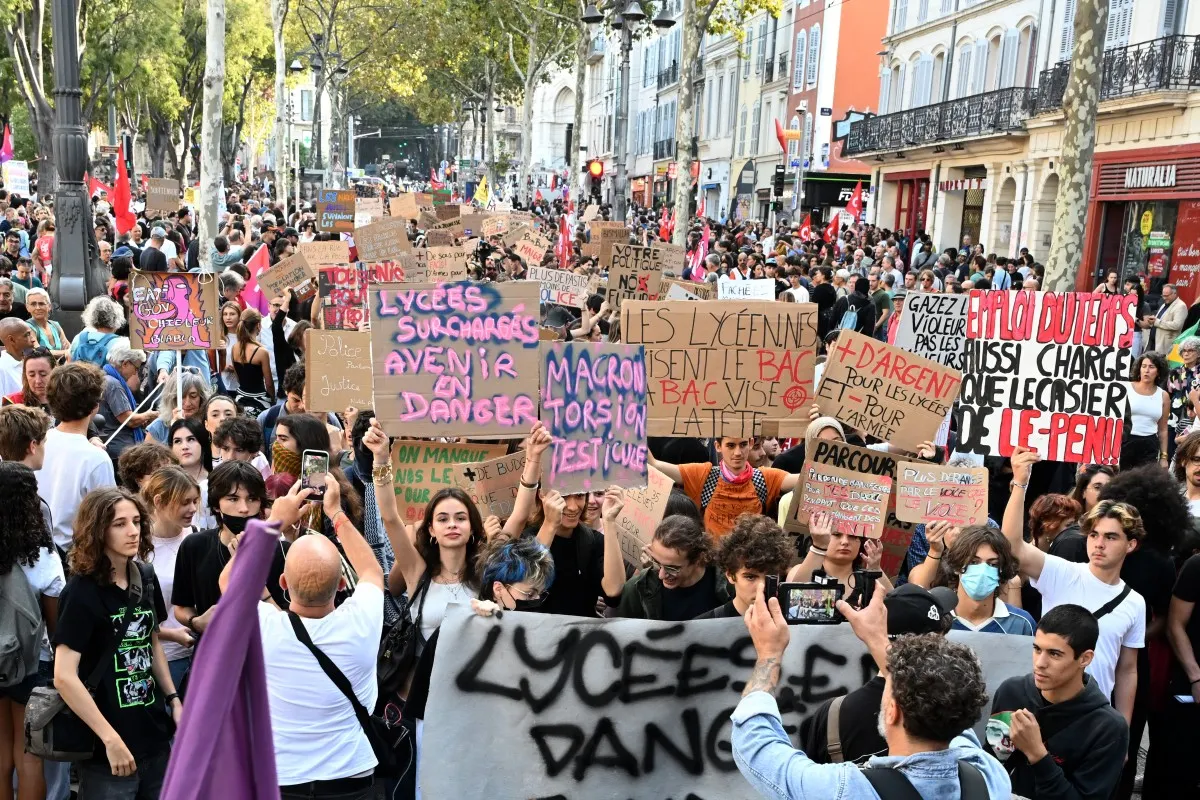
Océanne, 18, was among thousands of students, parents, teachers and union members marching in the country’s second largest city of Marseille.
“We just want to save our education and be educated,” the teenager, who did not give her second name, said in the southern port city.
She said she had suffered from absent teachers who were either not replaced or replaced by “pointless substitutes”.
Another student held up a sign complaining of long hours at school.
“Timetables as packed as Le Pen’s criminal record,” it read, in a jab at the far-right presidential hopeful.
READ ALSO: Bac to f**k: Understanding French lycées protest signs
In the western city of Nantes, thousands started marching on Tuesday morning behind a huge banner that read: “Schools with no money, country with no future”.
A major march departed from central Paris in the early afternoon, protesters set off at 2pm from Place de la République.
READ ALSO: MAP: The route of Paris high school student protest on Tuesday
Noah, who attends the Lycée international de Paris Honoré de Balzac, told The Local: “We just want a better budget for schools and overall a better quality of school life.”
His classmate Jack added: “There are 35 of us in a class and it’s hard to learn anything, especially when it gets hot.
“There are just way too many students and not enough teachers. Clearly we will keep protesting unless the government does something.”
Magalie Thibault, the socialist mayor of the Paris suburb of Rosny-sous-Bois, was at the demo to support the students. She told The Local: “I’m here today to support the lycée pupils and demand the best conditions for learning in their high schools.
“In certain high schools in Seine-Saint-Denis- one of the poorest départements in France – there can be between 35 and 40 students per class, there aren’t enough chairs or tables, and they are in buildings that are not at all adapted for the extreme heat that we’ve seen in the heatwaves.
“The students need to be heard, in a peaceful manner of course. They are tomorrow’s leaders so we need to take their demands into consideration and respond to them.
“It’s the responsibility of all elected officials, especially at government level, to listen to them and get things moving.”
The interior ministry said 86,000 had joined demonstrations so far on Tuesday with up to 40,000 more expected to join events in Paris later.
Earlier in the morning, some had also gathered outside high schools.
In Rennes, also in western France, teacher Romain Dubourg said he and other teachers were present outside the Chateaubriand high school to show support.
“With about thirty colleagues, we talked about the police brutality we’ve witnessed and decided to be there for our students if they need us,” he told AFP.
While many protests have been peaceful, some demonstrators have started fires, destroyed bus shelters or clashed with riot police.
Police have responded with batons, tear gas and riot-control rounds.
The government says 215 students and 715 police officers have been injured since the start of the movement.
A 15-year-old lost a hand to a sting-ball grenade fired by riot officers on Monday.
The government has sought to address the grievances, while accusing the hard-left La France Insoumise (LFI) party of being behind the movement.
Veteran LFI presidential candidate Jean-Luc Mélenchon has strongly supported the protests, while calling for non-violent methods.
Prime Minister Sébastien Lecornu’s office has called for “peaceful” gatherings.
The head of the CGT labour union Sophie Binet has said its members would be there to “protect high school students”.
Greens leader Marine Tondelier has urged local officials and parents to wear white and “go and protect our children during demonstrations”.
Amnesty International said on Monday that the French authorities should “put an end to the disproportionate police repression seen in recent days during student protests”.
“The images and testimonies widely circulated over the past week raise alarming concerns about the dangerous use of tear gas, batons and policing techniques by the police,” Amnesty’s Anne Savinel-Barras said.
The police have launched 10 internal investigations into allegations of brutality since the protests started, Interior Minister Laurent Nunez said late on Monday.
Since the start of the movement, 24 schools have been burned or ransacked, according to the education ministry.
More than 5,000 people, 87 percent of them minors, have been arrested.
Lecornu’s office said 85 teaching staff have also been injured.
The prime minister has sought to address the issue of missing teachers and renovating buildings that are dilapidated.
The government is also pushing legislation to make those responsible for damaging public property pay for repairs themselves, instead of using public funds.
Several strikes and demos are planned in France this autumn, including a cross-sector strike in November – Calendar: The strikes planned in France this autumn you should know about✎