
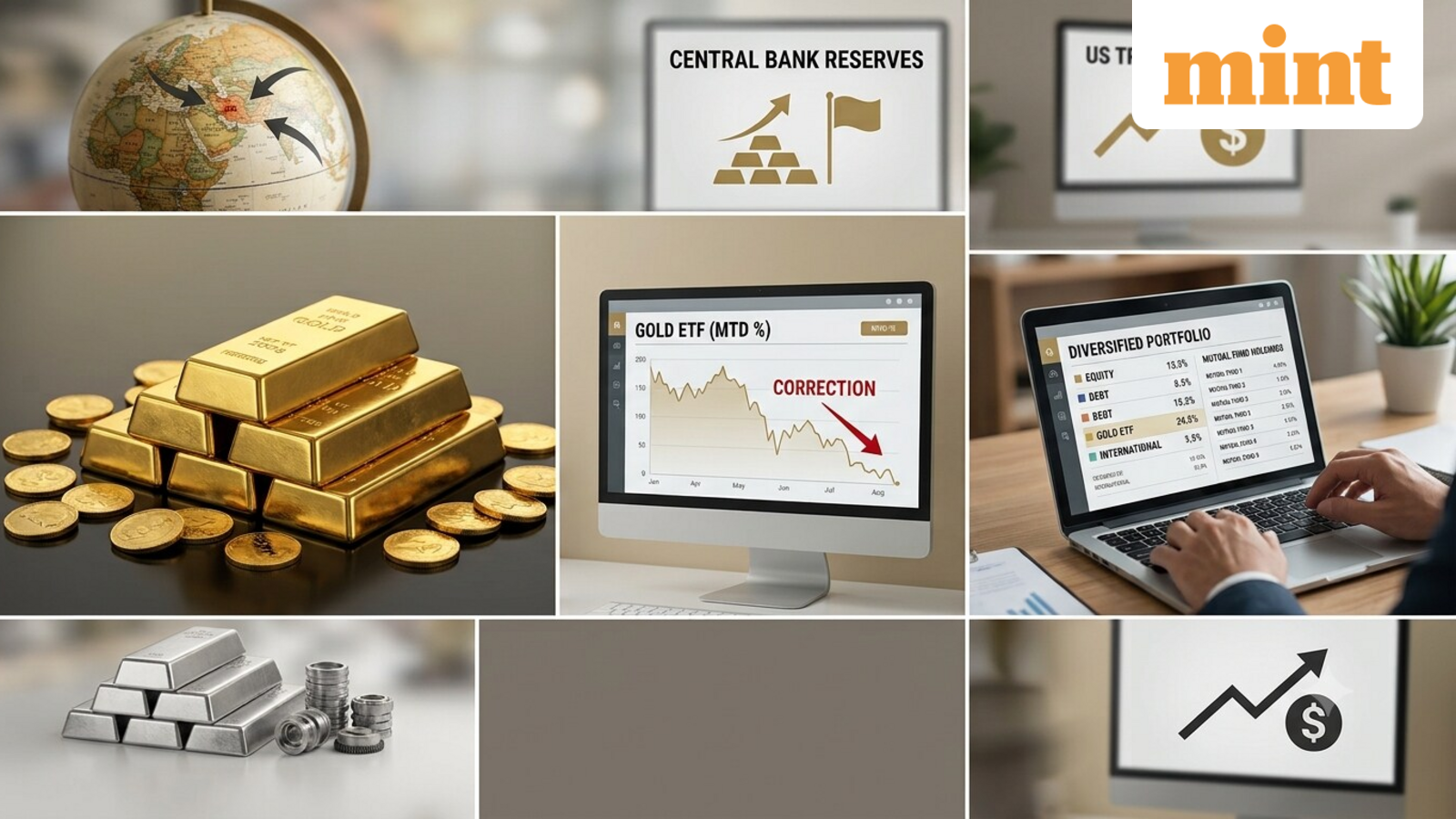
Gold falls 26% from January peak, silver deficit persists: How should mutual fund investors respond?
Investors who stayed on the sidelines during gold’s sharp rally may now have a reason to look at a different entry point. But has the correction changed the investment case for gold ETFs?
According to Tata Mutual Fund’s October 2026 report, gold prices have corrected about 26% from their January 2026 peak, falling from around $5,595 an ounce to about $4,138.
The recent decline has been driven largely by higher US Treasury yields and a stronger US dollar, rather than a deterioration in gold’s structural fundamentals.
Here’s what investors considering gold and silver ETFs should know and how they can approach the correction.
What is supporting gold despite the correction?
Tata Mutual Fund said higher US Treasury yields and a stronger US dollar have been the key recent headwinds for gold. “Despite substantial ETF outflows in 2022–23, gold prices remained resilient, supported by strong central bank purchases that effectively established a structural demand floor.”
Central banks purchased 289 tonnes of gold in the second quarter of 2026, while full-year purchases are estimated at 700–900 tonnes, above the pre-2022 annual average of around 400–500 tonnes.
Reserve diversification away from US-dollar assets, particularly by China and emerging-market central banks, remains an important source of demand.
Are gold ETF inflows lagging?
For gold ETF investors, the flow trend is particularly important. Tata Mutual Fund said investment demand had rebounded sharply in 2025, with ETF inflows rising significantly while central bank buying remained strong. The combination helped push total gold demand to a key milestone.
“Post that period, with the onset of the US-Iran conflict, global gold ETFs witnessed sharp outflows from March 2026. However, global ETF flows are showing early signs of stabilisation from July 26 onwards.”
India’s gold ETF data also shows that flows have remained positive in most months of 2026, despite moderating from the exceptionally strong levels seen at the start of the year.
Net inflows stood at $156.8 million in July and $260.2 million in August, compared with an outflow of $24.7 million in May 2026.
Why should ETF investors watch gold demand?
The report mentioned that Chinese gold imports have exceeded 1,000 tonnes in 2026, already surpassing full-year 2025 volumes, supported by retail demand, ETF inflows and central-bank purchases.
The fund house also highlighted geopolitical fragmentation, US government debt exceeding $40 trillion, and a fiscal deficit of around 6–7% of GDP as factors supporting gold’s role as a store of value and portfolio insurance.
What about silver?
Tata Mutual Fund also sees structural support for silver, with 2026 expected to be the sixth consecutive year of deficit as demand outpaces supply. Industrial demand accounts for most silver consumption and has risen steadily since 2021.
China holds about 11% of global silver reserves and controls 60–70% of refining capacity, giving it significant influence over the supply chain.
Rising industrial demand, supply constraints, and China’s efforts to prioritise domestic availability could support silver over the long term, although the report cautions that near-term price volatility could remain high.
What are the key takeaways for investors?
Tata MF said current gold prices offer a “significantly better entry point” for investors who missed the earlier rally, while central bank demand, fiscal risks and geopolitical uncertainty continue to support its medium-term outlook.
For silver, a persistent supply deficit and rising industrial demand support a “constructive long-term outlook”, despite near-term volatility.
For investors considering gold and silver ETFs, a staggered investment approach could help build long-term exposure while managing the risk of short-term price swings.
Disclaimer: This story is for educational purposes only. The views and recommendations made above are those of individual analysts or broking companies, and not of Mint. We advise investors to check with certified experts before making any investment decisions.
About the Author
Sheetal Goel is a Content Producer at Livemint, where she covers corporate developments, personal finance, business trends, markets, and SEBI-related updates. She focuses on simplifying complex financial concepts and presenting them in a clear, reader-friendly manner, thereby helping audiences better understand investment trends, personal finance, and market developments. Her writing focuses on making finance more accessible to everyday readers while maintaining clarity, accuracy, and relevance. <br><br> She holds a degree in Economics (Hons.) along with an MBA in Finance, which has helped her develop a strong foundation in financial analysis, market understanding, and business reporting. Before joining journalism, she worked with finance and broking firms, where she closely followed market developments, investment strategies, and evolving industry trends. This practical exposure strengthened her understanding of financial markets. She has also written content across multiple formats and platforms, including YouTube, LinkedIn, and Instagram. <br><br> Over time, she has developed expertise in covering market-linked stories, investor-focused topics, and regulatory updates in a simplified yet informative style. She also enjoys reading and listening to Hindi poetry, reflecting her appreciation for literature and creative expression beyond the world of markets and numbers.