
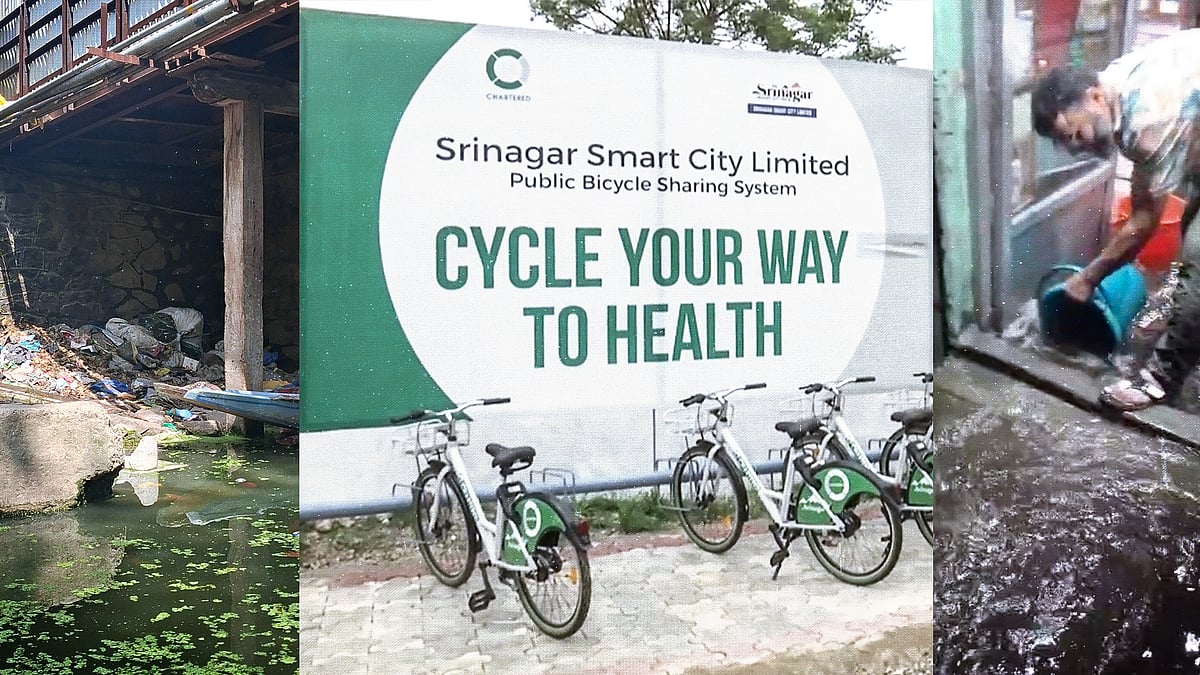
Srinagar’s Smart City project is 98% done. But locals say it’s beautification without the basics
In the second week of September, a cinema screen floated on the Dal. Srinagar was hosting the first International Film Festival of Jammu and Kashmir, with Chief Minister Omar Abdullah opening it against the Zabarwan hills. It was the city’s biggest international event since the G20 tourism meeting of 2023 and, like that one, mostly an argument made in pictures.
Seven weeks earlier, on July 20, an hour of rain had put the same city under water.
Lal Chowk, Polo View, Residency Road, the Boulevard, Khanyar, Sada Kadal, Nalamar, Bemina, Dalgate. Water got into the Civil Secretariat, of all places. By evening the valley’s papers had their verdict – so much for the Smart City – and the next day Abdullah called the Secretariat flooding a matter of shame. His cabinet, he said, had already ordered a third-party audit of the Srinagar Smart City project.
What the audit will find is anyone’s guess. But what residents describe is fairly consistent. They point to roads raised over drains that still choke, a landfill that keeps growing, a lake that got new decks and cycle tracks but kept its sewage, and beautification in place of the basics.
That may be a little unfair to a project that did build some things that work. But it’s hard to argue with people facing these problems, considering that the project is 98 percent finished on paper.
Done and dusted?
On paper, 157 of 161 sanctioned projects had been completed by March 31, 2026, the Union government Parliament in July. The completed works cost around Rs 3,530 crore against a sanctioned Rs 3,633 crore. The Smart Cities Mission itself formally ended on March 31, 2025, and the Ministry said no proposal to expand it is under consideration. Four projects are still underway, among them a SCADA-based water management system and water transport on the Jhelum and Dal Lake.
Srinagar MP Aga Syed Ruhullah Mehdi had asked in the Lok Sabha whether the government had taken cognisance of the flooding despite the Smart City Mission, and whether the project included storm-water or flood-mitigation works. The Lok Sabha named no such project and didn’t explain the flooding.
Though drainage was never meant to be optional. The mission’s own guidelines count sanitation and storm-water management among the basics a smart city must deliver.
But Srinagar Smart City Limited (SSCL), which ran the project, says it is being blamed for things it didn’t build – and on some counts, it has a point. An official the news agency KNO that Khanyar and Sada Kadal were not its roads, and that Nalamar was done by the Roads and Buildings department. On the stretches it did rebuild – Dalgate–Gojwara, M A Road, Residency Road, Karan Nagar – it says it only touched the surface. “The drainage and sewerage network already existed. We only carried out road redevelopment.”
That defence is also the problem.
Shops still counting losses
In Rajouri Kadal, in the old city’s copperware lanes, Nabeel Ahmed* has spent two months sorting what can be saved. He sells traam, the hand-beaten copper Kashmiris serve meals in.
“What Smart City! Nothing has changed here. The July floods washed away all pretense of smartness,” he said. Copper can at least be re-tinned. “With copper vessels, you have a provision for kalaai. My kaarigars can fix my damaged pieces, though that will take time. But it isn’t the same for others in this market who have to throw away what is damaged.”
Next door, Waqar Qadri*, who sells electronics, now carries his stock upstairs every evening and back down every morning. “Rain can come anytime and damage the goods again. I can’t take that risk. I have suffered losses worth several lakhs due to flooding this year.”
Both men watched their street being rebuilt – the road raised, drainage space, as they tell it, squeezed. “It looked good,” Qadri said. Both say they could see what was coming. Neither said anything at the time, claiming they feared punitive action. (More on why later in this report.)
About a kilometre away in Kawdara, the 16th-century shrine of Hazrat Syed Muhammad Habibullah Surkhabi has been shut since July. Next to it, a pool of rainwater that hasn’t drained in two months is, predictably, breeding mosquitoes. “Those of us who could afford it have contributed Rs 5,000 per person to clean the dargah and change the furnishings,” Nabeel said. “We don’t know when the dargah will be operational.”
SSCL took up Rajouri Kadal in 2022-23, as part of a plan to conserve downtown’s old streets. “The focus is more on functionality than on beautification,” Iftikhar Kakroo, then SSCL’s chief engineer, Asian Mail that November. Suhaib Naqshbandi, an SSCL planner, was broadly satisfied. “The execution was done rather well, with a few delays here and there.” He didn’t accept that the new streets had anything to do with the waterlogging.