Could MLK Corridor title help revitalize Bridgeport’s East End?
In the 1970s, Stratford Avenue, one of the main arteries running through Bridgeport’s East End, was designated as Dr. Martin Luther King Jr. Boulevard.
The name has honored King’s legacy, but a state designation could now give the neighborhood an opportunity to put that name to work in a more tangible way — bringing attention to economic development, investment and opportunities for the people who live and work along it.
The East End is one of seven areas in the state designated as a Martin Luther King, Jr. Corridor under a program intended to promote secured and unsecured lending and stimulate economic development. Other municipalities with these corridors include Middletown, New Britain and Norwalk.
“The designation gives the East End an opportunity to focus attention and resources on the neighborhood,” said Kelvin Ayala, an urban planner and economic development strategist with LBU & Associates, which is serving as the lead local organization for the Bridgeport effort.
The designation can also give applicants additional weight when seeking future state grants and funding, according to the Connecticut Department of Banking.
A separate East End streets study is examining issues on Stratford and Connecticut avenues like pedestrian safety, transit, bicycle access and improvements that could also support future economic development.
Councilman Ernie Newton, who represents the East End, said he is open to development that strengthens the neighborhood. “If there’s a way to generate more revenue, improve on what we’re doing, I’m all in,” Newton said.
For Newton, part of that vision is bringing back the kind of neighborhood he remembers growing up in, where residents could find many of the services and businesses they needed close to home.
The neighborhood has long sought basic services, including a grocery store and bank. Honey Locust Square, a long-delayed project on Stratford Avenue, now has an M&T Bank branch, while a Gala Foods supermarket and other businesses remain part of the planned development. The project has received nearly $4.5 million in city, state and federal support, but has faced years of delays and financial challenges.
Opportunities for growth
The stretch of Stratford Avenue that runs through the center of the East End is only open to eastbound traffic, while Connecticut Avenue to the north provides only westbound traffic access. Some residents and business owners have in the past complained about the one-way designation and the limits it places on access to the local businesses that make up the commercial corridor.
Bill Coleman, deputy director of Bridgeport’s Office of Planning & Economic Development, said the city’s work on Stratford Avenue is intended to complement the MLK Corridor effort. The city has been working with East End leaders and state lawmakers on a plan to convert Stratford Avenue to two-way traffic and redesign Connecticut Avenue to include a two-way protected bicycle track.
“The thought is to really try to recreate, particularly on Stratford Avenue, the MLK Boulevard, a neighborhood street that is supportive of a higher quality of life for residents and of a higher degree of neighborhood-based commerce,” Coleman said.
The avenue also connects the neighborhood to downtown Bridgeport on the west and continues east into the town of Stratford, where it opens to two-way traffic. Local planners and community leaders see the designation as an opportunity to build on what is already there and bring more investment, jobs and opportunities to the area.
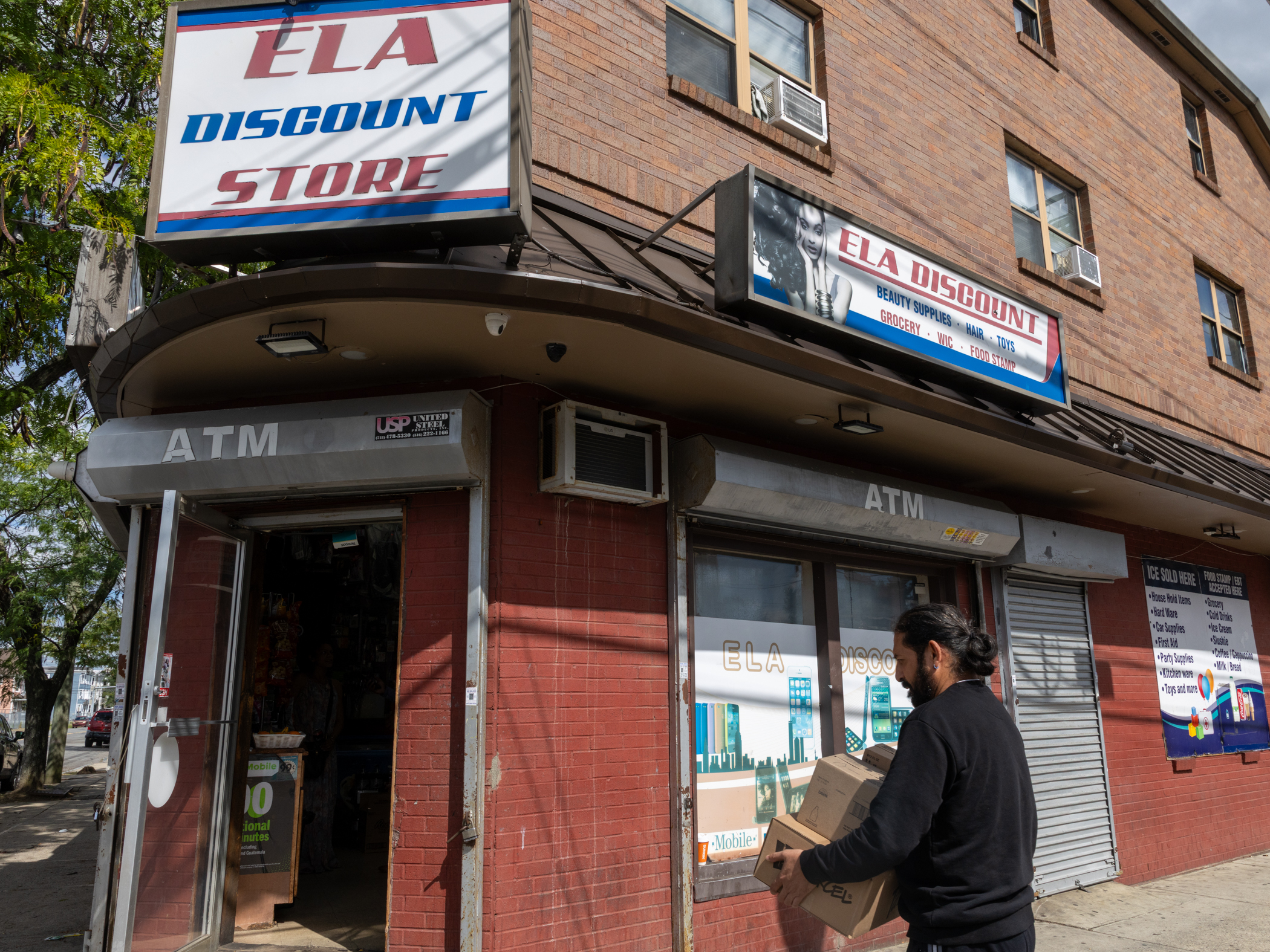
For some East End business owners, the neighborhood already has something that can’t be created through a development plan: a strong sense of community. Syed Imran, who has operated ELA Discount on Stratford Avenue for 21 years, said neighbors regularly look out for one another.
“If you treat them better… they help you. They will look after you. Like I look after them,” Imran said. Despite what he sees as negative perceptions of the area, Imran said he remains invested in the neighborhood. “I love this neighborhood. I have no problem,” he said. “Just people got a wrong conception about this area.”
Ayala said the designation creates an opportunity to build on the East End’s existing strengths.
“The broader objective is to create a stronger local economy,” Ayala said.
Ayala said the goal is to support existing businesses and create opportunities for residents to build wealth. LBU has divided the Bridgeport effort into three areas: public art and beautification, small business and workforce development, and real estate investment and economic development.
Keith Williams, head of the East End Neighborhood Revitalization Zone, said they need investment in several areas, particularly housing and infrastructure. “We need more for housing… and more businesses in the neighborhood,” Williams said.
He said improvements to Stratford Avenue, including the proposal to convert part of the corridor to two-way traffic, could help bring more activity to the area and support local businesses. Unlike other more high-density neighborhoods in the city, there is also some vacant land along the avenue that can provide opportunities for further development.
Coleman said the city views the MLK Corridor as complementary to its existing work, including efforts to improve infrastructure and complete projects such as Honey Locust Square. He said the goal is for Stratford Avenue to become a place where people spend time and do business.
“You don’t want to see Stratford Avenue and the MLK Corridor as a place you go through, but rather see it as a place you go to or that you live alongside,” Coleman said.
LBU is exploring ideas that could include helping entrepreneurs start and expand businesses, identifying opportunities for vacant properties, connecting residents with jobs and creating new public spaces along the corridor.
The designation itself does not guarantee those projects will happen. Instead, Bridgeport will have to use the designation to pursue investment and funding from other sources. Ayala said the goal is to bring together state and local officials, community organizations, businesses and residents around a common economic development strategy while building on what residents have already said they want.
Pastor Carl McCluster, senior pastor at Shiloh Baptist Church and managing director of the Freedom Faith Collaborative, which helped establish Connecticut’s MLK Corridor program, said Bridgeport’s success will depend on making the process broad and collaborative.
“It shouldn’t be a political prize, and should be an adventure in collaborative work in the community instead,” McCluster said.
Norwalk’s efforts
The state created the MLK Corridor designation in 2016, but expanded it in 2024 to increase the number of corridors the banking commissioner could designate from three to seven.
Matt Smith, the banking department’s director of government affairs and public policy, said the department only adds the designation and other agencies and organizations can consider it when awarding grants or other funding.
“There is no money associated with it,” Smith said. “We do not administer any money.”
Smith said the Department of Banking does not track whether other agencies use the designation when making funding decisions, so the department does not have data showing how often the designation has helped communities secure additional funding.
Rep. Kadeem Roberts, D-Norwalk, who has been involved in that city’s MLK Corridor work, said the designation became part of a broader local planning and investment effort that included public art, trees, walkways and bike infrastructure. Roberts said artists were brought into the process to create murals and other artwork reflecting Black history and culture in the neighborhood.
Norwalk’s corridor includes about two miles of Dr. Martin Luther King Jr. Drive and surrounding streets near the South Norwalk train station.
Roberts also pointed to a $14 million federal RAISE grant that Norwalk received in 2024 for improvements along MLK Drive and six surrounding roadways near the South Norwalk train station.
McCluster said the designation was created to bring residents together on economic development efforts and help leverage additional resources.
“I think you have to learn how to really bring the community together and to leverage a small amount that you have,” McCluster said. He pointed to Norwalk, where about $3 million in state funding helped leverage roughly $30 million for improvements, including facade work for longtime homeowners along the corridor.
Norwalk has used the broader MLK Corridor initiative to support other investments as well. Since 2019, the city says it has identified more than $7.6 million in priority investments in economic and community development, education, housing and safety, with funding from local, state and federal sources. Those efforts have included residential facade improvements, low-interest home improvement loans, streetscape projects and support for minority- and women-owned businesses.
Bridgeport’s vision
In Bridgeport, Ayala sees several ways the corridor could help the area grow and build on existing plans.
One idea being explored through the local effort is creating a pocket park near Stratford Avenue and Sixth Street on city-owned property. Ayala described it as a concept, not a project that has been approved by the city. The idea could create a small public gathering space while improving pedestrian safety. He also sees opportunities to connect East End residents with jobs and provide technical assistance to people interested in starting or expanding businesses.
Housing is another piece. Vacant and blighted properties could potentially be redeveloped, while existing housing and property-improvement programs could be pursued as part of broader investment efforts in the neighborhood.
“I’m hoping that we get more home ownership,” Newton said. “Because you need a middle class … in order to sustain any community.”
Longtime East End resident Cherie O’Dea said new investment alone will not be enough. She said residents also need better access to education, job opportunities and basic resources that can help them take advantage of that investment.
“I think it goes farther than just the East End,” she said. “It comes from putting systems in place that actually help people — more education systems, more systems to help people get their licenses. Because a lot of us, we didn’t have a chance from starting out.”
Ayala said the designation is one tool that can help bring people and potential resources to the same table, but the outcome will depend on whether the ideas developed locally can attract funding and move into implementation.
Ayala believes the opportunity is there for the neighborhood many residents have argued has been ignored by economic development officials and developers for years.
“We still have time to salvage it,” he said.