
Global Fintech Fest 2026: Agentic AI, tokenisation and quantum—how these 3 technologies could change how you invest
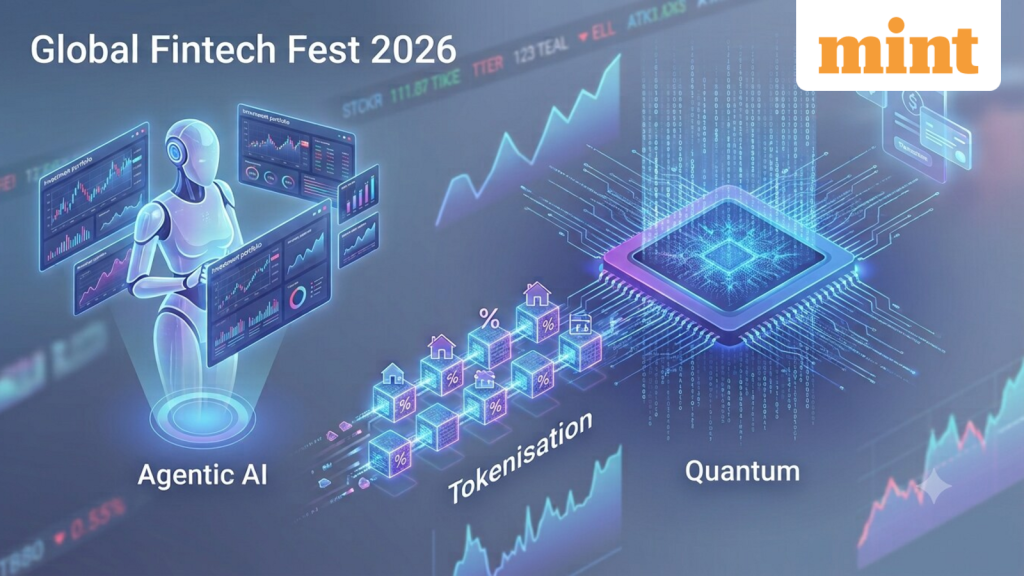
The Global Fintech Fest 2026 is bringing together some of the biggest conversations in financial technology. This year, the theme of the event centres on three key technologies: agentic AI, tokenisation, and quantum.
But what do these three technologies mean, and how could they reshape your investing experience over the next decade? Find out here.
What is agentic AI and how could it reshape investing?
According to the GFF website, agentic AI refers to the “autonomous orchestration of complex financial workflows, personalised services at scale, and continuous risk monitoring with minimal human intervention.”
The easiest way to think about agentic AI is that it moves AI from simply answering questions to actually taking action, Devyani Gupta, Founder & CEO, Arrowhead AI, added.
When an agent goes beyond answering questions to completing a multi-step job, that is autonomous orchestration of complex financial workflows. For example, it could compare tax-saving funds, pre-fill the form and seek your approval, Eshaan Lazarus, Founder & CEO, 021 Trade, explained.
He said personalised services at scale could work like a private relationship manager who knows your cash flows, goals, and tax situation and delivers customised services. Continuous risk monitoring means having an agent watch your portfolio constantly, rather than only when you open the app.
Today, AI mainly helps with stock screening and algorithmic nudges that require manual approval. Within five to 10 years, AI agents could potentially monitor life goals, execute trades, and actively manage wealth in the background, said Himanshu Sahu, Head of Engineering, Share.Market by PhonePe.
Algo trading already allows investors to execute on pre-defined guidelines. Agentic takes this to the next level and can monitor considerably larger data sets, said Bruce Keith, CEO & Co- Founder, Investor Ai.
Over the next few years, AI agents could move from simply alerting investors about portfolio changes to executing them within pre-set guardrails. This could include rebalancing, top-ups and tax-loss harvesting, said Rishabh Nahar, Partner and Fund Manager, Qode Advisors.
Sougata Basu, Founder and CEO, CashRich, said India has a significant advice gap because there are too few financial advisers. Today, an investor needs perhaps ₹50 lakh before a good adviser pays attention. An AI agent can bridge that gap.
What is tokenisation and what can it offer?
According to GFF, tokenisation means making every asset—public, private, physical or digital—programmable, divisible and instantly transferable on global infrastructure.
Tokenisation means creating a digital representation of an asset that can potentially be divided, transferred and managed digitally, Gupta said.
Tokenisation turns any physical or digital asset into programmable, tradable digital fractions on a blockchain. Over the next decade, ordinary investors might be able to instantly buy and settle micro-fractions of a commercial office building or private equity fund directly through their brokerage app, Sahu explained.
Tokenisation is not just an experimental concept, and regulators have started looking into it. SEBI’s 2026 annual report confirmed a pilot for tokenising corporate bonds, Lazarus said. He added that mutual funds are already fractional to four decimal places. You can start a SIP at ₹100.
What is quantum and what can it offer?
According to GFF, quantum technology could redefine security, optimisation and computation at a foundational level, unlocking exponential processing capabilities.
Quantum is less about changing what investors see on their screens and more about changing what financial institutions can solve for in the background, Gupta noted.
While still in the experimental stage, quantum could eventually transform retail investing by allowing platforms to run millions of risk scenarios in milliseconds, optimise portfolios, assess extreme market-crash probabilities and strengthen cybersecurity across the financial ecosystem, said Sahu.
How could agentic AI, tokenisation and quantum benefit investors?
An AI agent could understand an investor’s goals, monitor their portfolio and identify an opportunity. If the asset is tokenised, the agent could potentially interact with it digitally, while advanced computing in the background could help institutions with complex optimisation and risk analysis, Gupta explained.
Lazarus explained this with an example. An investor could tell an app they want more real estate exposure in their portfolio. The AI agent could assess their existing holdings and identify indirect real-estate exposure through bank stocks.
It could then offer options, including a tokenised infrastructure trust with a ₹5,000 minimum, instead of the ₹25 lakh required in 2026. Once approved, the money and asset could move simultaneously, eliminating T+1 settlement. The transaction could also be protected by post-quantum cryptography, he added.