
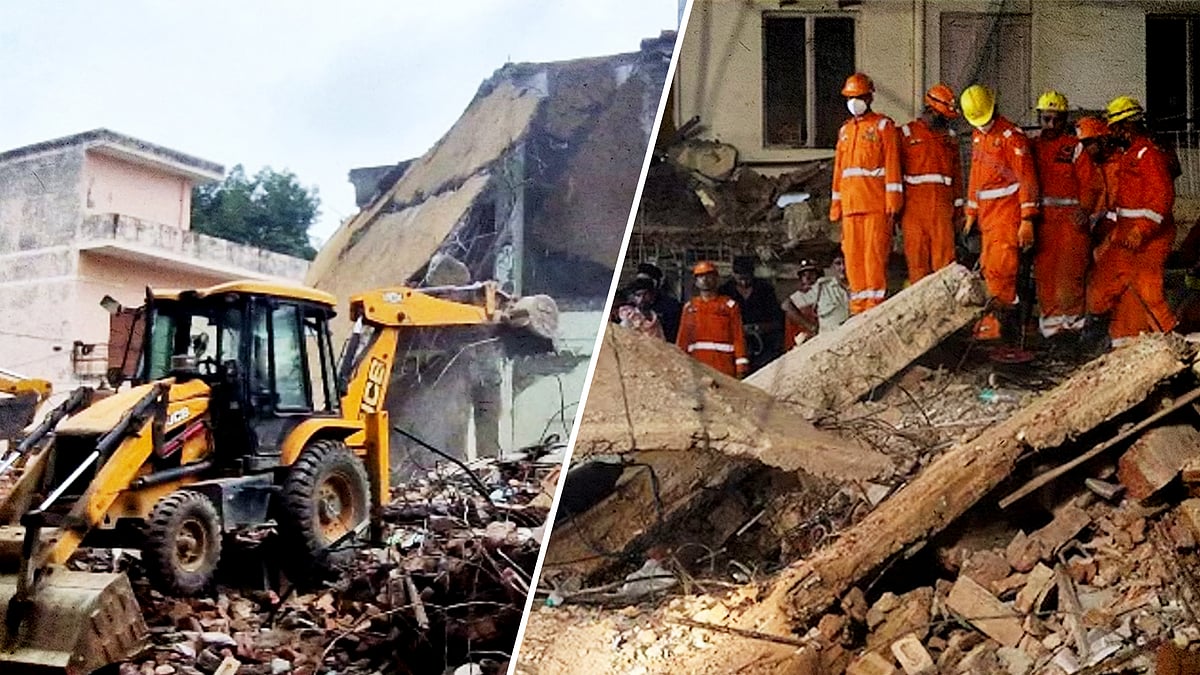
Saharanpur mosque, Satya Niketan PG are monuments to the same politics of violence and neglect
Two ruins have featured prominently in the news recently. The collapse of a student PG in Delhi’s Satya Niketan, and the demolition of a 100-year-old mosque in Saharanpur. In one case, the state failed to enforce building regulations – resulting in seven deaths – and in the other, it invoked building regulations to enact explicit celebratory violence in the form of bulldozer politics against Muslims. The two events initially seem to represent opposite failures. Saharanpur appears as a story of an excessively muscular state, and Satya Niketan, as that of an absent one. However, they are better understood as two expressions of the same kind of urban governance.
Deaths due to neglect of building regulations in Indian cities and violence using building regulations as bulldozer politics have been a feature of India’s urban governance for some years now. People have died because of collapsing flyovers, bridges, fires etc. and thousands of Muslims have been made homeless in bulldozer politics. Arguments around selective reinforcement, hypocrisy, and double standards have been rightfully made in this conversation, but they fail to capture the depth of this issue – they fail to illuminate a more holistic view of the Indian state’s relationship to the built environment today.
To understand this relationship, we must begin by unpacking the play of politics and space in contemporary India – that of simultaneous hyper-politicisation and depoliticisation. On the one hand, the state has used the built environment in a hyper-politicised manner. Urban redevelopment projects have been at the center of the political rhetoric of the BJP: Beginning with the Smart Cities Mission in 2015, to several politicians popularising themselves through their dream projects, rebuilding of major parts of cities, and through massive temple redevelopment and infrastructure schemes.
This has been accompanied with displacement and domicide and has shown its most hyper-political face as punitive domicide – destruction of architecture as punishment. In the case of development related domicide, several neighborhoods such as parts of Varanasi have been cleared using urban development laws in a language of improvement and progress. In the case of punitive violence, building regulations such as Floor Space Index – like in case of the Sanjauli mosque – or encroachment laws – such as in Jahangirpuri domicide – have been invoked by bureaucrats to demolish Muslim homes while political rhetoric used a language of security and punishment.
Construction and destruction have been equally powerful modalities of this hyper-politicisation with building regulations acting as the primary conduits of violence. It is, therefore, notable that politicians such as Yogi Adityanath and Himanta Biswa Sarma who have branded themselves as builders using their personal dream projects, have simultaneously been popularised and celebrated as destroyers with the bulldozer becoming an extension of their political persona and a common presence at BJP’s rallies.
On the other hand, the state has also tried to depoliticise the built environment. Major incidents of state’s neglect have been either suppressed, or their accountability has been outsourced to non-state actors involved in the public private partnership model of urban development, or death and suffering has been conveniently reframed as unavoidable technocratic accidents.
For example, in the Kumbh Mela stampede of 2025 that claimed 30 lives, the same news cycles that glorified the efficiency of the space with constant headcounts, hesitated to report the count of fatalities and injuries in the wake of the tragedy. In the case of the 2022 Morbi bridge collapse and the 2024 Mumbai hoarding collapse, private firms were presented as the only responsible parties while municipal authorities were aware of the danger and had acted neglectfully. And in the 2024 Rau IAS Coaching Centre flooding in Delhi, the structural weakness of the entrance gates that let the water in – based on a report prepared by IIT Delhi – was presented as the main cause of student deaths even when MCD authorities had been informed by a student of this looming threat well in advance.
In the Satya Niketan collapse we see this pattern already. Allegations of news suppression have started coming in, private PG owners are being framed as main culprits, and the CM of Delhi, without any inquiry and even before the debris had been cleaned, had attributed the tragedy to an excavation that might have damaged a column in the basement. It’s only after the high court’s intervention, that a post-facto investigation into the MCD has been ordered and a survey has been undertaken. This week, the high court also said that the deaths of these students cannot simply be called “a mishap”.
The state has, therefore, presented itself as both – heavily present and obsessed with the built environment and building regulations and at the same time, as completely absent and neglectful towards those same building regulations and urban infrastructure. The result in both the cases is death, suffering and injury. This brings us to an important point. The simultaneous hyper-politicisation and depoliticisation of the built environment reveals a state that is, at its fundamental, apathetic to the suffering of its citizens – the inhabitants of its cities.
The state uses both, construction and destruction of architecture as an exhibition ground for a very visual and aggressive politics, while ignoring those parts or elements of the city that do not feature in this spectacle, are too boring to be part of its propaganda or, in case of a tragedy, ruin the spectacle and challenge the state’s propaganda. In other words, for the contemporary Indian state, the city is a visual, a model, a stunning drone shot to be inaugurated and popularised as backdrop for political advertisements and news segments. But the state does not care about the citizens who use this built environment. Muslims can be rendered homeless in the interest of ethno-nationalistic politics, and people can die through utter neglect towards urban infrastructure.
The ruins of Saharanpur and Satya Niketan are not examples of hypocrisy or double standards or even selective enforcement; and they are certainly not opposites. These rubbles are monuments to the same politics of apathy, violence and neglect. One reveals a state that can mobilise bulldozers, police and municipal law with astonishing efficiency when it wishes to destroy; the other, a state that cannot summon the mundane competence required to prevent a building from killing its occupants. It is a politics that decides which buildings must fall, which may be allowed to fall, and whose lives can be buried underneath.
The author is a PhD scholar in architectural history, theory and criticism at Massachusetts Institute of Technology.